“I didn’t hear anything that I wanted to hear or anything that I felt I needed to hear”

Latest in a series of posts about the Bethlehem Police

Committee of the Whole meeting, October 29, 2020

Meeting documents here

view meeting here

“We’re not talking about things, it seems to me, that really matter.”
The Gadfly

The City Council Committee of the Whole meeting called by the Administration last night turned out as Gadfly feared.

The most number of people tuned in on the live-stream at one time was 9.

Truly, it wasn’t worth tuning in for.

The four City department heads made nice presentations, but, literally, they “phoned their reports in,” in the negative colloquial meaning of that phrase.

They pretty much read their reports.

Gadfly did learn a lot, but it was marginal stuff, and Gadfly could have read the reports himself in 1/8th of the time or less.

There was no reason to bring people together to hear those reports read.

A reason to bring people together would be meaningful discussion of core issues.

There was no meaningful discussion of core issues.

Council was polite, there were a few soft comments and questions, and much genuine backslapping for work done.

But Gadfly cannot see that anything of substance was accomplished.

Gadfly was disappointed with the Council members, each and every one of them.

And Gadfly has to feel that an opportunity was squandered.

Listen to what Gadfly had to say at the meeting and decide for yourself.

Mrs. Gadfly, mother of six boys and the family peacemaker, thinks his shorts must have been too tight.

to be continued . . .

Police handling children with care

Latest in a series of posts about the Bethlehem Police

ref: “Police department involved in a student trauma program”

Gadfly attended an interesting meeting yesterday about a pilot “Handling with Care” program involving our police department in which law enforcement officers are encouraged to advise the schools of children who have been involved in any sort of trauma, so that the schools can be on the lookout for any problems and are ready to provide care. No details of the traumatic event are given to the schools. And nothing goes on a student’s record. And so the “Handle with Care” report is not about students who have committed crimes but, for instance, can be about students who have witnessed traumatic events that might have an effect on their behavior or progress in school work.

Here Bethlehem Officer Robert Nicholson explains the program (7 mins.)

Great idea!

Gadfly thinking about Thursday’s Committee of the Whole meeting

Latest in a series of posts about the Bethlehem Police

“We should take this opportunity for self-reflection and to critique ourselves, and if necessary implement constructive recommendations that will continue to make the Bethlehem Police Department the best in the Lehigh Valley.”
Mayor Donchez, August 11, 2020

“Capt. Kott will no doubt bring a new perspective and energy to the department. . . . She’s a strong advocate of community policing, partnerships, and she has additional training in the areas of mental health, cultural awareness, de-escalation tactics, implicit bias training and crisis intervention.”
Mayor Donchez, September 23, 2020

The Mayor has requested a City Council Committee of the Whole meeting for this Thursday October 29 at 6PM.

The topic: Interaction of the Police Department/Health Bureau/Recreation/Department of Community and Economic Development.

Gadfly is not sure what the Mayor has in mind for this meeting. He assumes it is at least in part if not totally a response to the murder of George Floyd. And he looks forward to the meeting being productive.

Gadfly can’t be sure, but he doesn’t think it will be the kind of meeting (or series of meetings) he has been thinking about, one which is a more in-depth conversation about the Police Department itself.

Both the Mayor and the then Police Chief quickly made good statements subsequent to the Floyd murder, and the City was quick to produce relevant statistics and reports.

But neither statement indicated using the moment of the murder for an internal taking stock of the way the department does its business. There was no indication that this was a time for internal self-analysis. The Mayor indicated that he would be listening for good ideas, by which he seemed to mean from the outside. Gadfly, in fact, remembers the Chief ascribing the level of violence used by officers to the level of violence offered by subjects, which completely missed the point of the “mental health” issue in some subjects where tragedies occur that the Floyd death has foregrounded.

Gadfly implies nothing negative about our police department. Indeed, the fact that our department undertook a rigorous review and reform subsequent to the Hirko case a generation ago and now has a rather unique dual accreditation is very impressive and much to be applauded.

But Gadfly envisions a more “politic” statement subsequent to the Floyd murder along the lines of “we” (the City/Police Department) feel confident we are ship-shape but still “we” (from the inside) are going to take this cultural moment of public concern to do self-analysis anyway just to be sure and to be able to further instill confidence in the public about the way we do business.

And Gadfly can envision a City Council saying we recognize the accredited stature of the department and we imply nothing negative about its policies and procedures, but it is our responsibility to respond to this cultural moment by holding the kind of public conversation about issues that the Floyd murder have highlighted and which we have never had before.

So in his statement above about new Chief Kott, the Mayor indicates some specific topics for self-analysis and for those conversations: community policing, partnerships, mental health, cultural awareness, de-escalation tactics, implicit bias training, and crisis intervention.

A syllabus to which you have seen Gadfly in past posts adding recruiting and diversity hiring, promotion practices, internal discipline, residency incentives, the role of the Union in personnel matters, a citizen review board.

The department made various statistics public. Gadfly, remembering that Prof Ochs saw things there that others didn’t, wonders about seeking outside professional viewpoints on those statistics.

And Gadfly would certainly like to hear a detailed plan for involving the police in the Community Engagement Initiative since they are the “key factor” in its success.

Gadfly hopes that any changes that might be contemplated during Thursday’s meeting are more than just cosmetic.

Gadfly hears the tough words by a commenter at Council (was it July 7?) to the effect that we don’t need more pizza parties.

Your ideas, as always, invited.

Police department involved in a student trauma program

Latest in a series of posts about the Bethlehem Police

This is really the first that Gadfly has heard about the doin’s of the Citizen Advisory Board, an alliance between the City and the NAACP. Gadfly has tried to get agendas and minutes through Right-to-Know but no dice. The CAB is not considered an official City body. Sigh.

This looks good! Wonder why there isn’t more info coming from that group.

register here

Advancing the Community Engagement Initiative, Police on board

Latest in a series of posts about the Community Engagement Initiative

Followers know that Gadfly has been whining about lack of information about the development of the Community Engagement Initiative, a proposal that was adopted by City Council July 7.

The CEI was proposed in a resolution by Councilman Reynolds and Councilwoman Crampsie Smith. Councilman Reynolds seems to be the driving force.

Subsequent to July 7, Councilman Reynolds briefly sketched out that the CEI could have two types of meeting:

  • a City-run traditional meeting such as scheduled October 29 (the nature of which has yet to be described)
  • by various community organizations (such as at the Hispanic Center October 27)

At Tuesday’s City Council meeting, Councilman Reynolds finally laid down a plan for this second type meeting.

  • every month there would be a list of events
  • the list would be generated by members of Council (who, according to JWR, are “pretty connected” and have a good idea what’s going on)
  • Council members will be counseled to send items for that list to the City Clerk by a certain date each month
  • the City Clerk will assemble the list
  • the City will publish the list each month through its communication channels (Ha! I hope they include the Gadfly!)
  • the public and City folk can then know about and participate in the meetings

The key component, said Councilman Reynolds, will be “real involvement” from the Police department and involvement beyond the Chief to other officers, though the Councilman wasn’t envisioning full force participation.

Councilman Reynolds cited the importance in his own work as a teacher to go out and listen to the people in the community, an experience that can be an “eye-opener” and cause important significant self-reflection in realizing where the community is coming from.

Councilman Reynolds invited the brand new Chief to weigh in on whether the Police Department would participate in these community meetings, and Chief Kott gave strong support.

Here in what is her first significant public statement is the clip of Chief Kott providing her affirmation of the department’s participation in the CEI:

  • Absolutely.
  • That’s the way we are going to build that relationship is through positive, non-enforcement contact.
  • And not only is it going to help strengthen the bond between our officers and the community, but it’s also going to build that equity, it’s going to build that legitimacy.
  • And it’s going to help remind our officers why they became officers in the first place.
  • Because our officers want to go out into the community.
  • They want to help community members.
  • And that’s what our community is asking for.
  • It’s easy to try to think up what exactly the public wants.
  • It’s time to listen, not only to the community, but to our officers who want community engagement.
  • And I absolutely agree with you that it cannot be just the same one or two faces going to community events.
  • That’s not going to help build that relationship back.
  • That strength — you need to have it from a top to bottom approach, to have all members of the department engaged in community policing.
  • And I am very confident that the men and women of the Bethlehem Police Department want to take part in it.

An “historical night”: Michelle Kott appointed Chief of Police

Latest in a series of posts about the Bethlehem Police

In what Mayor Donchez called a “historical night,” Michelle Kott was unanimously confirmed at the new Chief of Police last night at the City Council meeting. Chief Kott is our first female police chief. Each Councilperson had words of appreciation and congratulation.

  • “Ms. Kott has always been a consummate professional, someone whom I’ve appreciated her thoughtfulness and transparency and engagement. . . . I can’t think of a time in my professional career where I saw someone who was as qualified for a position based on both their experience coming through the ranks of the department for the last 16 or so years and finding time somewhere in there . . . to complete the educational pursuits that you have.” Councilman Colon
  • “I think she understands the frustration a lot of people feel but also the potential, the hope, the capability of what we’re able to do if we look at, talk about, listen to these issues in a different manner. I think just listening to the Captain talk about these different issues over the past year or two, I’m confident she understands where people are coming from, and what they’re looking for in law enforcement . . . in 2020 in general, it’s going to look a little different than it has in the past.” Councilman Reynolds

selections from Christina Tatu, “Bethlehem’s first female police chief unanimously approved by City Council.” Morning Call. October 6, 2020.

Bethlehem City Council unanimously approved the city’s first female police chief Tuesday night, promoting Capt. Michelle Kott to the position after Mayor Robert Donchez recommended her last month.

“I’m so humbled to have this opportunity to serve the community and the men and women of the Bethlehem Police Department. I will not let you down. Through challenge comes real change and I’m ready to get started,” Kott said during Tuesday night’s virtual council meeting.

Council members spoke highly of Kott, 38, who was also the department’s first female captain.

“She is well qualified and most importantly has a great perspective for this position. She said ‘people want to be heard,’ and that’s a great perspective — the essence of human interaction,” Councilwoman Grace Crampsie Smith said.

Councilman J. William Reynolds, who along with Crampsie Smith has been spearheading a community engagement initiative to get residents, police officers and city stakeholders talking about issues of social justice and reform, said he hopes Kott will help foster a relationship between police and community members.

“I think if this is going to work and we are going to expand the conversation, we need to find a way to get not just the chief there, but other police officers as well,” Reynolds said.

Kott agreed.

“It’s time we listen not only to our community members but to our officers who want more community engagement. It can’t be just the two same faces going to these community events. We need to have a top to bottom approach to have all members of the department engaged in community policing,” Kott said.

Kott graduated from DeSales University in 2004 with a bachelor’s degree in criminal justice. She received her master’s degree in criminal justice from St. Joseph’s University in Philadelphia in 2010.

Last May, she was among the first group of students to earn a doctorate in criminal justice from California University of Pennsylvania.

She has been with the department for 16 years, serving in various roles including patrol officer, crime scene detective, patrol sergeant, detective sergeant, detective lieutenant and captain. She is also a member of the department’s professional standards division and is a team leader for the city’s crisis negotiation team.

Those with the rank of lieutenant, captain or deputy chief were invited to apply, making a total of nine eligible. All but Kott were men, and only one of those candidates was Black, according to Cichocki.

Can you train people to be less biased?

Latest in a series of posts about the Bethlehem Police

Can you train people to be less biased?

In other words, does implicit bias training work?

Is it worth the time and money that a police department (the City) would put in to it?

Gadfly had never heard of implicit bias training before the Public Safety meeting August 11, where there was talk of either increasing it (Gadfly is not sure whether any is done now) or offering it.

So Gadfly has been on the lookout for information on it.

Here is the recent public radio program on implicit bias that has a short summary for busy followers.

Hmm. No guarantees. Needs longer time. Won’t cure the racist. Needs to be coupled with structural change. There’s that pointer to the root cause in systemic problems that we’ve seen before. Hmm.

Gadfly is curious what is done in implicit bias training, aren’t you? What does such training entail?

See PBS WHYY The Pulse, “Confronting Implicit Biases” (49:35 mins.) Go to the very bottom of the page for the 8:55 min. “segments from this episode link.”

  • Wherever we go many in that group are somewhere between defensive and outright hostile.
  • This training is not going to cure a racist cop of animus toward minority groups, but it will inform the police officer of honest intentions that every police officer is part of the problem of biased policing and a significant part of the solution.
  • If the goal is training to eliminate implicit biases, there’s no evidence that that training works.
  • The training offers education. People can learn what implicit bias is and where it comes from.
  • By themselves [bias training] doesn’t solve the problem.
  • Real change is beyond the training.
  • It requires structural changes.
  • Implicit biases often come in to play when people have to make quick decisions.
  • A lot of the strategies revolve around how to give yourself more time to think, and how to put guardrails on how you judge other people so that you are less likely to act upon your bias.
  • For these trainings to have lasting impact, the commitment has to go beyond attending a few sessions.
  • Organizations have to examine every part of their culture.
  • Change in organizations has to be systemic . . . hiring practices . . . promotion practices . . . performance management processes.
  • Employees have to understand why they are doing this.
  • Some of these inequalities are so deeply embedded in the fabric of our society like when it comes to generational inequalities in income and wealth, that there is no way [that change can be done overnight], but at the same time I think that there can be periods of dramatic change, and I think we are living in one of those periods right now.

Need for long-term bias training . . . Citizen Academies . . . Community Academies

Latest in a series of posts about the Bethlehem Police

Knowing that Bethlehem, like virtually every city in the country after the murder of George Floyd, is scrutinizing the policies and practices of its police department, and knowing that Gadfly has been trying to open himself up to all information relevant to such inquiry, a follower called Gadfly’s attention to a pertinent August 10 anti-bias program by the National Law Enforcement Museum with a half-dozen experts on the subject, one of whom was Bethlehem’s own Guillermo Lopez. Over a series of posts, Gadfly will isolate short sections of the program and share them with you so that we can more knowledgeably participate, if only from a distance, in the local discussion here.

———-

We didn’t get enough detailed information about training at the August 11 Public Safety meeting. Gadfly couldn’t tell if training was sometimes a one-time check-the-box kind of thing or not. He remembers being struck by a reference by now (well, officially soon) Chief Kott about doing training at roll calls. Yuck. It seemed that one of the things that some Council members were considering was how to provide more time for training. This section of the program begins with Bethlehem’s Guillermo Lopez explaining the apparently well respected bias program that he directs. But interestingly it moves on to Citizen Academies and Community Academies. We have a Citizen Academy here — Gadfly thinks that at least three Council members have attended (as well as several Gadfly followers). It seems good training for a Council member actually. The Mayor once had recommended to the past Chief that I attend and the Chief and I communicated twice about it, but I never got a call. Sigh. We don’t have anything like a formal Community Academy, I don’t believe, but I seem to remember that the Hispanic Center has run some programs to involve police with the community. I may be wrong about that. Expanding both these Academies might be a good thing. The discussion on this topic ends going to the wider range of areas in which systemic racism operates and for which the police often serve as whipping boy — the kind of big picture look that Councilman Reynolds has articulated for us in laying out the Community Engagement Initiative.

How would you structure long-term bias training to move away from one-and-done training?

  • Chief Brooks and I [Guillermo Lopez] use a 4-layered program: . . . needs assessment . . . trust building within the department . . . skills building . . . sustainable partnership . . . It’s a long process.
  • You just don’t unpack this stuff. It’s not like opening up a suitcase and emptying it.
  • The real work is teaching how to communicate in a way that you want to work together.
  • And then the work continues with a sustainable partnership that they [the officers] continue the work . . . so that they can do it for themselves . . . becomes sustainable.
  • This is not a box that you check.
  • But the key component . . . would be a public involvement part . . . Citizen’s Academies.
  • Citizen’s Academies do two things; they teach what we do and the complexities of law enforcement that most people don’t take the time to consider when they pass judgment on the actions of officers, any time we can empower people with more information is going to be beneficial, but the other side is that it creates two-way communication.
  • It is that inter-action in a non-threatening setting where we can have meaningful interaction . . . calibrate our belief systems.
  • Citizen Academies . . . bringing people in to understand what we do . . . flip that . . . Community Academies
  • Community Academies . . . where the folks [officers] that live and work in those precincts go to the community and learn the history of that community.
  • Must be aware that communities have new generations of folks that don’t communicate in the same way as the older folk.
  • Having me come to you to learn what you are going to do to me is not ideal, is not what I call learning.
  • We are going to have to re-think how we present . . .
  • Part of the larger conversation about sustainability  is the question what is the role of policing now.
  • We’re shifting now, and we’re really questioning what is the role of police and public safety.
  • We also have to look at the systems that produce these folks . . . look inside an organization . . . organizational environment.
  • We seem to be the only lever people are pulling right now . . . housing . . . transportation . . . health . . . talk about pulling one lever, you gotta pull them all . . . things stop at the feet of police and that can no longer happen.

Accountability the key to addressing the perception that police are racist

Latest in a series of posts about the Bethlehem Police

Knowing that Bethlehem, like virtually every city in the country after the murder of George Floyd, is scrutinizing the policies and practices of its police department, and knowing that Gadfly has been trying to open himself up to all information relevant to such inquiry, a follower called Gadfly’s attention to a pertinent August 10 anti-bias program by the National Law Enforcement Museum with a half-dozen experts on the subject, one of whom was Bethlehem’s own Guillermo Lopez. Over a series of posts, Gadfly will isolate short sections of the program and share them with you so that we can more knowledgeably participate, if only from a distance, in the local discussion here.

———-

Another illuminating short section. The question cuts to the core of the issue. Why do so many people feel cops are racist? And the answer comes right back: accountability. Plain and simple. As we talk locally about the functioning of our police department, accountability deserves a high priority. Gadfly’s one encounter with a police issue — the so-called Hayes St. traffic stop incident — was marred by mystery, silence, confusion, obfuscation, unanswered questions. Can be no trust in a situation like that. Interestingly, the conversation here moves to systemic racism and Bethlehem’s Guillermo Lopez sounding, as Gadfly has remarked in the past, in tune with Councilman Reynolds on the importance of this bigger issue beyond the police.

“How is it that we address this perception that all law enforcement behavior is racist?”

  • Not all people have that perception.
  • The majority of the people even in the Black community think that the police have a purpose.
  • Part of how we get rid of this perception that all cops are racists is how we hold ourselves accountable.
  • Not everybody in the Black community thinks all white officers are racist.
  • There are more people right now that think we are not holding police officers accountable for their conduct, and I think accountability is just something that we can’t lose sight of.
  • The problem is that there are some people in this space and time that don’t want harmony, that don’t want dialog, and they do everything they can to stop it.
  • This is greater than just law enforcement, there are a lot of issues here that are challenging, that are causing a lot of issues in our community, and if we don’t take them all head on and have realistic conversations about them, we are going to find ourselves here again having the same conversation down the road.
  • When people are oppressed, and when they are oppressed enough to push back, when they look up to see who’s holding them down, and right now when they look up they see the police.
  • Police are being used as middle agents in our society, and it’s not fair.
  • I think they other thing that has to happen is that we have to learn in law enforcement and leadership to understand that when people are bringing up the issue of systemic racism to not take it so personal, that systemic racism is centuries old . . . [we understand the damage it does] and we are saying more than anything that this systemic thing has to stop.
  • Unfortunately, many people who don’t understand the history of it are taking it personal.

Residents chatter about a traffic stop video around Gadfly’s water cooler

Latest in a series of posts responding to the George Floyd murder

Vinnie Politan Court TV
click here

Gadfly caught this part of a conversation between two of his followers:

“Hey, thanks for sending me that Court TV video. Thanks, I think. That was hard to watch. That woman screaming. It was ringing in my ears long after I was finished. I don’t know how the cops kept their cool. My temples were pounding just watching the video!”

“We’ve all seen some very disturbing videos this year, the most horrifying being the George Floyd video. God rest his soul. This Connecticut video shows a woman freaking out when police stop her for a stolen car stop. It’s amazing how well behaved the police are, despite the screaming, the foul ‘cock-sucker’ language, and the ‘cameras in the face’ from by-standers with no tolerance for any police activity. How do any police tolerate this behavior?”

“We’ve heard a lot about bias training lately, there must be ‘Cool’ training. The cops sure showed that. One cop even tried to calm her down by showing the stolen car report. But the screaming was one thing but trying to move the car was another. Now that was a dangerous move — what was she thinking? — and her daughter is in the car. I wonder how old. I wonder if she could be aware of what’s going on. One thing I especially noted, though — did you hear it? — when she starts to shout ‘I can’t breathe.’ It scares me that Floyd’s tragic words will be misused to inflame situations now.”

“I did hear her say ‘I can’t  breathe’ and called for an ambulance. Agree, serious call for help is now a slogan. Am I an old coot because I am so offended by the foul language? How did we get here? What happens to a police person when they have to deal with that stuff all the time. Police techniques for de-escalation didn’t work. At what point would reasonable people agree with restraint?”

Such good questions. If somebody calls you a cock-sucker, that’s got to be fighting words. What does it do to you long-term to swallow that abuse without response in kind. Can’t be good. Frankly, I thought violence was going to explode any minute. I fully expected it. But did you see the cops employing de-escalation techniques? I’m not sure I did. The woman was hysterical, out of her mind. What’s the technique for dealing with that? With my kids I would just walk away. But I guess cops can’t do that. What do you do when someone is incapable of listening? Damn. There was a Black cop there — no help. Some by-stander was asking for a woman cop. Would that have helped?

Well, I would sa . . .

Police behavior is much under discussion these days. Would you want to continue the conversation on this episode?

Avoid analysis paralysis, listen to the stories

Latest in a series of posts about the Bethlehem Police

Knowing that Bethlehem, like virtually every city in the country after the murder of George Floyd, is scrutinizing the policies and practices of its police department, and knowing that Gadfly has been trying to open himself up to all information relevant to such inquiry, a follower called Gadfly’s attention to a pertinent August 10 anti-bias program by the National Law Enforcement Museum with a half-dozen experts on the subject, one of whom was Bethlehem’s own Guillermo Lopez. Over a series of posts, Gadfly will isolate short sections of the program and share them with you so that we can more knowledgeably participate, if only from a distance, in the local discussion here.

———–

Gadfly finds this very short segment of the discussion very interesting. We have seen on the blog that people who defend or support the police readily quote the kinds of statistics referenced here. And we have seen here, for instance, Lehigh’s Prof Ochs point out that Southside residents are significantly under-represented in statistics about complaints to the police department. That statistics don’t tell the whole story. Gadfly is a literature guy. He leans toward the stories over the statistics to get a keener sense of reality. He has suggested here community meetings on the Southside run by local organizations in which residents might feel more comfortable talking about what’s happening “on the ground” with the police rather than having to make the intimidating trip to City Hall to make a complaint. Note also the last bullet, where the speaker points us to the overarching problems of systemic racism where Councilman Reynolds has taken aim.

“How do we address the conflict between the perception of racist behavior by police and the statistics that officers shot Black subjects at a rate lower than Black suspects shot at officers and less than the rate of violent acts against their own communities?”

  • I want to speak more to not just perception but lived experience.
  • As a scientist I am all for science, but there is one thing that you cannot ignore and that is the lived experience.
  • Sometimes we do an over-reliance on science and let science do the talking for us.
  • True work has to happen on the ground between the police department and the community.
  • Lived experience in stories are truth.
  • That is the crux of the conversation, what’s really happening, what’s really not happening.
  • This where we get stuck.
  • Analysis paralysis.
  • Broaden your understanding and learning . . . talk to the people who are closest to the problem.
  • They will more than likely tell you what you need . . . to make course adjustments.
  • Science can only get you so far.
  • You have to broaden and have a better understanding of the lived experience.
  • People are not in the street for no reason . . . 75 days of protesting, peacefully, they are there for a reason .
  • That’s what you need to start understanding — why?
  • Try not to be distracted by the knuckleheads . . . try to understand why people are still in the streets.
  • And it’s not just about policing.

Kott: “There’s no denying this is a critical time in law enforcement”

Latest in a series of posts about the Bethlehem Police

selections from Christina Tatu, “Bethlehem mayor asks council to approve first female police chief.” Morning Call, September 23, 2020.

Mayor Robert Donchez has recommended Capt. Michelle Kott as Bethlehem’s new police chief.

Council will vote on the recommendation next month, though five of seven council members who could be contacted Wednesday evening said they are pleased with Donchez’s choice. If approved, Kott — who also was the department’s first female captain — will become the first woman to lead Bethlehem’s police department. The base salary for the position is $106,000.

“Capt. Kott will no doubt bring a new perspective and energy to the department,” Donchez said Wednesday during a news conference to announce his choice. “She’s a strong advocate of community policing, partnerships, and she has additional training in the areas of mental health, cultural awareness, de-escalation tactics, implicit bias training and crisis intervention.”

Kott, 38, graduated from DeSales University in 2004 with a bachelor’s degree in criminal justice. She received her master’s degree in criminal justice from Saint Joseph’s University in Philadelphia in 2010.

Last May, she was among the first group of students to earn a doctorate in criminal justice from California University of Pennsylvania.

She has been with the department for 16 years, serving in various roles including patrol officer, crime scene detective, patrol sergeant, detective sergeant, detective lieutenant and captain. She is also a member of the department’s professional standards division and is a team leader for the city’s crisis negotiation team.

“There’s no denying this is a critical time in law enforcement, one that calls for strong leadership, coupled with empathy, compassion, respect and responsibility,” Kott said Wednesday. “I believe I am more than up to the task and I look forward to taking on the challenges and working together with the men and women of the Bethlehem Police Department and the community.”

Kott also thanked her family — wife Kristin Snyder, with whom she just celebrated 10 years of marriage, and children Noah, 6 and Allie, 2.

A hiring committee that included Cichocki, Donchez, city solicitor William Leeson, business administrator Eric Evans, and retired Upper Macungie police Chief Edgardo Colon conducted interviews last week.

Reached after the news conference, several City Council members, who will vote on Kott’s appointment at their Oct. 6 meeting, said they were pleased with the recommendation.

“I think it’s a great choice and a historic choice for the city of Bethlehem and our police department,” Councilman J. William Reynolds said.

“I think in every conversation I’ve had with her, she understands the value of trust between a community and police department, and I think she understands that a police department needs to listen to the community and be an institution people feel they can trust,” Reynolds said.

Councilwoman Paige Van Wirt said she was impressed with Kott’s answers when Kott presented a recent report on the department’s use of force to City Council.

“She was calm, insightful and her training was evident. She is someone who will help Bethlehem’s police department become the finest it can be,” Van Wirt said.

Other council members reached for comment, including Michael Colon, Grace Crampsie Smith and Council President Adam Waldron, also praised Kott.

selections from Sarah Cassi, “Meet the choice for Bethlehem’s new police chief. She would be the 1st woman to lead the department in city history.” lehighvalleylive.com, September 23, 2020.

After furor over a Facebook post led Bethlehem’s police chief to retire, the city’s new chief will make department history.

Capt. Michelle Kott, who serves in the professional standards division and leads the department’s crisis negotiation team, was nominated as chief on Wednesday. If approved, she would be the first female chief in the department’s history.

“I’m very humbled. I look forward to the challenge, and leading the men and women of this department, and hoping to inspire other girls that may be interested in pursuing a career in law enforcement,” she said.

The 38-year-old Kott has been with the department since 2004 and started as a patrol officer, before rising through the ranks of crime scene detective, patrol sergeant, detective sergeant, and then a detective lieutenant. She was most recently promoted to captain in February 2019.

Kott noted it is a critical time for law enforcement, and that it calls “for strong leadership coupled with empathy, compassion, respect and responsibility.”

“I believe I am more than up to the task and I look forward to taking on the challenges in working together with the men and women of the Bethlehem Police Department and the community,” she said.

Kott and her wife, Kristin, who celebrated their 10-year anniversary on Wednesday, live in Macungie with their 6-year-old son, Noah, and 2-year-old daughter, Allie.

“They’ve all stood by me throughout my career and they’re my ‘why,’ for who I am and what I do,” Kott said.

Mayor chooses Michelle Kott as next Police Chief

Latest in a series of posts about the Bethlehem Police

press release

Mayor to Submit Captain Michelle Kott to City Council for Approval as Next Chief of Police

Bethlehem Mayor Bob Donchez announced today that he will submit to City Council the name of Captain Michelle Kott to be the next Police Chief of the City of Bethlehem.

Captain Kott has been with the Bethlehem Police Department since 2004. During her tenure, she has served in a variety of roles: Patrol Officer , Crime Scene Detective, Patrol Sergeant, Detective Sergeant, Detective Lieutenant, Captain, Professional Standards Division and is a team leader for the City’s Crisis Negotiation Team.

Captain Kott is a graduate of Marian Catholic High School in 2000, DeSales University, Bachelor of Arts, Criminal Justice, 2004, St. Joseph’s University, Master of Science, Criminal Justice, 2010, and recently received her Doctorate in Criminal Justice from California University of Pennsylvania in 2019.

Donchez said that Captain Kott will bring a new energy, and a new perspective to the Department. She is a strong advocate of Community Policing, Community Partnerships, and additional training in the areas of mental health, cultural awareness, de-escalation tactics, implicit bias, and crisis intervention.

Mayor Donchez states that the Bethlehem Police Department has been viewed as a progressive department. It has been certified by the Pennsylvania Law Enforcement Accreditation Commission (PLEAC) and the Commission on Accreditation for Law Enforcement Agencies (CALEA).

“During these challenging times, I believe the Bethlehem Police Department must be as transparent as possible and provide as much information as possible to the public.” Said Mayor Donchez.

Since the tragedy in Minneapolis, MN, the following information has been made public:

  • Report on Citizen and Police Interaction 2015-2019
  • A Report on the Use of Force by the Bethlehem Police Department.
  • Policing in the City of Bethlehem/Operational Statistics 2019.
  • Use of Force Directive Number 3.1.1.

I am looking forward to working with Captain Kott as we continue to move the Department forward and as we continue to serve the citizens of Bethlehem.

Bias training: leadership must walk the talk

Latest in a series of posts about the Bethlehem Police

Knowing that Bethlehem, like virtually every city in the country after the murder of George Floyd, is scrutinizing the policies and practices of its police department, and knowing that Gadfly has been trying to open himself up to all information relevant to such inquiry, a follower called Gadfly’s attention to a pertinent August 10 anti-bias program by the National Law Enforcement Museum with a half-dozen experts on the subject, one of whom was Bethlehem’s own Guillermo Lopez. Over a series of posts, Gadfly will isolate short sections of the program and share them with you so that we can more knowledgeably participate, if only from a distance, in the local discussion here.

———

The question for the program panel in this short section is “How would you suggest getting this [anti-bias] training not only to the line officers but specifically to the leadership?” And Bethlehem’s Guillermo Lopez, who runs anti-bias programs for police, is the main respondent.

This question is quite pertinent at this precise moment when Bethlehem is considering applicants for the Chief position.

And Gadfly is reminded that two people over the past year told him in confidence that the past Chief did not himself take the training that his officers did.

If true, quite interesting.

  • Nationally, there’s a difference between the police chief and the line officers.
  • A lot of times you’ll see line officers taking this training and the Chief doesn’t.
  • In most cases you’ll see that most Chiefs are aligned in a different political alignment than the line officers.
  • We know how important it is for leadership’s buy-in.
  • If we don’t have buy-in from leadership, we’ve turned down jobs. It just won’t work.
  • If you don’t have leadership walking the talk, why should the rest of the body follow?
  • We actually train leadership . . . in a more intense kind of way than we do the regular officers.
  • And we actually do a slightly different version for cadets, younger officers.
  • [Younger officers often told by older officers to forget what you learned in the Academy]
  • We have to strengthen the young officers to be able to resist that.
  • I am not condemning the officers that say that. I think we don’t treat them well enough.
  • [Suggests no more than 3 years on the street at a time for officers, then taken off for a year in social service, etc.]
  • We don’t treat police human enough and expect a lot.
  • In my best thinking there should be a kind of rotation.
  • Leadership, you train them first. . . . to determine whether this [the training] is going to be legit or not.
  • If the message gets distorted from the top . . . it’s a done deal.
  • They [leadership] have to unpack their own historical biases.
  • You come through the ranks and you can’t think that all of a sudden you put stars on that that was not you.
  • There’s a self-reflective piece that has to be inserted into leadership for them to understand that you lead by example.
  • Not just officers, but the organization has to be held accountable.

It takes a very special type of person to want to be a police officer

Latest in a series of posts about the Bethlehem Police

Bud Hackett is a Bethlehem resident who raised 4 kids in the City. He recently became very interested in quality of life issues in the city and hopes to offer a balance to the approach City Council is taking.

Gadfly:

We are living in a time (Fall of 2020) where our City and our nation are experiencing an unprecedented health crises, one of the worse economic circumstances of the past 100 years, and a level of civil unrest that exceeds any in my lifetime.

Police across the country have been a target of the civil unrest with new language being used to described the situation: “defund the police” and “systemic racism” – both are generalizations, but are the flashpoints for so much civil unrest.

Some, like the authors of the report Gadfly references, are suggesting “more training” and “better screening of new police officers.” OK, more and better is always good. Reference the same about school teachers a few years ago.

The question of “what kind of person wants to become a police officer” is a question beyond my knowledge. Yes, we all want:

  • the “Officer Friendly” of our youth,
  • the kind and forgiving traffic cop who let’s us go with a warning, and
  • the social worker who comes to the door of the domestic or neighborhood disturbance call.

Let me relate a story about another characteristic of a police officer.

Around this time last year, I stopped at the Dunkin’ Donuts at 4th street on the Southside of Bethlehem. It was around 11 pm, and I watched as the Bethlehem Police were handling a situation of 3 white kids, one a female, and I figured they were possibly students from Lehigh.

The female was the most drunk; she was literally kicking and screaming at the police. I watched her spit at one of the cops. Fortunately, the two males were relatively calm. The language and arrogant behavior of that young woman was, in my opinion, disgusting.

The police restrained the young woman, despite her amazing resistance and taunts, “do you know what my Dad is going to do to you?”

Restraint and patience were the police behaviors I observed, firsthand. I could never be that patient.

So, in addition to:

  • the boredom of being a cop – just waiting for the next call,
  • the uncertainty about what is going to happen when “they roll up to the next call,”
  • the cell phone videos in their face when they walk up to a disturbance,
  • the anger, drunkenness, fentanyl abuse they encounter,
  • the insanity of the domestic disturbance,
  • the occasional situation when they must deal with a very hurting person with a gun, sometimes pointed at their own head, and
  • the increasing situation where guns are at play with gangs and other crazies.

. . . I really wonder why anyone would do the job, but I do hear police officers say, in earnest, “to protect and serve.”

I, for one, think police are very special people, you have to deal with the worst of the worst in our society, they have a very special combination of skills and values. We’re lucky anyone signs up for the job.

Bud

Is anti-bias training effective?

Latest in a series of posts about the Bethlehem Police

Knowing that Bethlehem, like virtually every city in the country after the murder of George Floyd, is scrutinizing the policies and practices of its police department, and knowing that Gadfly has been trying to open himself up to all information relevant to such inquiry, a follower called Gadfly’s attention to a pertinent August 10 anti-bias program by the National Law Enforcement Museum with a half-dozen experts on the subject, one of whom was Bethlehem’s own Guillermo Lopez. Over a series of posts, Gadfly will isolate short sections of the program and share them with you so that we can more knowledgeably participate, if only from a distance, in the local discussion here.

———-

Is anti-bias training effective? Now there’s a key question. We may be putting a lot of stock in it here.

Gadfly was impressed by the qualifications made in the early part of the discussion to this question. Nobody was saying that anti-bias training is a magic bullet. One-off training not effective. Training can have short-term positive effects but it can (will?) succumb to the outside forces that have formed an individual over a long period of time. Not all programs are good. Success is in the delivery. Science tells us that there are mixed results. Officers don’t understand the need. Effectiveness depends on the officers “bringing something” to the table.

  • the training needs to be more than a one-off
  • there’s short-time awareness and effectiveness but that is fragile
  • need to talk about racism, it won’t go away if we don’t
  • adult learners need to know why the training is relevant
  • people tend to get offended at the need for discussion because it sounds as if we are saying that they are racist
  • such training can be effective but it’s all in the delivery, the approach
  • the science tells us that the training gives mixed results
  • effectiveness is not just about delivery, but each officer has to be self-reflective
  • people are exhausted and tired trying to make people feel ok about this conversation
  • where we get stuck is with people offended by the conversation
  • the effectiveness of the training needs to be measured but we are reluctant to do that
  • officers don’t understand why this conversation is important and necessary
  • the officers have to understand why
  • effectiveness depends on what the officer brings to the training

The conversation took a bit brighter tone in the latter part of this section when Bethlehem’s Guillermo Lopez described an anti-bias, police/community program he runs. Lopez co-directs the Law Enforcement Partnership Program for the National Coalition Building Institute. The key insight he conveyed from his experience is that we must understand that the police are working class people. If we don’t understand that, we will never gain officer trust.

  • training works when all the parts are in place
  • must assess the group, not one-fits-all
  • department has to trust the facilitators
  • need skills about relationships and listening
  • needs assessment > trust > than can go to hard stuff
  • has worked in this training 15 years, partnering with a police officer
  • key thing he figured out: officers sound just like steel mill workers, they are working class people, must understand that if you want to gain their trust
  • not every officer will respond to training but significant number will change the culture
  • must recognize that police have a culture, and that must be appreciated
  • you must listen to their stories, give sense they can trust you
  • must separate being uncomfortable and being unsafe
  • safety training must be primary
  • but lean in to uncomfortable, where we learn the most

“Maybe the best way to improve the problem of biased policing is to improve our recruitment process”

Latest in a series of posts about the Bethlehem Police

Knowing that Bethlehem, like virtually every city in the country after the murder of George Floyd, is scrutinizing the policies and practices of its police department, and knowing that Gadfly has been trying to open himself up to all information relevant to such inquiry, a follower called Gadfly’s attention to a pertinent August 10 anti-bias program by the National Law Enforcement Museum with a half-dozen experts on the subject, one of whom was Bethlehem’s own Guillermo Lopez. Over a series of posts, Gadfly will isolate short sections of the program and share them with you so that we can more knowledgeably participate, if only from a distance, in the local discussion here.

———–

The keynote speaker posed five basically rhetorical questions before focusing on recruitment as perhaps “the” place that attention should be paid if we are going to see improvement in bias problems within departments.

  • how rational is it to think that 4hrs. of anti-bias training will have significant impact?
  • how logical is it to think that there will be improvement if there is no accountability?
  • do incident reports require the kind of relevant information that equips supervisors with ability to assess?
  • is it reasonable to assume that without consequences there will be compliance with standards?
  • is it possible that we can train our way out of the problem of bias policing?

That last (rhetorical) question is the most challenging, for it calls into question any efficacy in training at all.

And it leads to this statement: “Maybe the best way to address the problem of biased policing is to improve our recruitment process.”

So, for instance, the keynoter questions whether the small amount of training that officers are now given and, moreover, a small amount of training without accountability and disciplinary consequences (which, it appears, she assumes as a common circumstance) is of much value. And she goes further, questioning whether even increased training (which has been mentioned by several of our Council members) is of much value either.

The keynoter pushes the focal point further back to the beginning — to recruitment and hiring. Though she doesn’t go into detail, Gadfly assumes that what she means is that we need to assess applicants and recruits for bias and attempt to weed out potential problem people at that point.

Seems like something for us to keep in mind. The only talk Gadfly remembers on recruitment and hiring at the August 11 Public Safety meeting had to do with the difficulty of doing so these days and especially the difficulty of hiring minority officers.

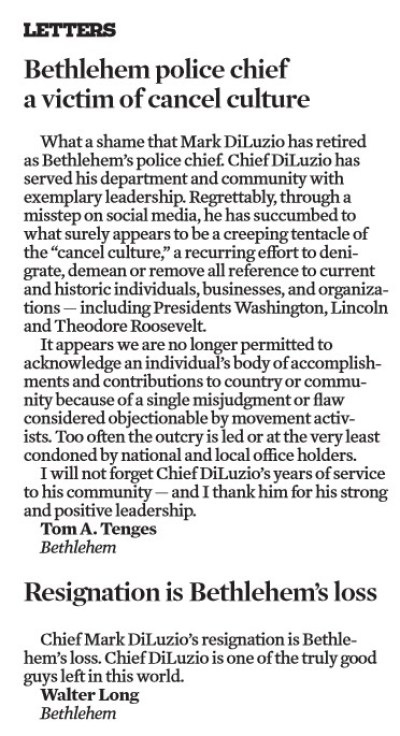
Cancel Culture Wins in Bethlehem Police Chief Case

Latest in a series of posts about the Bethlehem Police

Bud Hackett is a Bethlehem resident who raised 4 kids in the City. He recently became very interested in quality of life issues in the city and hopes to offer a balance to the approach City Council is taking.

Gadfly:

Two weeks ago Bethlehem police Chief Mark DiLuzio resigned, with much pressure from the Mayor and City Council, after he posted something stupid on his Facebook page.  He never should have posted an opinion on the optics of the National Basketball Associates (NBA) championship games. If you’ve watched the games, as I do, they’ve become become extremely political.  OK, their right to do so.

Problem is Chief DiLuzio seemed to be a pretty good police leader. I’ve never met him but did observe him in the past month as he and his team responded to City Council’s anti-police questioning in a series of meetings, including the August 7 City Council Public Safety Committee public meeting.

For those not aware of the developments, Bethlehem City Council had drafted resolutions, inspired, and delivered by the self-proclaimed radical left, held hearings, and generally appeased those groups wanting to “defund the police” in Bethlehem. More on City Council’s “pandering” in subsequent posts.

In preparation for the August 7 Public Safety meeting, Chief DiLuzio was asked to prepare three reports to explain police activity in the City – lots of data, ie., facts, about every aspect of police activity. Most observers of the presentation, as well as many Council members, thought the report was pretty good. In my opinion “Council was looking for problem with the police, and not finding a problem” in the Police presentation of the data and three reports.  I, for one, was happy to hear the presentations and felt our police are doing a pretty good job.

Chief DiLuzio made one of the most interesting comments of the 4-hour long meeting. In response to a comments/questions from Councilperson Mr. Reynolds, Chief DiLuzio departed from the prepared remarks and said something to the effect of “we need to look at the problems in a holistic way; economic conditions, health care, mental health issues, gangs, substance abuse – these are the underlying problems that cause people into actions that require police action” (not direct quote) . It was an “ad lib” comment from a 40-year police professional, someone who has probably “seen it all.”

DiLuzio showed an understanding of crime and bad behavior in the City that was truly insightful. A police leader with that kind of understanding is probably not the person you want to cancel. Yes, he is an older white male and that is not the profile of the politically correct looking police chief but that kind of insight and experience is a shame to dismiss.

Bud

Police reforms included in the Breonna Taylor settlement

Latest in a series of posts responding to the Jacob Blake shooting

Louisville just settled the wrongful death civil suit with the family of Breonna Taylor for a record amount of money, but the settlement was not entirely about money. The Taylor family wanted police reforms. Since we hope that locally we will shortly be publicly discussing possible reforms and new systems of public safety, we are more interested in those “other” terms of the settlement. Here on Gadfly we’ve been trying to open our minds to all good ideas and the pros and cons about them.

What do you think of these reforms negotiated as part of the Taylor settlement?

“These are all the police reforms included in the Breonna Taylor civil suit settlement.” WLKY TV, September 15, 2020.

Community related

  • a housing credit program to encourage officers to live within the community
  • adding social workers
  • encouraging volunteering with community organizations while on duty

Search warrants

  • new request procedures
  • require EMS presence for forced entry warrants

Accountability

  • new procedures when money is seized
  • an early warning system to flag officers with disciplinary problems
  • random drug testing
  • new policy on records in an officer’s personnel file
  • new policy on cases where officer leaves the department before a personnel investigation is complete

We look inside the department for a new Police Chief

Latest in a series of posts about the Bethlehem Police

The Mayor is moving quickly to hire a permanent Chief of Police from a pool of four current officers. Council will vote on the Mayor’s choice at their next meeting October 6. Among reasons for hiring from inside were the department is “not dysfunctional,” there are qualified candidates, and hiring an outside candidate might be unfair to the candidate since a new Mayor is on the horizon. One can assume that Deputy Chief, now interim Chief Scott Meixell and Capt. Michelle Kott are two of the four. Perhaps insider followers can provide Gadfly with the names of the other two. Former Upper Macungie Police Chief Edgardo Colon is Latino, but one wonders if, besides the usual suspects, the search committee shouldn’t have contained 1) someone deeply conversant with some of the new ways of policing that are being discussed nationally and 2) someone from the general public. In offering the search committee the best of luck, Councilman Colon said, “Obviously we are having a lot of discussions, meetings, groups getting together, community groups to talk about policing.” That caught Gadfly, who’s been whining about the lack of visible movement after the August 11 Public Safety Committee meeting, by surprise. For it sounds like a lot’s been going on. Sigh. Nobody tells Gadfly nuthin’.

selections from Christina Tatu, “Who will be Bethlehem’s next police chief? City looking at four internal candidates, expects to decide by Monday.” Morning Call, September 15, 2020.

An internal search is underway for Bethlehem’s next police chief and a decision is expected next week, said Mayor Robert Donchez, who has accepted applications from four city officers interested in the job.

A hiring committee that includes Donchez, city solicitor William Leeson, Human Resources Director Michelle Cichocki, Business Administrator Eric Evans and retired Upper Macungie police Chief Edgardo Colon will conduct interviews this week.

Third Class City Code requires Bethlehem officials fill the position internally unless no qualified candidates can be found. It will be up to Donchez to recommend one of the candidates for approval by City Council, which will vote on the recommendation at its Oct. 6 meeting.

A letter went out last week inviting anyone with the rank of lieutenant, captain or deputy chief to apply. Applications were due Friday, Donchez said.

Donchez did not name the four candidates for the permanent job.

Donchez is confident the police department already has qualified candidates who know the city. In addition, Donchez’s term as mayor ends in 15 months. He thinks it would be unfair to ask a national candidate to relocate right before a change in administration.

“I don’t believe we need to go outside. There’s always room to improve, but we are not a police department that’s corrupt. We aren’t a dysfunctional police department,” Donchez said, noting the department is accredited at both the state and national levels.

Councilwoman Olga Negron previously told The Morning Call she thinks the city would be prudent to look beyond its own for leadership.

“This is a great opportunity to rethink how we police, and this might be a good opportunity to bring in someone from outside,” she said Sept. 4 when DiLuzio announced his retirement.

Councilwoman Paige Van Wirt said it’s most important to bring in a chief who is on board with creating a more diverse police force that can address the community’s concerns and work toward change.

While a person of color or a woman would offer some symbolic change, Van Wirt said during a Sept. 4 interview that can’t be the sole purpose for selecting an individual.

“This really is about finding the right person. They have to understand the issues and grapple with the issues and not just be a symbol,” she said.

Esther Lee, a longtime civil rights activist and president of the Bethlehem NAACP, said her group was not consulted on the city’s search for a chief, but she believes hiring someone already in Bethlehem’s ranks would be best.

“I think communities ought to have police and their chiefs be more local,” she said, adding that most people in the community aren’t familiar with the city’s police officers, and hiring someone through a national search could add to that disconnect.

Lee hopes the city will include a member of the Black community on its hiring committee.

Donchez said he talked to Lee about who would be on the hiring committee and went with Colon, who is Latino, because of his experience as a police chief and because Colon grew up in Bethlehem.

Protests have a wider reason than raising awareness

Latest in a series of posts responding to the George Floyd killing

Gadfly:

Thanks for the great job you do promoting discussion and thought about local issues.

I saw the transcript of my City Council recording [the August 11 Public Safety Committee meeting]. To facilitate accuracy I am including the original text.

But first, let’s talk about the group promoting defunding the police, “Black Lives Matter.” While many of the recent protestors are truly interested in supporting minority rights, “Black Lives Matter Inc” contrary to its name, is at i’s core, a Marxist organization admittedly led by trained Marxists easily verified by a quick web search. It is funded to the tune of $1.3 billion by organizations from around the globe as well as by well-intentioned but misled corporations. Much of the money raised because of the George Floyd video just as easily may be funneled to French radicals or to the Congo, but not, you notice, to the devastated local black communities. It is international and has connection to the TIDES Foundation and others. By the way, Marxist movements historically are responsible for the deaths of 170,000,000 civilians, not counting deaths during war.

The violence you see today didn’t begin with the death of the vicious felon George Floyd , it began in 1999 or maybe even earlier when Marxist-Socialists protested the World Trade Organization meeting in Seattle demonstrating in what was called a “black box”. This is a collection of radicals all dressed in black with masks and helmets or head coverings. They paraded down the main streets damaging businesses, setting fires in trash cans, and smashing windows. Because of the complicity of the elected officials there, the police were regularly restrained from intervening and when they did the mob mingled and dispersed, their nondescript clothing making it impossible to arrest the vandals among them.

This type of activity went on occasionally for years since then. ANTIFA was the next progression. Same outfits, same tactics, but even more violent attacking individuals, often including the same radicals. Twenty years BEFORE George Floyd!

They were waiting for a video like George Floyd’s.

If raising awareness of injustice was the reason for the protests, how long would it have taken to raise awareness? But if the overthrow of our government is the goal then arson, destruction, intimidation, violent confrontation, and even extortion as we see in many cities is in order.

THERE IS NO APPEASING RADICALS.

This may seem far-fetched  . . . I’m sure it did to the people in Portland and Seattle too. But things eroded little by little.

First the language changed. They started using phrases like social justice and systemic racism. If we’re going to have discussions let’s define the words and discuss whether the problem is real or imagined. What is social justice? There are about 18,000 police departments in the US. There were 13 or 14 unarmed blacks killed in 2019. Does that sound systemic? When 4.4 million random stop and frisks were conducted in New York City, during the period from 2004 [to] 2012, even though Blacks were disproportionately singled out, the incidence of further police action was less for Blacks than for whites. Is that SYSTEMIC racism??

If you are rightly willing to condemn actions like those of ANTIFA and reject strategies of BLM like the dissolution of the family and defunding of police, say so, strong and clear at the beginning of this process Otherwise you are complicit in the lawlessness.

Socialism has a unwavering pattern. Venezuela was a prosperous country with rich oil supplies but with a lot of problems in their government. They saw Socialism as the solution to their problem. About 6,000 people a year are murdered by Venezuelan “law enforcement” in a country 12 times smaller than the US that has banned private gun ownership. There are no zoos, starving citizens have slaughtered the animals for food. There are no pets for the same reason. One of the leaders of Black Lives Matter, Opal Tometi, praised and posed with Venezuela’s Marxist Socialist Nicholas Maduro.

If Black Lives Matter wanted to be inclusive and healing they wouldn’t bristle at the phrase All Lives Matter. While many of the young people in good faith have responded to the BLM slogan others engaged WITH EVIL INTENT, let me leave you with a question. Would an organization whose goal is the empowering of black citizens trash and burn its black community to the ground?

Thanks again,
George Roxandich

Lawmakers should make it easier for body cam footage to be seen (and some thoughts on a new Chief of Police)

Latest in a series of posts about the Bethlehem Police

One hopes this issue is on the agenda when we discuss possible improvements in the way we do public safety. Perhaps a resolution to the state legislature?

And Gadfly’s been thinking about how Chief DiLuzio’s retirement might affect such discussions about the way we do public safety. Gadfly the Whiner has been looking for quicker action. Will the fact now of an interim chief further delay such discussions? Will some voices want to delay till a new Chief is hired, perhaps making his or her views on changes part of the interview process? Hmmm, let’s think further about a new Chief — hire from inside or outside? Is interim Chief Meixell a “natural” choice for the permanent position, or will we want to go outside the department? And then there’s Capt (“Dr.”) Michelle Kott — female and now leading the professional standards division in the department, certainly an area on which attention needs to be focused these days. Interesting time ahead!

selections from Paul Muschick, “Daniel Prude’s death illustrates why police videos should be public.” Morning Call, September 12, 2020.

The moments that led to the death of Daniel Prude remained a mystery for six months. He died after struggling with police in Rochester.

It turns out, Prude was held to the pavement with a hood over his head. That was revealed this week only after officer body camera video was released.

His final moments may have remained a mystery forever, if he had died after struggling with police in Pennsylvania.

That’s because it’s much more difficult to obtain body cam footage here.

Unlike in New York state, body cam and other police videos are not subject to Pennsylvania’s public records law, the Right-to-Know Law.

Our lawmakers should make it easier for these recordings to be seen by the public.

The release of audio and video recordings are governed by a 2017 law that authorized police to wear body cameras. That law allows police and other law enforcement agencies to withhold recordings for many reasons.

Agencies can deny a request if a recording contains potential evidence in a criminal matter; information pertaining to an investigation; or confidential or victim information, and if “reasonable redaction” wouldn’t remove that information.

Those are broad categories, which makes it rare for footage to be released.

It’s not even easy to ask for a video.

You can’t request one via email, letter or fax. The law requires requests to be made only by “personal delivery” or certified mail. If a video was recorded inside a residence, the request must identify everyone who was present, unless their identities are unknown and aren’t “reasonably ascertainable.”

And you don’t have much time to ask — only 60 days from when the recording occurred.

There is an appeal process if a police department refuses to release a video. But there’s a financial hurdle to take that road. It costs $125 to file an appeal with the county court.

Legislation is pending that could make it easier to obtain police videos in Pennsylvania. Unfortunately, it has not been considered since it was introduced nearly a year ago.

House Bill 1903 by Rep. Dan Miller, D-Allegheny, would make videos not recorded by body cameras, such as dashboard cameras, subject to the Right-to-Know Law.

Regarding body cam videos, the bill would give people 180 days to request them, and allow requests to be made by regular mail, email and fax. It would change the appeal process, giving jurisdiction to the state Office of Open Records instead of county court.

That’s important, because it removes the matter from the criminal justice system.

Miller said in a legislative memo that allowing body cameras was a positive step toward protecting police and citizens, but the “lack of transparency” undercuts the law’s benefits.

It does. It’s time for Pennsylvania to change that.

Further thoughts on Chief DiLuzio’s retirement

Latest in a series of posts about the Bethlehem Police

Reprinted from Councilwoman Van Wirt’s Facebook page:

I think this is absolutely the right question. “The real question is if the mayor has confidence in the chief to lead the conversation between our community and law enforcement,” Reynolds said. City Council has no power in appointing the Police Chief- this lies exclusively with the Mayor. But I do think it is important for City Council to give voice to legitimate concerns over the Police Chief’s leadership ability. My confidence in the Chief’s ability to not just lead his force, but to even want to participate in helping Bethlehem find a path forward through these serious and very real problems, has been further eroded. I do not think social media situations like this one are just a matter of a ‘poor choice’ but rather lets us see into the unvarnished truth of Chief’s Diluzio’s real feelings about protesting structural racism, (nobody cares) and his ability to embrace and understand Bethlehem’s modern day challenges and issues.

Morning Call, September 4

“Bethlehem police Chief Mark DiLuzio abruptly retired Friday, five days after reposting an offensive Facebook meme that prompted a public scolding by the mayor. ‘I do agree that it compromised my position. I figured, the hell with it — I’ll just retire now,’ DiLuzio said, noting he had planned to retire at the end of the year.” (Gadfly notes that the Chief suggests that his reason for re-posting the image was that “Both the movie and Seinfeld are two of my favorite shows.” Neither in his apology letters to Council, the message on his Facebook page, nor in this interview several days later does he recognize and acknowledge that the image itself is racially insensitive and apologize for his original choice.)

Councilman Callahan tries to get a political hot potato on the table

Latest in a series of posts about the Bethlehem Police

“We are the people who approve the police budget. We say, ‘yes put your
money toward yet another gun,’ or we could say we would like to scale
back on that funding and put some social workers in here.”
Councilwoman Van Wirt

Gadfly has earlier noted this “what the hell” moment by Councilman Callahan, hoping it doesn’t presage petty conflict on Council that impedes the serious discussion about public safety that needs to take place. Gadfly would also repeat that, while an unfortunate term, what is meant by “defunding the police” is not scary. It means reallocating resources with a concomitant reallocation of duty in order to better carry out the mission of public safety. It is a proposed solution to a problem. Defunding/reallocation has honorably happened in various model cities around the country, as previously detailed in these pages. No Councilmember here has yet publicly advocated defunding/reallocating as far as Gadfly knows, but two Councilmembers have already announced firm positions against it before any public discussion has taken place and without reasons to substantiate their positions. That can smell of “politics.” Gadfly expects that all Councilmembers have an open mind and avoid prematurely foreclosing discussion.

selections from Douglas Graves, “Defunding police issue continues.” Bethlehem Press, September 8, 2020.

Councilman Bryan Callahan tried to get a political hot potato on the table for discussion during the city council virtual meeting Aug. 25, but was overruled by the Council President Adam Waldron. At the end of the meeting and during the new business portion of the agenda, Callahan asked Councilwoman Dr. Paige Van Wirt if she is “in favor of defunding the police.”

Callahan did not ask other council members for their opinions, but focused his interrogatory on Van Wirt. He insisted, to no avail against Waldron’s objection, that his question was within the purview of Robert’s Rules of Order, but Waldron refused to let him continue.

Callahan had reduced a much more nuanced statement previously made by Van Wirt to a shorthand suitable for pointed sound-bytes, and has insinuated the subject during recent meetings.

Council has struggled with Callahan’s confrontational style before, as he has attempted to get specific issues discussed publicly.

Van Wirt declined to respond to Callahan’s question, but Callahan’s effort highlighted one of most contentious demands being pushed by the local Black Lives Matter activists who came before the council July 7.

An inflated or mischaracterized call for defunding the Bethlehem Police Department seems to be creating a fissure in the solidly Democratic city council.

While discussing the proposed community Engagement Committee, when Jonathon Irons of West Market Street spoke in person (most members were attending virtually), saying he supports what he described as the people who recently marched through Bethlehem calling for “defunding of the police.”

“We need to freeze the budget for the police department, including any new training initiatives coming out from this conversation must come from existing funding,” said Irons, as recorded in the official minutes of the meeting. “We need a hiring freeze with no new officers. We need to end the use of paid administrative leave, all these things to defund police.”

Councilwoman Van Wirt declined to elaborate further in a recent request by the Press.

As reported in the approved minutes of the July 7 meeting; “It was such a profound thing for her [Councilwoman Van Wirt] and she has to say until she really started listening throughout this whole engagement with Black Lives Matter and understanding what people of color go through, she did not understand what defund the police means. Of course, we all know it does not mean exactly that but it means looking at where we are spending our money and how can we do things better.”

As reported in council’s minutes, Van Wirt said, “Our power of the budget is huge here. We start our budget talks in the fall … to have any impact to what happens. We are the people who approve the police budget. We say, ‘yes put your money toward yet another gun’ or we could say we would like to scale back on that funding and put some social workers in here.”

While clearly there is no desire by any council members or administrators to actually defund the Bethlehem police department, that hasn’t stopped the idea from becoming a rallying point for citizens who have been led to believe that it is an issue being considered.

City council has passed a resolution calling for the community to be engaged in dialog with residents, police, schools and others seeking, as the Pledge of Allegiance says, “justice for all.”

A recent “Back the Blue” rally organized by Lehigh Valley Tea Party chairman and local attorney Thomas Carroll focused on a perceived threat to defund the Bethlehem Police. In a recent interview, Carroll conceded that no Bethlehem council member nor the mayor have called for defunding the police, but said he found the response by the council to demands of activists who attended the July 7 meeting to be “shocking and deceptive.”

Carroll, who is also the chairman of the Bethlehem City Republican Committee, said he didn’t want to see council make a “knee-jerk reaction” in responding to activists and start defunding the police department. Carroll said he supports the idea of council and the mayor funding social councelors to support the police.

Why do they shoot (including shooting themselves in the foot)?

Latest in a series of posts about the Bethlehem Police

“Lust lays another good man low!”
John Irving, The World According to Garp

Psycho-babble alert!

Gadfly just has to talk this out.

See if you haven’t been thinking along the same lines.

In a previous post your philosophical Gadfly tried to answer the question Why do they run?

The “they” was George Floyd, Rayshard Brooks, Jacob Blake.

And “run” was metaphorical. Only Brooks ran. Floyd inched along like a running back dragging a swarm of defensive linemen toward the goal line. Blake walked with firm, determined stride, like he was leading a group of unbelieving officers to where the body was hidden.

Maybe the question should have been better phrased as “Why did they resist?” And so irrationally. Against such odds. But the point is that they were moving away. Let’s call it running.

Gadfly gave you some psycho-babble as answer.

Not to be deterred, Gadfly ventures into psycho-babble territory again.

This time he asks the question “Why did they shoot?”

And the “they” this time is Derek Chauvin, Garrett Rolfe, Rusten Sheskey — and Mark DiLuzio.

Well, Chauvin didn’t shoot. And we’ll get to DiLuzio in a moment. Just play along.

Gadfly is willing to bet that when all is said and done we will find out that “they” all had all the kind of good de-escalation and other kinds of training we would hope for.

But look at the blank stare on Chauvin knowing he’s being filmed and even hearing bystanders detail the horror he is in slow, deliberate motion enacting.

Listen to Rolfe chatting with Brooks for 20-30 minutes as casually as he might with a Wendy’s clerk before he sheds blood in the Wendy’s parking lot in such a reckless manner that hitting “innocent” people was a reasonable possibility.

Count the steps as Blake walks away from Sheskey around the front of the car to the driver’s door while Sheskey impotently follows — seven steps? Would that then be seven shots for seven steps?

You have to wonder, don’t you, how after the inter-galactic furor over the treatment of Floyd — a din even the deaf could not escape hearing — that Rolfe and Sheskey did what they did? They were real knuckie-heads, weren’t they? — to use a favorite phrase in the Gadfly house.

Critics of the critics of the police, critics like our Individual-1, for instance, claim that this furor, this din is “making law enforcement officers hesitate and second guess.” Which would be logical. But we sure didn’t see that here. Just the opposite, in fact. It’s as if they haven’t heard anything, as if they didn’t get the Floyd memo to be careful because the world is watching.

How do we explain what happened in these three cases? How will we know what to do now to lessen the possibility of such future happenings in our town? How will we know what to propose when our discussion of how we do public safety commences?

The question draws Gadfly like a giant magnet. Why did they shoot?

Which brings us to Mark DiLuzio and perhaps to an even more perplexing question. Why did Chief DiLuzio shoot himself in the foot? For that he did.

Until Last Friday Mark Diluzio was our Chief of Police, the head of a department he called the best in the state.

Chief DiLuzio said good things during the opening City conversations in the post-GeorgeFloyd reckoning with race that Bethlehem has been engaged in like the rest of the country. Listen to his “George Floyd’s Death & Policing in America” statement at the June 3 City Council meeting, the first meeting after Floyd’s murder. And Gadfly can’t put his finger on the audio right this minute, but he remembers in a subsequent meeting the Chief memorably agreeing with Councilman Reynolds about the reality of systemic racism, specifically about how many Black people lack the early life advantages that he and Reynolds enjoyed.

Many liked Chief DiLuzio and supported him in this recent situation. Gadfly published praise from a typical supporter yesterday.

But not everybody liked and supported the Chief. Gadfly would sometimes hear negative stories about him whispered or shouted in confidence. And, in fact, Gadfly recently found in his Facebook news feed mention of a case pending in Federal court involving him and troublesome activities under his watch.

Gadfly himself, in the “Hayes St. traffic stop” case, the only specific example on which he could judge, did not form a particularly good opinion of how the Chief acted to support an officer who was possibly racially insensitive.

So the Chief knew he and his department were in the spotlight, on the hot seat, under the microscope — calling for rigorously circumspect behavior.

And yet he’s not only on the “Keep America Great” Facebook page (which, of course, doesn’t necessarily mean he subscribes to the political and racial sentiments expressed there in abundance), but he re-posts a racially charged post he finds there.

What was he thinking? What was he not thinking? Did the instinct for self-preservation just evaporate?

And the rationale for his action, the rationale for the re-posting, rings hollow. Gadfly will grant the however unlikely and remote possibility of missing the explicit text above the Facebook image when spontaneously clicking the share button below the image. But, as Councilwoman Negron pointed out, the image on its own is offensive. The Chief’s racial radar doesn’t seem to have recognized that even days later and even after intense public scrutiny of the image.

How explain shooting himself in the foot? Chief DiLuzio is a knuckie-head like the others.

So why do they shoot?

  • outright racism
  • implicit bias, the attitudes or stereotypes that affect our understanding, actions, and decisions in an unconscious manner
  • the indelibility of the deep-seated default character of the “Warrior” rather than “Guardian” style of policing
  • original sin (Gadfly was Jesuit trained), “In Adam’s fall, we sinn-ed all”
  • the “Imp of the Perverse,” from the Edgar Allan Poe horror story, the inner urge to do exactly the wrong thing in a given situation for the sole reason that it is possible for wrong to be done
  • “a Jungian shadow-self rearing its head to get out and reveal his true feelings,” per a chatterer around Gadfly’s water cooler
  • Facebook disease

When it comes to Chief DiLuzio, Gadfly’s first thought was from a scene in John Irving’s novel The World According to Garp, in which a wrestling coach dies from over-excitement watching porn and his peers render the verdict “Lust lays another good man low!”

Facebook lays another good man low.

But, seriously, if we don’t know the cause of the problem, how can we solve it?

Where did the training go, where did commonsense go at these moments of engagement? Doesn’t give you much faith, much confidence in “more training” as the answer to mitigating such tragedies in the future, does it?

Training is no panacea, but maybe it’s all we got.

Unless we subscribe to the nihilism of the Black lady in the video we watched a while back who said, “You know, there’s really nothing at this point that they could do that would make me feel any safer with them without them just point blank clearing them all out and starting all over from scratch.”

Sigh.