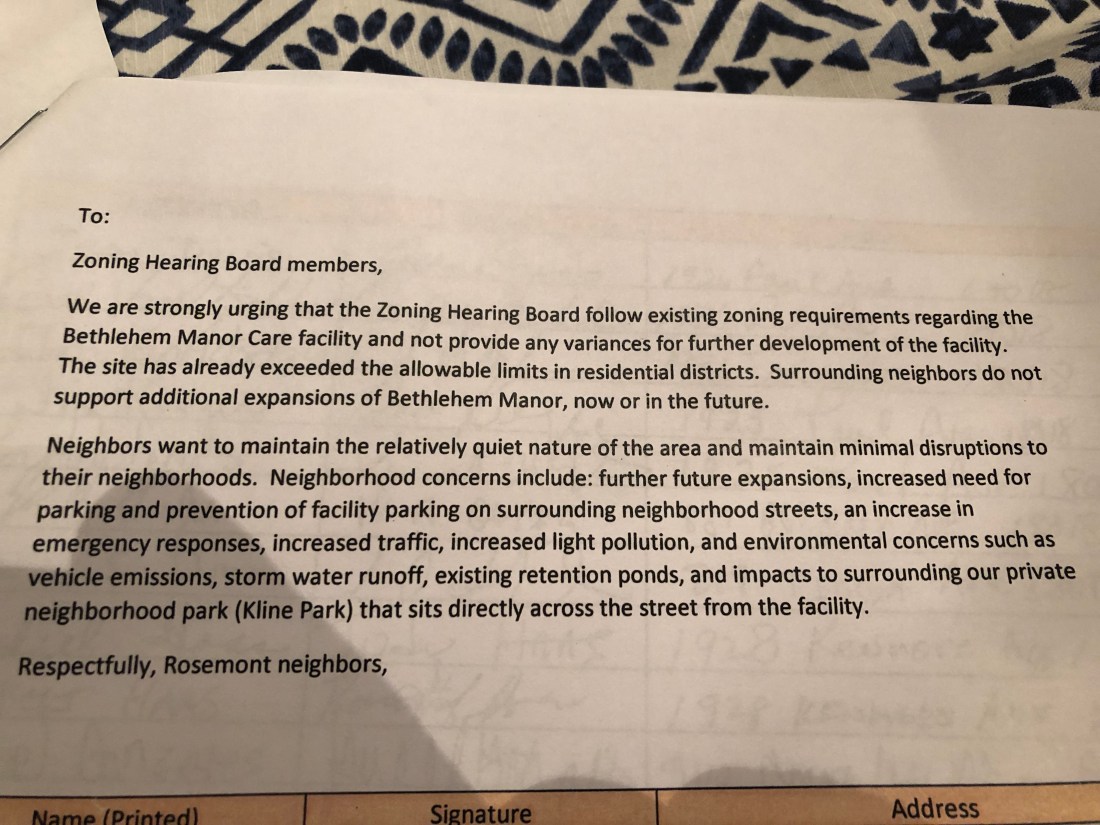
(Latest in a series of posts on Bethlehem Manor and Neighborhoods)
(Some clued-in followers will recognize that Gadfly refrained from using the name of the Bethlehem Manor representative — a name that comes with some baggage in local circles. Gadfly tried to think about this case on its merits, without prejudice, as the Zoning Hearing Board should be expected to.)
So we come to crunch-time. The Board deliberation and vote.
Unfortunately, we do not get to hear the Board deliberation as we do in, I think, all other boards and commissions — and City Council. In most other cases, we have an idea of why members are voting the way they do.
The Zoning Hearing Board is considered a quasi-judicial body (all witnesses are sworn in!), and thus they deliberate out of public view.
The Board deliberated roughly 20 minutes.
The vote was 3-2 to deny the proposal.
During the roll call, one of the two deniers paused a good 5 seconds before voting, indicating some indecision.
Ha! So perhaps the true vote was 3.5 to 1.5 against the Bethlehem Manor proposal.
As he said earlier, Gadfly was surprised (smart money and water-cooler chat usually believes that in Bethlehem voting favors the builder/developer), and he wishes he knew the basis of the votes.
As he also said earlier, when all is said and done, “we” depend on Board members who are intelligent, objective, fair, and empathetic.
We depend on good Board members. We depend on the Mayor to provide them, Council to appoint them, and Council to hold them accountable.
We can judge some of those traits from their behavior in the open part of the hearings and in the brute fact of their vote, but it is in deliberation where those traits would be most needed and most visible.
‘Tis unfortunate that we are not privy to the best evidence we could have of Board member suitability. Thus, the initial selection process is extra-special in the case of the Zoning Board.
More on that in a following post.
Where does the case go from here?
Bethlehem Manor will appeal to Northampton County Court.
If the denial here locally was based primarily on neighborhood “quality of life” issues — as Gadfly suspects it was — then how will that play at the county court level?
Gadfly is not sure, but the Bethlehem Manor attorney seemed confident, and you can hear him laying the groundwork for appeal on the Manor’s compliance with all technical issues:
Neighborhood concerns may not play well at the higher level.
Does this series of posts give you an idea of a Zoning Hearing Board process?
Gadfly will be on the lookout for action at the next level and keep you apprised.
 Elaine Torres — whose house is in the Manor’s “backyard” — carrying the dog of her deceased mother — not in the best of health — brought an emotional storm to the proceedings, chastising the Bethlehem Manor team for unresolved operational issues — like mosquitoes from the “rain gardens” that made it hard to work in her yard — literally, vigorously calling out the architect. She had to be soft-gaveled back to decorum twice or thrice by the chair. Gadfly would not recommend a heavy diet of such resident testimony at proceedings such as this, but, on the other hand, he must admit that this spectacle of raw anger and anxiety — so different from the conduct of the other proposal critics — starkly reminded him that these proceedings were not just a paper exercise performed by slickly dressed lawyers.
 In her first question, Anne struck deep at the heart of a damning inconsistency. How could an accomplished and experienced personal care home Administrator not have been thinking about the move to private rooms from the get-go? The question undercut the narrative — the origin myth, if you will — that Bethlehem Manor was positing.