What is “affordable housing”? Anna starts the conversation

(The latest in a series of posts on Neighborhoods and Affordable Housing and Southside)

Anna Smith is a life-long Southside resident and Director of the Community Action Development Corporation of Bethlehem, a non-profit dedicated to improving the quality of life in south Bethlehem by fostering economic opportunity, promoting community development, and empowering residents to actively participate in the decision-making process regarding the future of our diverse community.

Peter:

Funny you should ask–I just wrote this up last week but hadn’t sent it in just yet . . . Here’s what I’ve got to start the conversation:

What is “affordable housing”?

Affordable housing, or “workforce housing,” is a big topic in the Lehigh Valley these days. We’re regularly told that the Lehigh Valley is experiencing an “affordable housing crisis,” but what does that mean? For many, a lack of affordable housing is interpreted as an increase in the number of people on the brink of homelessness, or another way of saying poverty. In order to effectively address the crisis, however, we need to agree on definitions—and by definition, affordability is much bigger issue than its connotations would lead us to believe.

According to the US Department of Housing and Urban Development (HUD), “affordable” housing means that a family is spending 30% or less of their income on housing. This number was determined arbitrarily but continues to be the general standard for affordability that is used by the federal government and those who receive their funding subsidies. If you live in public housing or receive a Section 8 voucher, you are typically asked to pay 30% of your income in rent.

When we talk about rental affordability for a particular region, such as the Lehigh Valley, we can use HUD’s calculation of “Fair Market Rent” to guide our understanding of what the government considers a “reasonable” amount for a landlord to charge a tenant, given local market conditions. Naturally, Fair Market Rent varies based on the size of the apartment or house in question and the federal government updates the threshold yearly.

So what does this all mean for the Lehigh Valley?

In our metropolitan area, Fair Market Rent for a three-bedroom house or apartment is currently $1,464. This amount increased by 8% in the past year—if only income was increasing at the same rate! But let’s break this down into more meaningful terms. How much money do I need to make to be able to afford that three-bedroom house? If we use the HUD standard, I need to earn $54,080 a year. I have an Ivy League Master’s Degree and I lead a non-profit organization, and I don’t make that much money. In order to afford that three-bedroom house in the Lehigh Valley, I need a second income.

Affordability concerns are not restricted to families living in poverty; as rental prices increase far more rapidly than incomes, more and more of our families become “cost-burdened”—in HUD lingo, these families pay more than 30% of their income toward rent. But what about those families on the lower end of the earnings spectrum? If you make minimum wage ($7.25 an hour), you need to work 87 hours a week to afford a one-bedroom apartment, 111 hours a week to afford a two-bedroom house, and 143 hours a week to afford that three-bedroom home. For a family with two parents working minimum wage jobs, that’s 71.5 hours a week each to afford a “fair” rental price for a three-bedroom house in our community. For more details on Lehigh Valley wages and affordability, visit the National Low Income Housing Coalition’s Out of Reach 2019 report and select the Allentown-Bethlehem-Easton MSA.

In south Bethlehem, where 67% of households rent their homes, affordable rentals are a major priority. However, many affordable housing programs focus on homeownership. What does affordability for homebuyers mean locally? HUD prioritizes spending on homeowners that have “low- to moderate-incomes,” which means families with an annual income that is 80% or less of the Area Median Income, based on the size of the family. In the Lehigh Valley, a four-person family that would qualify for HUD-funded affordable homeownership programs would have an income of $62,700 or less. Far from poverty-wages, affordable homeownership opportunities target a substantial portion of our professional workforce (which is why many advocates have switched from the term “affordable” to “workforce” housing—although that term is also imperfect, since it excludes those who may not be in the workforce).

When we speak about an affordable housing crisis in our community, we are talking about families with two incomes, single-earner families, young professionals, individuals on fixed incomes, and elderly adults who cannot afford to live in our communities, and who are making impossible choices between paying their rent/mortgage or paying for healthcare or food, saving for the future, or paying off student loans, among many other priorities. We’re talking about a significant percentage of our neighbors, co-workers, family and friends who have spent their entire lives in a community and who are now unable to envision a sustainable future there. The next logical questions are: what has caused this crisis, and what can we do to mitigate its impact on our community? I’ll save my thoughts on that for a future post, but I’ll throw out my conclusion now: there is no simple explanation and no simple solution, alas!

Anna

Lots to chew on here!

Calling Anna!

(The latest in a series of posts on Neighborhoods and Affordable Housing)

To Anna Smith:

Is there an accepted, reasonably-authoritative definition of ‘affordable housing’?

(Some people have suggested that $1500/mo for an apartment is affordable housing.)

Peter Crownfield

Will proposed new apartments be “affordable”?

(The latest in a series of posts on Neighborhoods and Affordable Housing)

Andrew Wagaman, “City Center to offer ‘financially attainable’ apartments in 200-unit complex at former Holiday Inn in Allentown.” Morning Call, July 9, 2019.

Kevin Duffy, “After three years, nearly 100 high-end apartments at old Palmer Township industrial site could start going up.” Morning Call, July 9, 2019.

Nicole Radzievich, “And sew it goes . . . ‘starter’ apartments proposed for former textile factory in Bethlehem.” Morning Call, July 9, 2019.

So the question of affordable housing has been threading its way through Gadfly recently. All of a sudden, today is affordable housing day in the print version of the Morning Call. Not one, not two, but three articles. Affordable housing in Allentown, Palmer Township, and Bethlehem.

Gadfly realizes that “affordable housing” is a relative number — ability to allocate up to 30% of your income to housing costs is “affordable.”

And what we’re interested in more of is housing that low and moderate income individuals and families can afford.

In the Allentown plan above, studio apts are figured at $750/mo and one-bedrooms at $950/mo. Can somebody do the math on that? Will those apts do low and moderate incomers any good?

So we’ve been hearing about the lack of affordable housing, well, specifically, on the Southside.

But at the Planning Commission tomorrow there are two proposals for a total of 97 new apartments.

Planning 1Gadfly’s question is, will they be affordable in the way we are talking about? Or will we see the all-too-familiar “luxury apartments” signs plastered on them?

The Bethlehem developer (he whose name shall not be spoken) speaks of his project as “starter” apartments. That sounds good. (But I think of the poor senior guy pleading for affordable housing on the Martin Tower site at the very end of the Nitschmann meeting — can there be “finisher” apartments too?!)

Gadfly’s other question is, does the City/Planning Commission have any power or influence on the pricing of the apartments?

How about the “density bonus” permissible under our code cited by CW Negron?

Atiyeh
1830 13th Ave.
Planning 2
565 W. Lehigh St.

This is a large number of new apartments.

A Facebook follower of CW Van Wirt moaned, “How many apartments are enough?”

But maybe the more important consideration is what the rental prices will be.

(O, my, look at agenda item #1 too — a 70% increase in units?!  Gonna be an interesting meeting.)

Good news! There are groups like the Southside Vision Housing Committee working on affordable housing

(The latest in a series of posts on the Southside and Neighborhoods)

Anna Smith is a life-long Southside resident and Director of the Community Action Development Corporation of Bethlehem, a non-profit dedicated to improving the quality of life in south Bethlehem by fostering economic opportunity, promoting community development, and empowering residents to actively participate in the decision-making process regarding the future of our diverse community.

Thanks for the clarification, Olga! Some more background on the project (which does not have a catchy name, alas–just a piece of CACLV’s new housing rehab program):

CACLV received a $500,000 grant from Project Reinvest: Neighborhoods, which was originally designated for the first stage of the development of 36 twin homes at Edwards, Sixth and Seventh streets in south Bethlehem. The project was deemed financially infeasible, and these funds were instead used to purchase 5 homes in south Bethlehem for full rehabilitation and resale to low- to moderate-income families through the Lehigh Valley Community Land Trust (a subsidiary of CACLV).

Three of the homes are nearing completion and will be on the market soon, and two homes will be on the market this fall. These are older homes that require a significant investment in rehabilitation if they are to be sold to low- to moderate-income families–no one wants to stick a family with a major repair expense in the first few years of homeownership, so the rehab is fairly extensive and includes weatherization.

The rehab costs were funded by the City of Bethlehem and the Pennsylvania Housing Finance Agency (PHFA). Once the homes are sold, the proceeds will be invested in the purchase of additional homes for rehab and resale, creating a revolving fund devoted to affordable housing development on the Southside. However, the program will be dependent on additional subsidies for the rehab component, which is where the City of Bethlehem comes in. Thanks to support from the City’s department of community and economic development, CACLV receives CDBG and HOME funds that pay for rehab.

This program is a significant investment in affordable housing in south Bethlehem, but it is far from a solution to the affordable housing pressures on our community. As I mentioned previously, we need multiple, coordinated strategies if we’re really going to tackle this issue at scale. The good news is, there are groups out there working together to come up with ideas. On the Southside, the Southside Vision Housing Committee is working to implement a variety of different strategies and dream up new ones, and we welcome anyone who is interested in getting involved!

Anna

“Affordable housing, as we all know, is a challenge throughout the Lehigh Valley and we are making an investment”

(The latest in a series of posts on the Southside and Neighborhoods)

Tip o’ the hat, CW N, that’s the article I was looking for! I don’t see the project called “Neighborhood Works” but “City Lights,” the project CM Callahan was unsuccessfully seeking info about at the last Council meeting. Same thing, I guess.

Gadfly:

That was not the mayor’s work but CACLV: https://www.mcall.com/news/local/bethlehem/mc-nws-south-bethlehem-affordable-housing-20190408-4x6q3gcyerhb5hpt7fywmq4zuu-story.html

Councilwoman Olga Negrón

—-

Nicole Radzievich, “South Bethlehem lands $1 million investment in affordable housing.” Morning Call, April 8, 2019.

The affordable housing proposal envisioned at the so-called “zombie tract” — a grassy slope in south Bethlehem where some streets were cut more than a dozen years ago but nothing was ever built — is now officially dead. But the spirit behind the “City Lights” project will live on as the $1 million in grants awarded for the development now will be spent on five weathered houses scattered across the South Side.

Standing in front of one of those homes at 735 Hayes St., Mayor Robert Donchez announced Monday that the grants and city contributions will be diverted so the Community Action Committee of the Lehigh Valley can bring those homes up to code for sale to first-time homebuyers. The homes will remain affordable for 99 years.

“The goal of this program is really to increase homeownership among people who have been excluded from the housing market,” said Donchez, who grew up just blocks from Hayes Street. “Affordable housing, as we all know, is a challenge throughout the Lehigh Valley and we are making an investment.”

Bethlehem’s affordable housing project comes after recent years of community investment on Hayes Street. CACLV and the city have helped rehabilitate the facades of 13 homes, rehab three homes, plant 39 trees, paint a mural and develop a pocket park.

During the five years that those improvements were made, the Hayes Street corridor has experienced a 9% increase in homeownership.

[Council-goers will recognize that CM Callahan consistently points to Hayes Street as a sign of valuable City activity in improving affordable housing.]

City Lights had been billed as a $6 million residential project that would attract people of all incomes to the 1200 blocks of Sixth and Seventh streets. CACLV held neighborhood meetings last summer, but ultimately decided the project was “financially untenable, illustrating the market challenges of developing housing for low- to moderate-income homeowners.” Plans for the property date back to 2003 under a previous developer.

Do your research, Gadfly!

(The latest in a series of posts on the Southside and Neighborhoods)

Gadfly: I’m sure if you Google it, you will find recent news coverage of the Neighborhood Works program. The problem as I see it is that this program, while well-intentioned and a start, pales in comparison when you compare the amount of private development dollars going into upscale rental housing to the funds available in this program (for some reason $500,000 is in my head). Home ownership opportunities for all levels of income are what make a community vibrant and stabilize neighborhoods, not a home here, a home there, while hundreds of upscale rental units are the preferred model for most private investors.

Dana Grubb

Dana, I have a recollection of an article with a picture of the Mayor in front of a house (or houses), which I think was about Neighborhood Works, but I couldn’t locate it today. Sigh. But I was thinking more of the Mayor taking the opportunity to fill us in on that and such other projects, not just a newspaper article.

But I did find this good article by Sara Satullo that looks pertinent: “Worried your Bethlehem neighborhood’s going downhill? City has a plan for that.”

The Mayor’s answer to the South Bethlehem Historical Society: A teachable moment

(The latest in a series of posts on the Southside and Neighborhoods)

The backstory:

Gadfly can’t depend on his followers “following” the streams of his thoughts. So let’s just recall two recent time marks that continue to disturb the calm waters of his retirement.

1) The letter to the Mayor and City Council about the impact of “progress” on the Southside from the South Bethlehem Historical Society delivered by president Lou James at the May 22 Council meeting.

2) Councilwoman Negron’s emotionally powerful response to that letter at the June 4 Council meeting in which one of the two problems she identified was lack of affordable housing on the Southside.

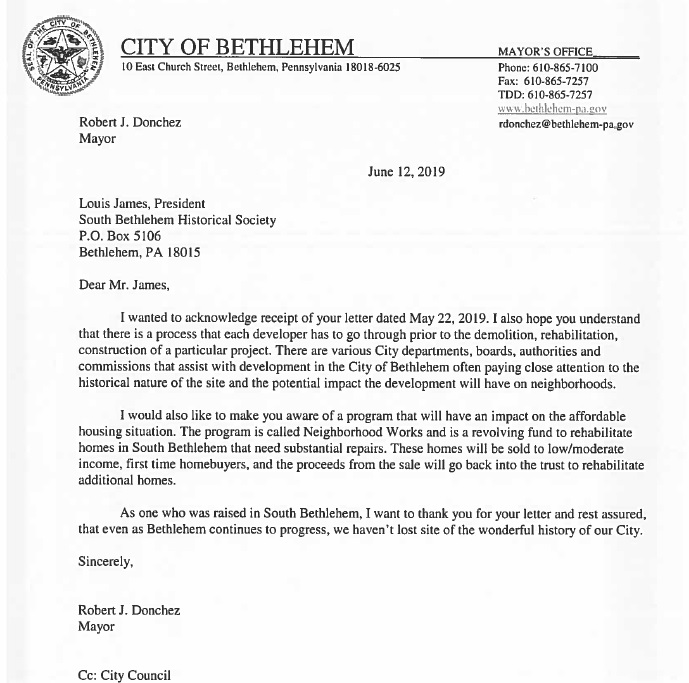
Here in full is the Mayor’s June 12 response to SBHS.

Mayor SBHS

Hoping to not sound overly dramatic, Gadfly is starting to sense somewhat of a “crisis” in regard to affordable housing on the Southside.

(Some of you will rightfully say, “where have you been, Gadfly. Get your head out from under your wing.”)

And wondering why there isn’t something like a “task force” addressing it.

The fact that Councilman Callahan spoke at the June 4 meeting of “teaming” with Councilwoman Negron to encourage developers to provide affordable housing would seem to indicate that there either is no such plan in operation now or that if there is such a plan, it is not widely recognized.

We have just been through an election. And “affordable housing” was liberally sprinkled throughout the campaign rhetoric, always receiving appreciative nods. But no one mentioned a plan. Words are easy. And when the polls close, they can be forgotten.

Gadfly doesn’t remember affordable housing on the Southside making it into the Mayor’s State of the City address.

Affordable housing on the Southside sounds to Gadfly like it should be at the top of somebody’s agenda. Somebody who cares about the character of the Southside. Somebody with power.

Who will mobilize the “wide-range of coordinated strategies implemented simultaneously by public and private actors” that Anna envisions? Who will forge the “public and private partnerships” Dana speaks of?

It sounds like no minor undertaking.

The SBHS letter provided a teachable moment in regard to affordable housing, not just for SBHS but the “us” at large. The Mayor references the Neighborhood Works program but misses the opportunity to provide much more in the way of details that would effectively make the general public feel confident that a (hoping not to be overly dramatic) “crisis” is being addressed.

Gadfly for one would like to hear much more about Neighborhood Works, about the problems the City faces in improving the stock of affordable housing on the Southside,  and about where affordable housing on the Southside sits on the City’s list of things to do.

Another southside housing story: simultaneous coordinated strategies needed

(The latest in a series of posts on the Southside and Neighborhoods)

Anna Smith is a life-long Southside resident and Director of the Community Action Development Corporation of Bethlehem, a non-profit dedicated to improving the quality of life in south Bethlehem by fostering economic opportunity, promoting community development, and empowering residents to actively participate in the decision-making process regarding the future of our diverse community.

Gadfly:

I’m about as big as Southside fan as they come, and it took me an entire year of searching to buy a home on the Southside. The home we purchased went on the market around 8 pm in the evening, and we were in the house the next day at 5 pm for a showing. When we got there, my realtor found her colleague’s card on the counter, and she called her to find out that the house had already been shown to an investor interested in renting to students. My realtor talked her colleague into talking her client out of purchasing the home, and we put in a bid by 11 pm that evening. We had already lost out to cash buyers on a home in Fountain Hill and another in West Bethlehem, so we knew we had to act quickly . . . Two homes in south Bethlehem that we were interested in purchasing never went on the market and were snapped up by investors before we could even put in a bid.

Some of the trends are national (see: https://www.nytimes.com/interactive/2019/06/20/business/economy/starter-homes-investors.html?mtrref=www.google.com), but many of the the unique characteristics in the Southside housing market are creating an increasingly untenable situation for families who would like to own homes here . . . Meanwhile, renters (67% of Southside families) deal with low supply and high demand, leading to high rents, poor conditions, and increased discrimination. While I wish there were a clear solution, altering the market is challenging; the best alternative (that I see) is a wide-range of coordinated strategies implemented simultaneously by public and private actors. No single policy or program can do it all!

Anna

See Dana Grubb’s similar thoughts.

The NYT article is frighteningly fascinating . . .

Yes, Southside Reality

(The latest in a series of posts on the Southside and Neighborhoods)

Olga Negron is a Bethlehem City Councilwoman.

Gadfly:

ref Judy Parr’s post

That’s the Southside reality, the reality that some think that by just “covering their eyes with one hand” no one else will see. It’s happening! Current longtime owner occupied are being chased out and families interested in buying can’t compete with developers. Needless is to say: sad, sad, sad . . . I REST MY CASE . . .

Olga

The proposed Packer Ave. Promenade

(Latest in a series of posts relating to Lehigh University, the Southside,
and neighborhoods)

“Lehigh University proposes to have the City of Bethlehem vacate the portion of Packer Avenue from Webster Street to Vine Street to create a pedestrian corridor.”
 – Lehigh Traffic Study

Gadfly is confident that we have all at one time or another been traveling on Packer Ave. through the Lehigh campus and experienced the hazardous crossing right at the main entrance.

Especially at class change time, students and faculty flow en masse up and down across Packer Ave., sometimes almost oblivious to traffic.

Students coming down the hill often flow with such force and determination that you are reminded of one of the falls in the Jim Thorpe area.

Students going uphill have the primal focus of salmon going upstream to spawn.

While students sometimes seem oblivious, drivers run the gamut from impatience to anger.

It’s not a good scene.

For this and other reasons having to do with a new physical plan in operation for the campus, Lehigh (as Gadfly first noted in the student newspaper back in March) is exploring seeking approval from the City to make Packer between Adams and Vine a promenade.

The safety concern would be eliminated.

And one can see good things in such a plan from Lehigh’s perspective. A promenade would help unify the lower campus buildings and fit right in to the (laudable) goal of a walking campus.

At a meeting two or three weeks ago, Gadfly heard the Mayor say there was no definite decision yet, but the positive thing he saw was a better flow of students down to the 4th St. businesses. So, at first blush, good for the City economics too.

In early May, a group from a Lehigh graduate class studying this proposal made a presentation to our Environmental Advisory Council (EAC), primarily, I think, to recommend use of their assessment tool — Sustainability Impact Assessment (SIA) — to complement existing planning processes in new development projects.

Active Gadfly follower Peter Crownfield seems to have been involved in the assessment (see the conclusion to the executive summary), and I am sure we will hear from him.

Here is the complete PowerPoint presentation: Packer Promenade – Sustainability Council.

And here the executive summary:

001

002

Per Gadfly usual practice, let’s look at the primary sources before we editorialize and criticize.

But Gadfly had in mind then at the EAC presentation and has more in mind now with the South Bethlehem Historical Society May 22 letter about the impact of “progress” on the Southside still bubbling on his brain things like impact on the residential neighborhood, consultation with neighbors, and the dreaded “Lehigh sprawl.”

So join me in chewing on the Packer Ave. Promenade proposal.

Sad Southside buying experience

(The latest in a series of posts on the Southside and Neighborhoods)

Judy Parr is a lifelong resident of Bethlehem.

Gadfly:

A young man I know is employed at Lehigh and wanted to buy a house on the south side. Lehigh offers grants to employees who buy within its catchment area. Despite this, and despite almost a year of looking, he gave up and moved to the other side of route 22. He couldn’t compete with the professional property buyers. He made an offer of asking price on one house and was beat out by someone who offered $20K less than that but who could pay cash. Here was someone who wanted to buy near work, work encouraged him to do so, and he just couldn’t get a foothold.

Judy

Gadfly asked for this! Peter does some chewing on the Mayor’s letter!

(The latest in a series of posts on the Southside and Neighborhoods)

Peter Crownfield is officially retired but spends most of his time working with students in his role as internship coordinator for the Alliance for Sustainable Communities–Lehigh Valley.

Gadfly:

1. Why do the Mayor & Council assume that economic development = progress?
Wouldn’t a more logical & holistic approach be to define progress not only in terms of money, but in realizing the provisions of Article I, §27 of the PA Constitution? (‘The people have a right to clean air, pure water, and to the preservation of the natural, scenic, historic and esthetic values of the environment. Pennsylvania’s public natural resources are the common property of all the people, including generations yet to come….’)

2. The Mayor says, “There is a process that each developer has to go through prior to the demolition, rehabilitation, construction of a particular project. . . . There are various city departments, boards, authorities, and commissions that assist with development in the city of Bethlehem often paying close attention to the historical nature of the site and the potential impact the development will have on neighborhoods.” Are these ordinances and guidelines waived for certain favored developers? Why then did the administration pressure the Historic Conservation Commission to recommend a Certificate of Appropriate for the new building at 3rd & New and support Planning Commission & City Council approval — despite the fact that it violated provisions of the zoning ordinance and historic guidelines?

3. I suppose we will never know whether the department that approved the exception for Zest was negligent, incompetent, or just going along with [Dennis] Benner.

4. The Mayor & Historic Conservation Commission should demand that Council rescind the COA for a 9-story building at 4th & Vine, another absurd and outrageous violation of the zoning ordinance & historic guidelines. (This was also approved by the HCC under extreme pressure from the city.)

5. Those concerned about a sustainable future should demand that no new building be approved unless it is climate-neutral.

Peter

The Mayor answers SBHS

(The latest in a series of posts on the Southside and Neighborhoods)

Chew on this.

Followers know that the May 22 South Bethlehem Historical Society letter touched Gadfly deeply and kicked off a thread that started here and continues, a thread that has several thoughtful responses, especially the series by Anna Smith.

The Mayor sent SBHS a letter June 12? That’s two weeks ago. Damn. Nobody tells Gadfly anything.

Sara K. Satullo, “Does the gentrification of South Bethlehem pit preservation against progress?” lehighvalleylive.com, June 27, 2019.

Today, the face of the Southside is changing amid a growing gentrification as those with disposable income are drawn to an arts district, restaurant and burgeoning craft beer and spirits scene that’s been many years in the making. As South Bethlehem increasingly is seen as a hot place to live, developers are serving up building after building of luxury apartments, where the rents are sometimes double the going rate for nearby homes.

All of this has left the South Bethlehem Historical Society fearful that development may drive out the very residents that built the neighborhood’s vibrant social fabric. This led the board to write an open letter to Mayor Bob Donchez and city council members, which President Lou James read to council May 22. The letter was posted on Facebook Tuesday.

Mayor Bob Donchez, who is a Southside native, penned a response to the historic group June 12. “I’m on the Southside a lot and frequent many of the businesses on the Southside,” Donchez said Wednesday. “I understand their concerns. You try to find a balance to economic development where you want to preserve history and move the city forward with economic development.”

The mayor knows that it can be hard and controversial to find the right balance between preservation and economic development, but it is gratifying to see a renaissance that’s been talked about for more than 30 years finally taking shape. “There is a process that each developer has to go through prior to the demolition, rehabilitation, construction of a particular project,” Donchez wrote in his response to the historical society. “There are various city departments, boards, authorities and commissions that assist with development in the city of Bethlehem often paying close attention to the historical nature of the site and the potential impact the development will have on neighborhoods.”

The historic society and Negron worry that this rapid redevelopment of the Southside with luxury apartments and new Lehigh University student housing is pricing long-time residents out of the area or into apartments in deplorable conditions. The group and Negron want to see proper code enforcement and slumlord landlords shut down.

In his letter, Donchez points to the Neighborhood Works revolving fund as a program that can help create affordable housing. The program provides money to rehabilitate homes in Southside in need of substantial repairs and the homes are then sold to low/moderate income, first-time homebuyers. The proceeds from the sale go back into the trust to rehabilitate more homes.

Negron said she knows of several smaller developers who are bullying residents to sell their properties to them. “People are literally being chased out,” she said.

The Mayor clobbers the 1st Terrace proposal, but . . .

(The latest in a series of posts on the Southside and Neighborhoods)

Zoning Hearing Board meeting, Town Hall, tonight, Wednesday,
June 26, at 6PM

There are three items on the Zoning Board agenda tonight.

The middle one is the proposal to put 40 student housing units on residential 1st Terrace above Lehigh University.

We have written about this before as a bad proposal. Gadfly was troubled that the Planning Commission couldn’t find its “no.”

Now it is before Zoning.

Stimulated by the posts of Kim Carrell-Smith, Gadfly devised the notion of butt-sharing.

Neighbors helping neighbors.

You get your butt to the hearing about my neighborhood, and I will get my butt to the hearing about yours.

Lots of you have never been to a City Council meeting, much less a Planning or Zoning meeting. Tonight would be a good opportunity to see important City neighborhood business in action.

Please turn out and lend silent symbolic support, even if you don’t plan to speak.

But the 1st Terracers have an unusual, powerful ally. The Mayor has taken a position against the proposal in the letter below. This IS unusual. Word is that this Mayor has not taken this step in a residential case before.

Donchez 1st Terrace

But the attorney for the developer is a good one. We’ve seen him in action before. He’s used to winning.

And the Planning Commission, faced with the same kind of evidence, couldn’t find its “no.”

It seems hard to say no to a developer. That’s why every neighborhood should be on the alert.

And butt-sharing.

Zoning Hearing Board meeting, Town Hall, tonight, Wednesday,
June 26, at 6PM

New idea: butt-sharing

(The latest in a series of posts on the Southside and Neighborhoods)

Zoning Hearing Board meeting, Town Hall, Wednesday, June 26, at 6PM

Gadfly tries to make clear that when he writes about one neighborhood, all neighborhoods should pay attention.

What’s happening in one neighborhood can happen in another.

Especially if it’s something bad.

We are all linked.

A recent case is the proposal to build 40 student units in the 1st Terrace residential neighborhood just above Lehigh University.

Gadfly whined about the Planning Committee’s wussy decision on this proposal: The Planning Commission couldn’t find its “No”

Then Kim Carrell-Smith followed with a provocative proposal of her own in these posts: butt-sharing.

Please support the residents of the 1st Terrace neighborhood at the Zoning meeting June 26

Southside residents and environmental folks need your body in a seat!

Well, butt-sharing is my term for what she suggested.

We have bike-sharing, ride-sharing, why not butt-sharing!

Kim suggests that even residents from outside the 1st Terrace neighborhood attend the Zoning Hearing Board meeting, Town Hall, Wednesday, June 26, at 6PM, in a show of support.

What a great idea.

Butts-in-the-seats!

And in one of her posts Kim even suggested standing in solidarity during the testimony! Better yet!

We give blood to our neighbors in need. How about giving your butt to a neighbor in need?

Are you free Wednesday night? Stop by. Developers are persuasive in this town. Our volunteer resident Boards sometimes have a hard time saying “no” to them.

“No” is easier with lots of butts in the seats.

Developers are easily emboldened. Let’s activate some restraint.

Southside residents and environmental folks need your body in a seat!

(The latest in a series of posts on the Southside and Neighborhoods)

Kim Carrrell-Smith is a 31-year resident of Bethlehem’s historic Southside, where she taught public history at Lehigh University for almost two decades. She is also an aspiring gadfly, buzzing in on issues of historic preservation, public education, city government, and other social justice issues. She tips her wings to the master gadflies who have served our community for so long!

Greetings active citizens,

Sorry to be sending alerts two weeks in a row, but there is another local govt-related issue coming up, and Southside residents could use some significant support.

Southside residents and environmental folks need your body in a seat

 THIS WED NIGHT 6/26 at 6 pm

 ZONING HEARING BOARD 

 TOWN HALL IN BETHLEHEM

(You can bring a book, and there is free wifi available in town hall, too…)

Newspaper article links and specifics are at the bottom of this email, but here’s the main info about a proposed 8 townhouse (40 student) development on First Terrace on South Mountain near Lehigh…

At issue are 

  1. the stability and safety of a great neighborhood
  2. the request for significant variances*  (see below email) to key environmental provisions in city ordinances, in particular steep slope and impervious coverage, among other requests.

THIS MATTERS TO THE WHOLE CITY: if one developer can bypass key ordinances in such a significant way, it sets a precedent for others to do the same.

Can we beat this?

  • City officials have told us “butts in the seats matter” to the Zoning Hearing Board. Please help us back up residents in the face of a powerful landlord with deep pockets.
  • And we’ve also heard elsewhere that standing up behind residents who speak could matter to the ZHB, since these folks may not be aware that that the Southside neighborhoods are places many Bethlehem residents care about.

Happy to fill you in about any of the particulars on traffic, parking, quality of life, etc., connected to this case, if you need more info.

THANK YOU, and thanks for sharing this with sympathetic friends and colleagues,

Kim

________________________________________

* The developer is asking to “increase the maximum impervious coverage in steep areas from 5% to 39%” and “decrease the minimum lot area from 10 acres to .7466 acres”

The ordinance states that if a parcel has any steep slopes above 35% grade within the construction area, the lot size must be a minimum of 10 acres and have a maximum impervious coverage of 5%.

https://www.lehighvalleylive.com/bethlehem/2019/06/this-developer-wants-to-raze-southside-houses-for-40-beds-of-student-housing-but-opposition-is-mounting.html

https://www.mcall.com/news/local/bethlehem/mc-nws-mayor-against-zoning-20190623-ytmfudjmkffbrfnrmkz7lvtuqa-story.html

The Mayor finds his “No”

(The latest in a series of posts on the Southside and Neighborhoods)

ref: The Planning Commission couldn’t find its “No”

But the Mayor did find his “no.”

Ashley Stalnecker, “Bethlehem mayor opposes proposal for student housing in residential neighborhood near Lehigh University.” Morning Call,  June 23, 2019.

Bethlehem Mayor Robert Donchez wants board members to reject an appeal at the upcoming Bethlehem zoning meeting that would pave the way for more student housing on a sloped street near Lehigh University.

“The plan as presented is not compatible with the surrounding neighborhood development which consists of single family detached homes,” he said in the June 19 letter. “The project more than doubles the density of these four parcels when combined.”

At a Planning Commission meeting this month, residents voiced concerns that bringing students to the area would add to an already overloaded parking situation. The board voted 2-1 to advance the proposal to the zoning board with no action for or against. Vice Chairman Matthew Malozi cast the lone no vote because he did not believe the project would fit with the community.

Now this is interesting.

Gadfly agrees with the Mayor’s petition, as will be obvious from Gadfly’s post on the Planning Commission meeting referred to and linked above.

For one thing, Gadfly is glad to see an official negative response to a developer. Gadfly was upset by the Commission decision (well, 2 of 3 members) when the evidence so clearly required a negative vote (at the very least, negative commentary) .

But two mayoral decisions within a few days makes Gadfly wonder about the role the Mayor’s position has in Planning and Zoning decisions.

Is it suggestive? influential? determinative?

Coming from someone just like us or from He-Who-Must-Be-Obeyed?

Gadfly was troubled by the recent 9th-inning Administrative (Mayor?) affirmation of a developer proposal in the 2 W. Market case.

Now in the 1st Terrace case, on the other hand, he gets a position he likes from the Administration.

So it gets him wondering about the principle and the practice involved here.

I believe Planning and Zoning are designed to be independent.

What is the relation between the Mayor and these groups in general? Is his input welcome, helpful, or disruptive — especially since, in this upcoming case, it comes before the ZHB has heard a word of testimony? Should he be weighing in personally at all?

A City official sits at the head table at Planning meetings. Gadfly has been at Planning meetings at which a report from the City professional staff has been presented. Gadfly, frankly, is not quite sure that he has heard such official make definitive statements that the PC either should or should not approve a proposal. Gadfly’s memory sense is that such positions are communicated more softly.

But the Mayor is upfront and direct.

Here in the 1at Terrace case, though I very much agree with the Mayor’s position and hope it prevails, his letter, coming before the Board has heard any testimony, seems peremptory.

More on this upcoming hearing shortly.

Empathy and consideration are currently lacking greatly in Bethlehem’s processes

(The latest in a series of posts on the Southside and Neighborhoods)

Dana Grubb is a lifelong resident of the City of Bethlehem who worked 27 years for the City of Bethlehem in the department of community and economic development, as sealer of weights and measures, housing rehabilitation finance specialist, grants administrator, acting director of community and economic development, and deputy director of community development.

Gadfly:

Kim is absolutely right with her assessment. If you chip a piece of marble off of a statue in a less obvious location, most wouldn’t notice it. But, when you chip a piece of the nose, and then another chip, and then another chip, etc., pretty soon you won’t have that magnificent piece of art.

This is exactly what is happening in Bethlehem, a chip here, a chip there, but no holistic approach that says enough is enough because each of those chips contributes to destroying the original. Whether it’s a marble statue or a community, how much can be absorbed the integrity of the statue or character and quality of life of the community are lost? And, how many of these citizens who are appointed  on the ZHB and PC are ever directly impacted by the decisions they’ve made? A rhetorical question. When I was the City’s deputy director of community development, I was constantly stressing to staff to treat each situation as if you lived next door, or your parents did. Bethlehem’s residents need public appointees and officials to put themselves in others’ shoes, and show some empathy and consideration. Empathy and consideration are currently lacking greatly in Bethlehem’s processes and in some very key employees, and that contributes to a declining quality of life and civility.

Dana

Please support the residents of the 1st Terrace neighborhood at the Zoning meeting June 26

(The latest in a series of posts on the Southside and Neighborhoods)

We last saw Kim Carrell-Smith on these pages in her role organizing the Great Southside Sale 2019.

ref: The Planning Commission couldn’t find its “No”

Yes, Gadfly, we need to mount up. But not just the immediate neighborhood, although that is important. But EVERYONE in our city needs to be concerned about the way developers are bypassing city ordinances. The developer’s lawyer said at the last Planning Commission meeting that they are seeking “small variances.” SMALL?? Check out the percentages of steep slope and impermeable surfaces they are asking for and compare with the ordinances they are seeking to bypass! This is about environmental damage and quality of life in the First Terrace neighborhood . . . aside from the other obvious issues of serious traffic problems and inadequate roads and parking, as well as scale of the project, noise, and housing a total of 40 students, where four houses stand today. But if ZHB only wants to hear about steep slope and impermeable surfaces, those issues are egregious enough.

ALL CITIZENS of Bethlehem should be concerned about this. Although we are told there are no such thing as precedents with these kinds of decisions (that’s what we’ve heard from Planning Commission folks, ZHB, and others), we have definitely heard the same folks say, “well, we did this for the __ project, so I guess we have to do it again for this developer, or they could sue us.”

Is that the way we want our city to function? I don’t live in the First Terrace neighborhood, but I see what may happen to neighborhoods on the Southside, OR North, when developers with deep pockets can come in and bypass our city laws, which exist for good reasons and are the will of the people of our city. The developers have the lawyers; residents don’t, and won’t, unless they can find themselves some deep-pocketed supporters; that’s not happening on First Terrace.

Please support the residents and other speakers on June 26 [Zoning Hearing, 6pm, Town Hall]; just stand up in the audience when they speak! Don’t let the Zoning Board think that no one cares about this kind of thing. You should, and I think you would if it were your neighborhood . . .

Kim

Gadfly was “nonplussed” at the lack of courage by the Planning Commission on this 1st Terrace case last week.

The Planning Commission couldn’t find its “No”

(The latest in a series of posts on the Southside and Neighborhoods)

Kevin Duffy, “South Side Bethlehem residents voice concerns over student housing.” June 14, 2019.

South Side Bethlehem residents Thursday implored the city’s Planning Commission to take a long, hard look at a proposal for additional student housing in their neighborhood before recommending it move ahead.

City dwellers living nearby 1st Terrace took turns voicing their displeasure over Lehigh

032
the site on 1st Terrace

Property Management’s intention to add two four-unit town homes each numbering five bedrooms with three floors above garages to the narrow, hilltop street zoned high-density and overlooking the Asa Packer Campus of Lehigh University.

The board reviewed a sketch plan revision from one presented to them in March and opted by a 2-1 vote to advance it to the zoning board with no action for or against.

Vice Chairman Matthew Malozi, who cast the lone no vote, said he’s concerned that the project might not fit within the community, and urged those in attendance to return for the zoning hearing and speak again.

“We’ve created a plan that conforms to all of the ordinances of the city,” [the developer rep] said.

“Implored” — there’s that tough verb again.

The one that indicates the gulf between the powerless and the empowered.

Some South Side Bethlehem residents Thursday implored the city’s Planning Commission, the Morning Call article states, just like the May 22 South Bethlehem Historical Society letter implored the Mayor and City Council.

People who implore are, figuratively if not literally, on their knees.

They are looking for mercy (or justice).

So residents of upper Hillside Ave. and 1st Terrace implored the Planning Commission to take a stand against the developer sketch plan (second version) to raze four homes on 1st Terrace and build two town homes accommodating forty students.

The residents were calm but firm. In short, they said, this is an out-of-scale project involving the need for serious variances regarding steep slopes, impervious surfaces, and parking that will destabilize a highly cohesive neighborhood when the University has said there is no need for extra student housing.

This is a highly functional, mixed-income, ethnically and racially diverse neighborhood in which neighbors know each other, look out for each other, which

057
1st Terrace looking west

will be destabilized by this project . . . if Bethlehem city government allows all those variances to be issued for a project which is demonstrably destructive to the neighborhood, we have to ask what is the Planning Commission for . . . This is a project that simply has no place in this neighborhood. (Seth Moglen, min. 7:55)

We have been threatened several times by the developer’s maintenance persons saying that you should move, you are not going to like where you live in a couple of years . . . we should sell our houses now before the area is destabilized. I invite you all to please take a drive up to our lovely little quaint neighborhood, it’s a beautiful quiet street, we’ve lived there a long time, we have a great neighborhood. (Gretchen Starke, min. 13:20)

Last week we were on the front porch, and Justin my 9-yr-old said, “This neighborhood is starting to suck . . . there’s no kids around here any more.”  We can’t make it go worse. We want more families to come into the neighborhood. And we have the potential to do that. . . . We want to be here, we choose to be here. My grandfather grew up in this house . . . we want to stay in this house. . . . We want to be sure we have a community and a place where we can raise kids like Justin to know all the things the Southside has to offer not just being a party town where kids come to party. (Murdock Saunders, min. 17:40)

One of the things that makes all of the Southside a cool and interesting place to live is that we have an eclectic blend of architecture, and we like it that way, it’s kind of cool, but what we don’t have are new things that completely depart from that old

059
1st Terrace looking east

look of a neighborhood . . . those are just not ways houses were designed in the old days . . . part of the interesting features of the Southside are things that blend, they might be different but they blend . . . the biggest issue is scale that does not blend. (Kim Carrell-Smith, min. 20:52)

The problem with this project is to put such density of housing on this relatively small site on a steep slope with all those cars means a malformation of the neighborhood. . . . Those would be conditions under which we would consider moving. . . .  The difference between what is permitted and what is requested is so great, I don’t understand how people could really consider it just a variance. . . . Consider the scale of the variance. It’s not minor. (Kristen Handler, min. 27:28)

When you buy a home and put a lot of money into it, the expectation is your Planning Commission and Zoning Board keeps that stability. They don’t go ahead and put a Wal-Mart behind your house. This is not Rt. 22, this is not Catasauqua Rd. . . . A project like that would be 3rd St., 4th St. (Steve Mendez, min. 31:05)

Gadfly loves the power of Bethlehem resident commentary, and he encourages you — please! — to listen to their full testimony:

So what was the up-shot of this forceful testimony?

The purpose of the PC at this meeting was to review the developer sketch plan (2nd version) before it headed to the Zoning Board, allowing the Commission to provide any comments they would think meaningful to Zoning for the future development of the plan.

One PC member said “we heard you loud and clear,” and it was a “tough decision” — and two members of the 3-member PC recommended that the neighbors attend the Zoning Board meeting on June 26.

The PC had three options: recommend for the sketch plan, recommend against it, or take no action.

A motion to take no action passed 2-1.

“We heard you loud and clear,” but we will take no action.

Gadfly was nonplussed.

Why is it so hard to say no to a developer?

Ok, in fairness, the sketch plan had moved in a good direction in this second version, and there was no significant testimony from the developer (no rebuttal to the residents), and, the key decision on those significant variances seems to be with Zoning, and, if Zoning approves, the PC gets to vote again — ok, Gadfly gets all that . . .

But why is it so hard just to say no when that is manifestly the right decision?

Take no action. Such a wussy decision.

But at least one PC member was willing to be clear about the significant negative issues here.

At least one PC member took a stand.

Residents — mount up again on the 26th!


Reflections on Southside Bethlehem, Part 5: My New Neighborhood

(Conclusion of a 5-part series of posts on the Southside by Anna Smith)

Anna Smith is a life-long Southside resident and Director of the Community Action Development Corporation of Bethlehem, a non-profit dedicated to improving the quality of life in south Bethlehem by fostering economic opportunity, promoting community development, and empowering residents to actively participate in the decision-making process regarding the future of our diverse community.

Gadfly:

The Southside is far from a monolith, and I moved a mile across town this past winter. I’m not sure what my neighborhood’s challenges and opportunities are quite yet, but I’m starting to get a feel for my new community. I look forward to continuing conversations about my neighbors’ hopes and fears for their community over the backyard fence and on nightly dog walks on the eastern side of south Bethlehem.

I bet that housing affordability will be a big one—my mortgage payment is a lot cheaper than what I paid in rent for a much smaller and more run-down place on the Southside. Rental prices are spiraling upward, and there isn’t nearly enough affordable, quality housing to go around. It seems to me that neighborhood change is accelerating these challenges, and the stories I hear from residents on a daily basis illustrate the human impact of our affordable housing crisis. What do we do about it? As always, my inclination is start by listening.

There are no simple or straightforward answers when it comes to dealing with neighborhood change. But as it continues, here are a few principles that I’ll be keeping in mind:

  1. The Southside is a unique, diverse community with individuals who have a range of perspectives on any issue—any attempt to suggest otherwise is disrespectful to the experience and agency of those who call our community home. All have the right to be heard.
  2. The best ideas usually come from those who have personal experience with the topic at hand. If they are not at the table, then we should stop discussion until they are and do what it takes to make participation easy—even if it means taking a step back or down.
  3. Southside Bethlehem has always changed and will continue to change. However, the inevitability of change does not mean we have to accept all changes as inevitable.
  4. Deficit-based thinking leads to missed opportunities, or worse, can lead to the accidental destruction of assets. If we can identify what is great about our neighborhoods, we can preserve it and use it as inspiration for future development. Always start with assets.

It may be hard to believe, but former Southsider and folk singer John Gorka wrote this song about south Bethlehem in 1991. Concerns about neighborhood change are hardly new to the Southside and are indicative of a deep sense of commitment to a community. The least we can do, and the best place for any of us to start, is to listen to them.

Reflections on Southside Bethlehem, Part 4: The Specter of Student Housing

(Fourth in a 5-part series of posts on the Southside by Anna Smith)

Anna Smith is a life-long Southside resident and Director of the Community Action Development Corporation of Bethlehem, a non-profit dedicated to improving the quality of life in south Bethlehem by fostering economic opportunity, promoting community development, and empowering residents to actively participate in the decision-making process regarding the future of our diverse community.

Gadfly:

Campus-community tensions are an inevitable component of any college town. South Bethlehem and Lehigh are no exception to the rule (if you can find an exception anywhere, I’d love to hear about it!). Once again, your perspective depends on your location (in this case, physical location matters), and your frame of reference. Here are a few of the things I’m thinking about these days.

Going back at least a decade, the expansion in off-campus housing for Lehigh University students drastically changed the face of Fifth Street, Hillside Ave, Birkel Avenue, and Montclair Avenue. Once home to families and homeowners, portions of these streets are now almost exclusively student housing. This transition was painful for the remaining homeowners who feel that the community where they bought their homes has disappeared. They can probably sell their homes for more money now, but the emotional component of losing a neighborhood has to be recognized, and we can’t deny that the look and feel of a community has value for those that call it home. Backyards once home to meticulously tended rose gardens have been converted to parking lots. Remnants of student parties are piled high on trash day, and old couches continue to appear on front porch littered with beer bottles. Neighbors who have witnessed the transition from Bethlehem Steel retirees to students are entitled to their frustration. Not all students are bad neighbors, but that’s not the point.

Like development, however, the student housing expansion did not occur in a vacuum. Without student housing, what would have happened to these properties? Overall economic trends in south Bethlehem and similar deindustrializing communities would suggest that many of these properties would not have been purchased by homeowners following the relocation of their original owners. The neighborhood would have experienced change with or without students—what that change would have looked like is difficult to say, and value judgments are beyond the scope of this discussion. However, the lack of a resident voice—the lack of choices—in what happened to these neighborhoods was enough to create a sense of impotence among those left behind. That frustration can be difficult to understand for those focused solely on the economics of the situation, but taking some time to listen to the stories of our neighbors brings the aches and pains of neighborhood change into view.

For those living on the outskirts of the student neighborhoods, the student housing discussion is quite different. Give them Birkel and Fifth, my former neighbors on Carlton plead; just don’t let them take over my neighborhood. The students are generally fine people, but they just have different hours and lifestyles that don’t mesh well with raising a toddler. Doesn’t it make more sense to concentrate the students close to one another and to campus? What family wants to live across the street from a student dorm, anyway? The conversion of single-family homes to student housing feels threatening to residents on the outskirts of predominantly student neighborhoods who are watching their blocks change more rapidly than they ever had before. What will they do if they are the last homeowners on the only block they have known for the last 50 years?

Anna

Reflections on Southside Bethlehem, Part 3: An Alternative Approach to Development

(Third in a 5-part series of posts on the Southside by Anna Smith)

Anna Smith is a life-long Southside resident and Director of the Community Action Development Corporation of Bethlehem, a non-profit dedicated to improving the quality of life in south Bethlehem by fostering economic opportunity, promoting community development, and empowering residents to actively participate in the decision-making process regarding the future of our diverse community.

Gadfly:

Instead of starting with nothing, why don’t we start with something? Community-driven, asset-based development is an alternative approach that some community organizations have taken in south Bethlehem, and that can be applied to any potential development project. Working with residents and other stakeholders to identify a neighborhood’s strengths and assets and then creating a plan for development that builds off those strengths ensures that development adds to a neighborhood’s character without erasing the elements that attracted development in the first place.

A classic example is the South Bethlehem Greenway—a defunct rail line was converted into a community park that connects south Bethlehem commercial districts, improving walkability in an already walkable community.

On Hayes Street, the historic architecture of St. Stanislaus church was adapted into a multi-purpose space for the Southside Lofts affordable apartment community.

In both examples, a community need or challenge was identified and a strategy was developed to address that challenge by building off existing assets.

This approach brings its own challenges, and no development project will ever be supported by everyone. However, making an effort to engage community members tends to make for a better project in the end.

Anna

Reflections on Southside Bethlehem, Part 2: “Ten years ago, there was nothing here”

(Second in a 5-part series of posts on the Southside by Anna Smith)

Anna Smith is a life-long Southside resident and Director of the Community Action Development Corporation of Bethlehem, a non-profit dedicated to improving the quality of life in south Bethlehem by fostering economic opportunity, promoting community development, and empowering residents to actively participate in the decision-making process regarding the future of our diverse community.

Gadfly:

“Ten years ago, there was nothing here”

This refrain is a classic remark at grand openings and ribbon cuttings throughout the Southside these days. I know why it is used—perhaps there was nothing here that attracted your attention, money, or time. However, as a lifelong resident, it’s hard not to take this personally; I was here. My family was here. We shopped, ate at restaurants, went to school, and played at parks here ten years ago.

We erase the livelihoods of thousands with a single phrase when we speak of development as if it has occurred on a blank canvas. Development never occurs in a vacuum—“nothing” may have been a vacant lot where neighborhood kids played or a makeshift community garden. Good, bad, or somewhere in between, I doubt it was nothing. In fact, there was a reason that someone chose to invest in this area to begin with—if there were nothing here, why would you spend time and money to build something new here?

History and perspective matter, and they inform the decisions we make and our evaluations of their potential impact. I don’t expect someone who doesn’t live in my neighborhood to truly understand its assets (how could they?), but I do expect them to try. Listening is a good place to start.

Anna

In these first two posts, Anna nails something important to me as I think of the “divide” between CPs Negron and Callahan on visions of the Southside. I tend to use their expressed views as my frame of reference. What I hear in BC is measuring change “in investment dollars, new construction, jobs created, businesses opened—the bigger the numbers, the better.”  ON measures change in a totally different way (though in her long remarks at the last Council meeting, she is certainly appreciative of and even proud of some of the things that BC talks about). “Listening is a good place to start.” Yes.

Reflections on Southside Bethlehem, Part 1: Economic and Community Development

(First in a 5-part series of posts on the Southside by Anna Smith)

Anna Smith is a life-long Southside resident and Director of the Community Action Development Corporation of Bethlehem, a non-profit dedicated to improving the quality of life in south Bethlehem by fostering economic opportunity, promoting community development, and empowering residents to actively participate in the decision-making process regarding the future of our diverse community.

Neighborhoods change. And they have always changed. There’s no question that change continues in south Bethlehem, and, value judgments aside, most folks living in the City will agree that change is happening faster these days.

Recently, a colleague asked me what data points I track to measure economic development over time in south Bethlehem. Number of apartments? Rental prices? Number of employees? Commercial vacancies? Median sale prices of single-family homes? New investment dollars?

In the world of government and big business (under a neoliberal system), change tends to be measured in investment dollars, new construction, jobs created, businesses opened—the bigger the numbers, the better.

In my experience, however, when you ask neighbors what they think about their neighborhoods, they never cite these numbers to describe change. Changes in quality of life are measured in terms of friendly neighbors who stay put, trash on the street, dogs barking, leaving doors unlocked, walking to work or school, parks and green space, street lighting, police activity, graffiti, and safe places for children to play.

I think a lot about what quality of life means for our community as the director of an organization tasked with expanding economic opportunity and promoting community development in south Bethlehem. How do we identify quantitative and qualitative measures of “progress” that resonate at all levels with diverse stakeholders—local government, corporate funders, neighborhood organizations?

The indicators we track and how we interpret them shed light on our values, our priorities, and our goals as a community, and they will inevitably vary depending on the angle from which we are examining south Bethlehem. I don’t expect us all to agree—sharing different perspectives, debating their merits, and coming to collective decisions is what participatory democracy is all about.

From my perspective as both a lifelong resident of south Bethlehem and as the leader of an organization tasked with improving the quality of life in our neighborhoods, here are some of the things I’m thinking about as we debate neighborhood change and its winners and losers.

Anna