The Community Action Development Corporation of Bethlehem(CADCB): Part 2

(Latest in a series of posts about Neighborhoods and the Southside)

Community Action Development Corporation of Bethlehem
409 East 4th Street, Bethlehem, PA 18015
Anna Smith, Director
http://cadcb.caclv.org/

“Empowering people and transforming South Bethlehem”

In the previous post this morning you saw the powerful impact on Councilwoman Negron of a presentation by the Southside Vision Housing committee.

That’s a good segue to Gadfly’s second post on the  Community Action Development Corporation of Bethlehem. Last time Gadfly promised info on the Southside Vision 2020 plan.

CADCB organizes “a steering Committee of community residents, business owners, clergy, non-profit organizations, city government, and community leaders . . . responsible for implementation of Southside Vision 2020.”

Gadfly had at least heard of CADCB. He just didn’t know what they did. Hence, his curiosity and the visit to Anna Smith.

But he had absolutely no idea about Southside Vision 2020. And he can tell you — after attending three meetings — that this is a group and a plan that we all should know more about.

Browse through the Southside Vision 20/20 web site with Gadfly.

“This Southside Vision Master Plan is a comprehensive strategy to continue the revitalization of south Bethlehem. It is an initiative of Community Action Development Corporation of Bethlehem (CADCB), a subsidiary of Community Action Committee of the Lehigh Valley (CACLV), and is administered in partnership with the City of Bethlehem. Southside Vision began with the approval of a Neighborhood Partnership Program through the Pennsylvania Department of Community and Economic Development (DCED) in 2001. Southside Vision leverages this funding to engage corporate, public, and private resources so that the community’s vision for a better future can be mobilized and realized. The goals described in this plan will be accomplished through strategic partnerships among community organizations, state and local governments, south Bethlehem residents, educational and healthcare institutions, law enforcement agencies, and the private sector.”

The plan consists of five interconnected areas:

  • Economic sustainability
  • Housing
  • Public spaces
  • Safety and well-being
  • Community engagement and communication

On the Gadfly blog, we have been hammering the need for affordable housing lately.

See the goal of the Housing group in the plan — who most probably made the presentation that Councilwoman Negron attended: “Through education, advocacy, and rehabilitation of the existing housing stock, south Bethlehem residents will have access to safe, decent, and affordable housing.”

“This committee will improve the housing stock of south Bethlehem through façades, emergency repairs, and code enforcement. Initiatives for increasing home-ownership will be prioritized.”

Remember that in a thoughtful previous post, Anna wrote: “I’d encourage anyone interested in getting more involved in the discussion [about affordable housing] to join us at the Southside Vision Housing Committee—send me an email at asmith@caclv.org and I’ll get you the details!”

Gadfly is pleased to point you to a valuable example of your tax and non-tax dollars at work!

Remember what CADCB and CACLV stand for. There will be a test.

CADCB: “Empowering people and transforming South Bethlehem”


“Thank you,” Mr. Antalics, “for always keeping us on track.”

(Latest post on such topics as Neighborhoods, Southside, Affordable Housing)

Heard on Jeopardy last night: “What Bethlehem resident wants the definition of family as five unrelated persons changed in order to stifle the negative effect of student housing on the Southside?”

Just kidding.

But everybody who follows the Gadfly knows the answer to that question.

Stephen Antalics.

Gadfly #1.

And he is not kidding.

This man has wit and whimsy, for sure, but at Council he is all business.

He’s a Southside warrior.

At Council Tuesday night Stephen challenged the “silence of the lambs” once more.

Classic gadflyism. A model for us all. Listen.

For once, Stephen’s words did not go unanswered.

The 11 o’clock news could well have led off with a fiery segment on the fired-up Congressman Callahan to which I have strongly urged you to listen.

That’s where the sensationalistic headlines would be.

But the precious jewel of the meeting was the easily overlooked — wedged as it was between Callahan fusillades — barely three minutes of Councilwoman Negron in response to Stephen.

Councilwoman Negron’s soft demeanor bespeaks her sincerity and belies her strength.

“Like [Mr. Antalics], the Southside issue is dear to my heart,” she said, recounting the consequence of listening to residents about affordable housing at a meeting of the Southside Vision Housing Committee:

  • “I couldn’t even sleep last night because I was so upset, especially because I heard the urgency in which they were speaking.”
  • “I am not going to go anywhere till something is done, or that will be my end on City Council because there is no purpose if that cannot be changed.”
  • “I just want to assure you [Mr. Antalics] that just because we are not talking about it every night as you have, and you have the right, and I’m glad you have, we are working on it.”
  • “The only reason I was glad to read the[South Bethlehem Historical Society] letter was to realize that I am not crazy or that I am just whining about something dearest to my heart.”
  • “So housing is getting to be a big distress on the Southside, and we are looking to make some changes in the near future.”
  • “Thank you for always keeping us on track.”

Beautiful.

Gadfly has sensed some momentum on the housing issue since that SBHS letter, some tide-turning, though, of course, there are such prior currents as that generated by Southside Vision that he was not aware of.

“We are working on it.” “We are looking to make some changes.”

Action.

“I am not going to go anywhere till something is done.”

Resolve.

Passage of the “Antalics Amendment” is playing on Gadfly’s mind-screen.

And — he knows it’s early — but Gadfly’s mind has been drifting ahead to the mayoral race.

A strong program to improve affordable housing will need the executive’s power.

And will take longer than Mayor Donchez’s term.

There were probable candidates for mayor in the room Tuesday night, and more watching on television. Gadfly thinks this is a cause the next mayor must take up.

Not too early for people to be thinkin’!

Thank you, Mr. Antalics, for always keeping us on track.

Thank you, Councilwoman Negron, for saying thanks.

Zoning Hearing Board appointment withdrawn, Council discussion ensues

(The latest in a series of posts on City government)

In a post yesterday, Gadfly took a strong stand against one of the Mayor’s nominations to the Zoning Hearing Board.

The Mayor withdrew the nominations (there were two) before the meeting, so a vote was not taken.

Gadfly spoke briefly during public comment  — in rather uncharacteristically strong terms, he now says as he listens to himself — about the wisdom of one of the Mayor’s nominations.

Councilman Callahan raised the subject under New Business as the last agenda item of the meeting, and one hour of “discussion” followed, dominated by Councilman Callahan.

Gadfly urges followers to listen before he makes any comment about the discussion. In Gadville, we always go to the primary source and form our own opinions.

Gadfly strongly urges you to listen.

Gadfly has video and will post it here (see below) after processing. The video will also be posted on the City web site later today (go to the last hour).

After hearing the discussion, Gadfly has one regret about his strong negative stand against one of the nominees.

He should have made clearer that he was implying nothing evil, shady, dishonest about the person’s character. She has an enviable record of public service. On many a City ABC she would be a welcome addition. But in Gadfly’s opinion she was an obvious mismatch in appearance and optics for this position, and the Mayor was tone-deaf in nominating her.

Video now available:

part 1

part 2

part 3

part 4

part 5

Grace Crampsie Smith: One step closer

(The latest in a series of posts on City government)

Grace Crampsie Smith 2

Morning Call photo

Smith is on the verge! Let’s welcome her. If you browse through “candidates for election” under Topics on the Gadfly sidebar, you will find abundant statements by her. One of Gadfly’s goals is to help you know your Councilpersons.

Nicole Radzievich, “Bethlehem City Council picks unopposed candidate Grace Crampsie Smith to fill vacant seat.” Morning Call, August 20, 2019.

Democrat Grace Crampsie Smith, who is running unopposed this fall for Bethlehem City Council, will be sworn into her seat on council early.

She was unanimously picked Tuesday by City Council to fill out the final four months of the term of freshman Councilman Shawn Martell, a Democrat who resigned this month for personal reasons. She is unopposed on the November ballot for a two-year term, which would start in January.

Smith is expected to be sworn into office next month.

After Tuesday’s vote, Smith said in an interview that she was honored and humbled by the support she received during the campaign and by council’s appointment. She said she appreciated the ability to join council in time to be part of vetting Mayor Robert Donchez’s budget proposal for next year.

Smith, a school counselor, holds a master’s degree in education and school counseling from Lehigh University and a bachelor’s degree in sociology and social welfare from Bloomsburg University.

She was a member of the adjunct faculty at Lehigh Carbon Community College and also worked as an addictions counselor and coordinator of community and early intervention services for the office of Lehigh County Mental Health and Developmental Disabilities. She completed the Bethlehem Police Citizens Academy. And has participated in several political groups including the Northampton County Democratic Committee, Lehigh Valley Democratic Progressive Coalition, Lehigh Valley ROAR and Lehigh Valley for All.

Zoning Hearing Board members are “quasi-judicial”

(The latest in a series of posts on City government)

Breena Holland is an Associate Professor at Lehigh University in the Department of Political Science and the Environmental Initiative. She is a past and current director of Lehigh University’s South Side Initiative.

Dear Gadfly,

Can you please clarify something? Did you indicate that after deliberating, none of the ZHB members gave any explanation of their votes? I find that troubling. How would elected officials know whether to reappoint a ZHB member if there is no way get a sense of how they view and reason about local land use decisions? Do you know if ZHB members are prohibited from explaining their decisions, or whether they just remain silent so as to avoid being properly evaluated by those who appoint them later?

Thanks,

Breena

Yes, Breena — no explanations. All I have heard is that they enjoy “quasi-judicial” standing, which enables the out-of-view deliberation.

Zoning Hearing Board appointment at issue tonight

(The latest in a series of posts on City government)

A great deal of important City work is done by volunteer citizen-based Authorities, Boards, and Commissions.

Gadfly calls them the ABCs.

Because of the important work the ABCs do, it is crucial that we have the best people serving.

Especially on what he calls the “hot-button” ABCs: Parking, Criz, the Historical Conservation Commission, Planning, Zoning, and so forth.

Gadfly goes to a lot of meetings. He sees a lot of good people doing a lot of good work. In fact, that is what he mostly sees. Gadfly loves this significant exhibition of community involvement. A vision of Gadfly’s Norman Rockwell fantasy world in action.

Take a moment and mentally high-five those volunteer good people doing good work when they could be sitting on their fannies.

But Gadfly has some worries.

You’ve seen him register them once in a while — at the Parking Authority, for instance.

So you have also seen Gadfly — joined with some Council members — calling for tighter oversight of membership on the hot-button ABCs at least, especially by calling for evidence of performance when members come up for reappointment.

The Mayor nominates members for the ABCs. And you can imagine that it is not always all that easy to identify and persuade good people to serve. Good people are very often busy people.

The Mayor nominates people to Council. Gadfly is not sure, but he thinks most times appointments are (or have been) pretty pro-forma, with the Mayor sending only a resume of the person to Council. Gadfly is not sure that the resume is accompanied by a letter of support from the Mayor explaining the person’s qualifications or suitability.

Council’s job is to approve the Mayor’s nomination based on the information provided but also free to do independent interviewing or investigation. As far as Gadfly knows, Council choices are independently arrived at; there is no effort to act in concert — for instance, joint interviews. One can imagine that a number of Council approvals are based on “faith,” faith in the Mayor’s judgment and/or the person’s background demonstrated in a print record.

Then Gadfly has made some noise lately about requiring performance evidence if and when a person comes up for reappointment. To ensure some accountability.

The initial appointment to a hot-button ABCer should be taken very seriously. It should involve more than a resume.

Two new members of the Zoning Hearing Board — a hot-button ABC — are slated for appointment tonight at City Council.

One of the proposed appointees is currently an alternate member of the ZHB and served, in fact, as a voting member on the panel for the Bethlehem Manor case that has been the subject of a half-dozen posts here on Gadfly recently.

Gadfly doesn’t suppose there is a “job description” in the layers of City codes for this ZHB position, but if he were to write one, it would stipulate that members of the ZHB — though they need not necessarily have any relevant professional skills — must be intelligent, independent, objective, fair, and empathetic.

How can we tell if the two proposed appointees tonight exhibit these desirable traits?

One has a record that can be viewed. She ran unsuccessfully for City Council in the May primary.

And her May and June “Campaign Finance Reports” can be viewed on the City web site.

What can we see?

1) The records seem to be incomplete. The June report shows expenditures of  $8475.58 from a Schedule III. There is no schedule III. One would like to see how the money was spent. And Gadfly cannot find a total contribution amount that matches the itemized contributions. But this vague paperwork isn’t the big problem. The big problem is what one can easily see.

2) In her contributions, $4500 came from the “Friends of Bryan Callahan.” Gadfly does not think anyone would deny that Councilman Callahan is very “pro-development,” a fact he himself has admitted to Gadfly in personal conversation. In addition, another $4300 in contributions came from people even the inexperienced Gadfly recognizes as associated with developers. Then there is $2000 from Union sources — construction people, building people. The vast majority of her campaign funds taint assurance of independence and objectivity.

Gadfly became aware of the “Friends of Bryan Callahan” contributions at the 11th hour of the primary and wondered aloud here in posts about the ethics of that, but since her Council bid was unsuccessful, he let concern about it slide. But it should be back in view now that she is being selected if not elected to an important City position.

Gadfly sees a BIG RED FLAG here! red flag

CODE RED!

Developers and builders are very much interested parties in many Zoning cases.

The evidence would lead a reasonable person to believe that this nominee has strong ties to the developer/builder community.

The evidence would lead a reasonable person to believe that she could not be trusted to be independent and objective.

This person should not be appointed to the Zoning Hearing Board.

Council, please take note!

Bethlehem Manor: the Zoning Board deliberates and votes

(Latest in a series of posts on Bethlehem Manor and Neighborhoods)

(Some clued-in followers will recognize that Gadfly refrained from using the name of the Bethlehem Manor representative — a name that comes with some baggage in local circles. Gadfly tried to think about this case on its merits, without prejudice, as the Zoning Hearing Board should be expected to.)

So we come to crunch-time. The Board deliberation and vote.

Unfortunately, we do not get to hear the Board deliberation as we do in, I think, all other boards and commissions — and City Council. In most other cases, we have an idea of why members are voting the way they do.

The Zoning Hearing Board is considered a quasi-judicial body (all witnesses are sworn in!), and thus they deliberate out of public view.

The Board deliberated roughly 20 minutes.

The vote was 3-2 to deny the proposal.

During the roll call, one of the two deniers paused a good 5 seconds before voting, indicating some indecision.

Ha! So perhaps the true vote was 3.5 to 1.5 against the Bethlehem Manor proposal.

As he said earlier, Gadfly was surprised (smart money and water-cooler chat usually believes that in Bethlehem voting favors the builder/developer), and he wishes he knew the basis of the votes.

As he also said earlier, when all is said and done, “we” depend on Board members who are intelligent, objective, fair, and empathetic.

We depend on good Board members. We depend on the Mayor to provide them, Council to appoint them, and Council to hold them accountable.

We can judge some of those traits from their behavior in the open part of the hearings and in the brute fact of their vote, but it is in deliberation where those traits would be most needed and most visible.

‘Tis unfortunate that we are not privy to the best evidence we could have of Board member suitability. Thus, the initial selection process is extra-special in the case of the Zoning Board.

More on that in a following post.

Where does the case go from here?

Bethlehem Manor will appeal to Northampton County Court.

If the denial here locally was based primarily on neighborhood “quality of life” issues — as Gadfly suspects it was — then how will that play at the county court level?

Gadfly is not sure, but the Bethlehem Manor attorney seemed confident, and you can hear him laying the groundwork for appeal on the Manor’s compliance with all technical issues:

Neighborhood concerns may not play well at the higher level.

Does this series of posts give you an idea of a Zoning Hearing Board process?

Gadfly will be on the lookout for action at the next level and keep you apprised.

The Bethlehem Manor case: field trip!

(Latest in a series of posts on Bethlehem Manor and Neighborhoods)

So have you been playing along? What decision would you make if you were on the Zoning Hearing Board?

At the historic commissions, planning commission, and zoning board hearings, Gadfly has often thought a field trip would be helpful for the members.

Those bodies work from photos, sketches, design plans, blueprints, verbal testimony, etc. I wonder why video is not used. A laptop set up at the “Mayor’s desk” would make it possible, I think. And maybe it could be helpful at times.

Gadfly was struck by neighbor Anne Lendzinski’s comment that what Bethlehem Manor wanted to do was appropriate at their Saucon Valley Manor facility but not the “homey environment” of Pennsylvania Ave.

So Gadfly decided to get a personal feel for the validity of her point and take a field trip to both locations and take (unfortunately) unprofessional videos.

Here are two short videos on Bethlehem Manor: Bethlehem Manor 1 and Bethlehem Manor 2.

And here are two short videos on another facility owned by the same company, Saucon Valley Manor, Main St., Hellertown: Saucon Valley Manor 1 and Saucon Valley Manor 2.

Does Anne have a point?

Would “being there” help the Board make a decision?

Bethlehem Manor: “It’s a nice homey environment. We’re in, you know, a neighborhood.”

(Latest in a series of posts on Bethlehem Manor and Neighborhoods)

Ok, back to our “anatomy” lesson on a Zoning Board hearing, focusing on Bethlehem Manor’s proposal to construct an addition to their Rosemont school personal care facility that will enable a 70% increase in population.

We’ve seen the Administrator testimony; we’ve seen the neighbor testimony. What about the role of the Zoning Board?

The Zoning panel is made up of 5 residents nominated by the Mayor and appointed by City Council.

The members of the Zoning Board are the most important factor in these cases. Both sides argue their positions.

But the Board decides.

Members of the Zoning Board — it goes without saying — must be intelligent, objective, fair. And maybe “empathetic” would be a good addition to a list of desirable traits.

One of the members of this panel is currently an alternate member of the Board but is up for appointment as a full member at tonight’s City Council meeting. Gadfly will post on this important appointment later today. Stay tuned.

But for now look at this few minute selection of the Board questioning the Bethlehem Manor Administrator to get a flavor of the interaction.

The interaction between Board and Administrator elicits several important points. The motivation for the expansion is the desire to provide private rooms to meet concrete demand for them, a demand she did not realize at the beginning. The Administrator elaborates on the reason people want private rooms to start, how movement to shared rooms at the same location is fostered when money becomes an issue, why she wants to fill that demand at this Rosemont school location rather than elsewhere, how she interacts with neighbors — while indicating her confidence that she would fill the new space in quick order.

Good points. Worthwhile listening to this interchange if you are playing Board member as Gadfly was and weighing what your decision would be.

But, ironically, the Administrator, in praising the neighborhood — in Gadfly’s opinion — makes the neighbor’s case. In answering a question about why a fence was not erected along the outside recreation area as promised in the original Zoning approval in 2016, the Administrator says:

It’s a nice homey environment. We’re in, you know, a neighborhood, and to take a fence and put it there, you know, you’re 95 years old and you’re looking at a fence. You know it’s not as attractive. . . .It’s nice for them to look out.

Wow! There’s the crux. The neighbors talk about such a large addition rending “the fabric” of the neighborhood, and Bethlehem Manor’s position is that they precisely want to provide their often very senior personal care residents with the feel of a neighborhood.

See what makes this an interesting case?

Charter schools: “The system must be changed”

(26th in a series on Education and Charter Schools)

Another good article in the string of thought-provoking pieces on charter schools, which we have been following because of their impact not only on the quality of education for our kids but also the budget strain from what seems to be an unfair system.

Pressure on legislators is needed.

See that great community organization BASD Proud Parents on this issue too.

Paul Muschick, “Why we should blow up Pennsylvania charter school system and start over.” Morning Call, August 18, 2019.

The proposal from Gov. Tom Wolf on Tuesday to overhaul the state’s charter school system is aggressive, welcome and long overdue.

The current system is unsustainable. School districts are paying too much money — $1.8 billion statewide last year — and those figures are only going to increase. Allentown’s costs have doubled to $60 million, 20% of its budget, in just five years.

And that money is going to charter schools that are public schools in name only, in many ways.

They don’t have the same level of accountability and transparency as school districts. It’s hard to consider them truly public if they aren’t held to the same standards, such as publicly bidding major expenses, releasing details of every dollar spent and answering to a local, publicly elected school board.

Wolf’s heart is in the right place. But I fear this may be just another example of him banging his head against the Republican wall in the Legislature, similar to his attempts to levy a severance tax on natural gas mining.

His administration can impose some changes on charter schools. But the biggest need — changing funding formulas — requires legislative action. And Republicans are the party of school choice.

Democratic Auditor General Eugene DePasquale has been calling for changes to the charter school law for years and the Legislature hasn’t listened. Let’s see if the governor has any more pull.

Those discussions should start with revising the faulty thinking of a student’s per capita funding “following them” from their school district to a charter school.

It doesn’t always cost charter schools, especially cyber charters, that much to educate the same student. And districts don’t see an accompanying dollar-for-dollar reduction in their costs.

Unless an entire classroom of students at the same grade level moves to a charter, a district can’t cut the expenses, including the teacher’s salary, that go with that classroom. State officials need to come up with a better formula.

Cyber charters especially make out under that formula now. They collect the same tuition rate as traditional charter schools but have substantially lower costs. Taxpayers are overpaying more than $250 million annually, according to a February study by Education Voters of Pennsylvania, a project of the left-leaning Keystone Research Center.

I have a few suggestions in addition to Wolf’s recommendations:

* Reimburse districts for some charter tuition costs.

* Don’t require school districts to pay tuition for private school students or home-schooled students who move to charter schools.

There is a place for charter schools. But if they are going to be publicly funded, they must operate under the same rules as traditional public schools, and be funded realistically.

The system must be changed to make that happen.

City Council meeting tomorrow Tuesday August 20

Our next City Council meeting, the “face” of Bethlehem City government, occurs Tuesday, August 20, Town Hall. at 7PM.

This meeting is video-recorded and can be viewed LIVE or at your convenience on the City’s website after the meeting at http://www.bethlehem-pa.gov > Quick Links > City Council Meeting Agendas and Documents.

Gadfly urges attending, one way or the other.

You can find the meeting agenda here: https://www.bethlehem-pa.gov/citycouncil/meetings/archive/2019/Background/20190820/00%20Agenda%2008202019.pdf

Of interest:

  • looks like appt of Grace Crampsie Smith to fill the vacancy on City Council
  • two Zoning Board members are up for appt, and you know how important these positions are (Gadfly will be posting on one of the appts tomorrow).
  • It’s possible the Parking Authority will be present for Polk Street Garage discussion  and the fine structure decision.

Be involved, quoth the Gadfly.

Other residents testifying against Bethlehem Manor

(Latest in a series of posts on Bethlehem Manor and Neighborhoods)

In addition to Brian Nicas, three other residents testified against the Bethlehem Manor proposal.

They represent an interesting range of approaches.

022Elaine Torres — whose house is in the Manor’s “backyard” — carrying the dog of her deceased mother — not in the best of health — brought an emotional storm to the proceedings, chastising the Bethlehem Manor team for unresolved operational issues — like mosquitoes from the “rain gardens” that made it hard to work in her yard — literally, vigorously calling out the architect. She had to be soft-gaveled back to decorum twice or thrice by the chair. Gadfly would not recommend a heavy diet of such resident testimony at proceedings such as this, but, on the other hand, he must admit that this spectacle of raw anger and anxiety — so different from the conduct of the other proposal critics — starkly reminded him that these proceedings were not just a paper exercise performed by slickly dressed lawyers.

Bill Scheirer — better known as Gadfly #2 — spoke with his 029
signature compelling softness, and spoke directly to the Board, making a meaningful distinction aimed at the wonks on the Board. Adaptive reuse of a surplus school is one thing, said this cool customer, but the Bethlehem Manor proposal is entirely different. It is expansion not adaptive re-use. Leave it to Gadfly-deuce to make sure the argument was framed properly.

It was Anne Lendzinski whom Gadfly thought asked the two most pertinent and incisive questions of the night:

  • “You were already the Administrator at Saucon Valley and at Whitehall, so I don’t understand how can you not project the need for private rooms if you were already building on your other building for private room demand.”
  • “This is a huge expanse. There are already engineering issues that have not been resolved, so why this expansion when those existing issues are not fixed yet?”

010In her first question, Anne struck deep at the heart of a damning inconsistency. How could an accomplished and experienced personal care home Administrator not have been thinking about the move to private rooms from the get-go? The question undercut the narrative — the origin myth, if you will — that Bethlehem Manor was positing.
To her credit, the Administrator had a good come-back — she was working, she said, from the pervasive model in this Rosemont neighborhood exemplified, for instance in Holy Family Manor — but for Gadfly the question itself was telling in his own decision-making.

The second question — tapping the network of troublesome details of the Bethlehem Manor operation — just seemed to call attention to the fact that Bethlehem Manor was not the squeaky clean good neighbor it proclaimed itself to be and thus had not earned this vote of confidence from the neighborhood.

Gadfly looks back on the short Anne-Administrator dialogue here as a turning point for him.

Bethlehem Manor’s position: the elderly deserve the honor and privilege of living their last years in a nice neighborhood

(Latest in a series of posts on Bethlehem Manor and Neighborhoods)

In Gadville there are always two (or more) sides to an issue.

So let’s look at how the Bethlehem Manor argued for acceptance of their proposal.

The BM administrator stated that in the course of marketing the facility she determined a new demand for/discovered a market for a type of room that she didn’t anticipate and can’t currently satisfy: “a private room with a private bathroom.”

Now if someone wants a private room, she offers space in her other locations in Whitehall and Hellertown, but often location (they do serve families in the immediate Rosemont neighborhood) is key, and families want to stay in this area: “location is a huge factor.”

The Administrator spoke of the economies involved in adding a building to this location rather than opening another facility at a separate location and further stated that the proposed addition was necessary for her business to stay competitive.

Not very dramatic video, but you can begin to judge the character of the Administrator (and through her Bethlehem Manor) in her opening testimony on these subjects and several other subjects here:

Testimony from neighbors raised a series of problems running from cigarette butts to mosquitoes to traffic, and in her rebuttal the Administrator made a rather remarkable  impassioned defense of her specific mission and the cause of the elderly in general.

Don’t skip this audio:

  • “I know the neighborhood has not been impacted negatively, and it won’t be, giving us the honor of adding 54 more beds.”
  • “We’re just asking for our residents to have a good quality of life too without hurting any of the neighbors or the neighborhood.”
  • “They just want to have a good quality of life, hopefully they have 20-30 years, but some have 2 or 3, and they deserve that as well.”
  • “They are equally as important. Just because they’re older and they’re in a personal care home does not diminish the fact that once they were home owners, once they were people more contributing to the community, but that should take away their desire and our need to give them a good quality of life.”
  • “We want to be good neighbors, but, also, yes, we want to satisfy the market, which means satisfying the elderly.”
  • “It’s not about just making the money.”
  • “But it is hard if you’ve ever cared for someone elderly.”
  • “54 residents in their rooms, in their building are not going to change anything for the neighborhood.”
  • “I only request and ask that you give the other 54 residents . . . the honor and privilege of living their last years in a neighborhood that is very nice and they should deserve that.”

Were you expecting all that?

The Bethlehem Manor Administrator turns “quality of life” on its head. The personal care residents deserve good quality of life too!

Gadfly found the Administrator’s statement powerful. She defended her position with emotional vigor.

So the Zoning Board decision was not an obvious one to Gadfly.

Let’s go on to look at a few more aspects of the hearing.

Zoning Hearing Boards and Planning Commissions are in place to protect the quality of life not to be rubber stamps

(Latest post on neighborhoods and city government)

Dana Grubb is a lifelong resident of the City of Bethlehem who worked 27 years for the City of Bethlehem in the department of community and economic development, as sealer of weights and measures, housing rehabilitation finance specialist, grants administrator, acting director of community and economic development, and deputy director of community development.

Gadfly,

It is critical that residents be made aware of potential “quality of life” issues in their immediate area, because at some time or another nearly every neighborhood is impacted. Even more important is that members of both the ZHB and Planning Commission listen intently to the concerns being expressed. City officials, both elected and appointed, also need to keep their ears to the ground. First and foremost, zoning is meant to protect and limit, yet the folks who are seeking the kinds of variances sought seem to think the zoning laws are only suggested protections. Individually these variances often don’t seem harmful, and they are granted almost pro forma. For example, a request to allow a setback for a backyard shed to be reduced by 2 feet seems pretty harmless. However, when one begins to take a look at the cumulative affect of variances granted, particularly use variances, you can see that the overall quality of life of a community can be impacted negatively. For those who reside in a municipality over longer periods of time, that cumulative effect is obvious. ZHBs and Planning Commissions are in place to protect this quality of life, yet many times they come across as rubber stamps because they seldom look at the bigger picture, or put themselves in the place of those who oppose. That is when they fail the community they are supposed to be protecting.

Dana

Bethlehem Manor neighbors present a petition to the Zoning Hearing Board

(Latest in a series of posts on Bethlehem Manor and Neighborhoods)

Gadfly assumes that you (well, most of you ) are like him and have never had the opportunity to look “inside” a zoning hearing, the place and the process where so much important to the quality of life in our neighborhoods is decided.

Thus, over a few posts, he’d like to talk about the Bethlehem Manor (815 Pennsylvania Avenue) proposal to expand the number of beds 70% in their assisted living/personal care facility via a new addition to the original building.

035

After approval by the Planning Commission on July 11, the proposal was denied by the Zoning Hearing Board August 14. Bethlehem Manor will appeal that decision to Northampton County Court.

This is an interesting case for us to look at.

Bethlehem Manor is located in the old Rosemont School. After some controversy, Bethlehem Manor’s proposal to re-purpose the school as an assisted living/personal care facility was granted in 2016, and the facility opened in May 2017, just over two years ago.

Re-purposing an unused school building, we might all generally agree, is a good thing.

Personal care facilities, we might all generally agree, are good things.

What is rather surprising in this instance, what is immediately attention-getting is the — would you disagree? — huge percent of the proposed increase in beds and, perhaps as well, the short time since the original request was proposed.

Surely, this is a case in which Bethlehem Manor must be called upon to make a very strong supporting case.

But who will “force” them to do so? Who will provide the necessary friction to make sure the proposed change is good for the Rosemont neighborhood?

Perhaps like me, some of you will say “the City.” You will say the City looks out for “us.” Well, not so fast.

Take a look at this detailed letter from the City responding to the Bethlehem Manor proposal.

Lots there.

But looks like the City can only be depended upon to hold Bethlehem Manor’s feet to the fire in terms of technical requirements. There is nothing in the City response relative to what we might call “quality of life” aspects.

So, no, “people” issues are up to us. Though, as far as Gadfly knows, the City is mandated to help public awareness by — at least seven days prior — posting notices of hearings in the newspaper, providing notices (regular mail) to adjoining property owners, providing notices to property owners within 300 feet. Also, proposers must likewise post notices of hearings in conspicuous spots on their properties at least one week ahead.

Now Gadfly has more than once heard residents complain they were not “aware” of issues and hearings. Gadfly is realist enough to know that many people simply don’t pay attention and that the City can not always be blamed for their ignorance, but — especially since better ways to communicate with residents is being studied right now — there might be improvements in this system in this new technological age in which people are accessing information in different ways.

So, it’s up to “us” to be aware of what concerns us and to take active measures.

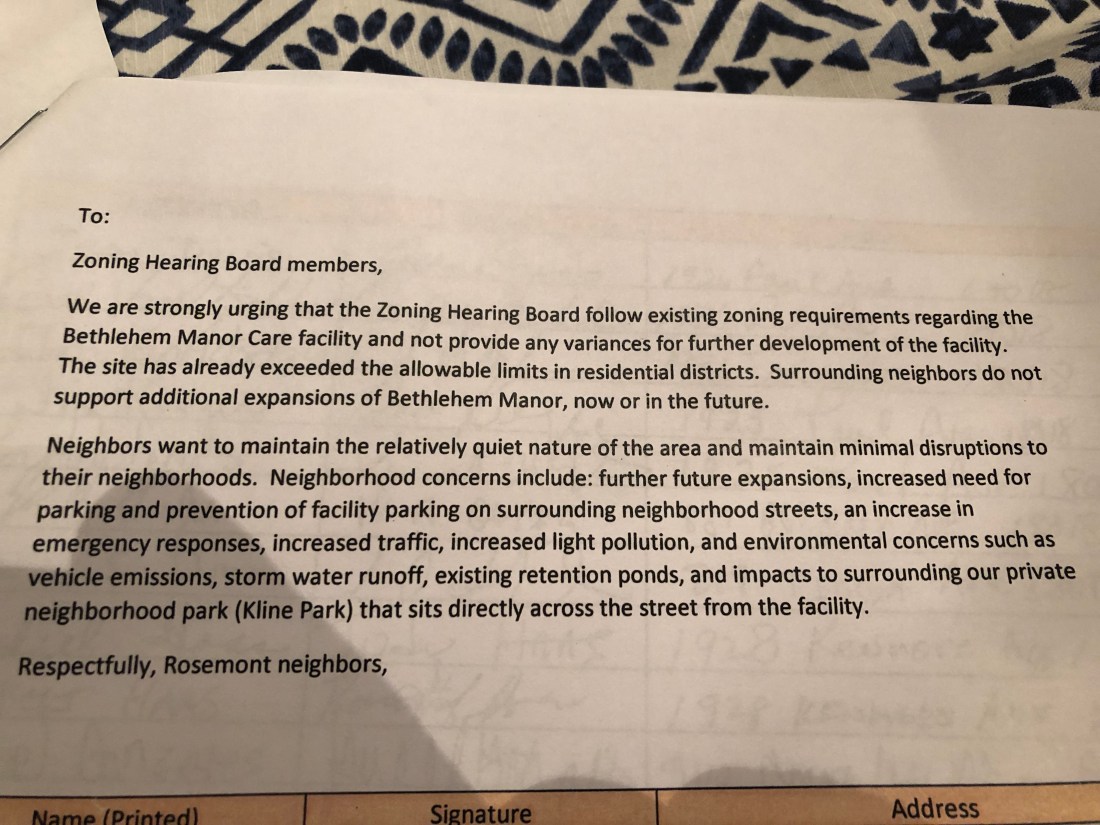
And so, in this case, neighborhood resident Brian Nicas took the initiative to circulate a petition eventually signed by 25 other residents that he presented to the Zoning Hearing Board August 14.

Bethlehem Manor resident petition.jpeg

Gadfly is pleased to offer Brian’s complete presentation on audio and a portion of it on video as an example of the kind of productive citizen participation that he loves to highlight and which stimulated two other neighbors to speak out at the meeting as well (we’ll “hear” from them in later posts).


Bottom line — the residents were successful in this instance. Their involvement and their participation paid off. But in the next few posts let’s look a little deeper at the dynamics of the meeting and understand how the process played out.

O Little Town of Bethlehem Popping Up All Over the Big Big World

(The Gadfly invites your “local color” reflections of this sort***)

Michael Colón is a lifelong Bethlehem resident and enthusiast. He also moonlights as a City Councilman. 

Dear Gadfly,

Now that we’ve closed out another Musikfest that brought people from near and far to our fine city, I wanted to share recent experiences that truly highlight how coincidental life is. Both involve trips out of state; both involve our two colleges.

The first happenstance was last month while I was on a trip out west. One arid, Arizona evening some of my extended family took me out to Sedona to see a desert sunset. Whilst hiking up a large rock, we noticed a young man perched way ahead atop the crag. His father was in earshot of our comments and shared he unfortunately didn’t have his phone to capture this great photo opportunity. My aunt volunteered to text it to him, while asking for his number. “717” he started before we interrupted him. Turns out the family is from Lancaster meeting up with their son while he’s on a one-man road show in a used RV for the summer because he just earned his master’s degree from our very own Lehigh University.  The young man negotiated with his employer, located in Bethlehem Township, to start after Labor Day, allowing him this chance to see the country all summer in his hopefully reliable used RV. As he descended, we had a chance to speak to the young man named Justin. My family and I shared we’re Bethlehem folk too. We wished him well in his travels and career, then continued on as strangers passing on a rock, 2500 miles from home, known to each other only because of the need for a cell phone camera. If his father would’ve had his phone, would we even know that we’ve all come from one tiny area of earth all this way to share this view of AZ together on an even smaller patch of earth?  Likely not.

The second event occurred a couple weeks ago. On a hot Saturday with nothing on the schedule for either of us, my girlfriend and I decided to hit the beach (or go down the shore). We chose Point Pleasant for no reason other than my youngest brother talks about it. We walked up the boardwalk, choosing a beach entrance at random. As we paid to get onto the sand, we were instructed to wait for “one of the guys” who would give us a beach umbrella. Our “guy” working on the beach was a teenager who after telling us to follow him turned around displaying a Moravian College drawstring bag on his back. We immediately shared with the young beach-hand that we’re from Bethlehem. “Is that near Moravian?” he asked. Turns out this 16-year-old Jersey Shore local is the son of someone in a management position at the college. He knew Moravian is a college where his dad worked and that it isn’t close to home. He learned locals from Bethlehem like to tell him about it. After kindly helping us plant our umbrella, he returned to work; my girlfriend tuned out my drumming about how coincidental this was, and I got sunburn on my foot. Out of all the beach towns we chose that one, out of all the beach entrances we chose that one, and out of all the employees helping out we got that one. What are the chances?

I share these stories because I’m fascinated by luck, fate, coincidence, or whatever other word you want to attach to it. We’ll never truly know how many close encounters pass us by, but when we do become aware of the stranger on the desert rock or the kid at the beach, it is a unique experience. Admittedly I’ll always be partial to the ones about our not so little town of Bethlehem.

Thanks for reading, and if you feel so inclined, please share your stories of Bethlehem turning up in unexpected places outside the Valley.

Michael

*** From the Gadfly About page: “Local Color: original creative work with recognizably local Bethlehem subjects or connections — art, poems, mini-essays, vignettes, photographs, songs — that help us see or think about our town and townspeople in interesting ways.” Please do follow Michael’s lead and take him up on his invitation.

Sharing your reading: “hiding” the Polk Street Garage

(109th in a series of posts on parking)
(also 6th in a series about sharing your reading)
(and also relating to walkability too)

Jeff Speck: “Hide the parking structures. Exposed parking structures
do not belong next to sidewalks.”

(Walkable City Rules, 2018)

Jeff Speck: “Design parking structures for eventual conversion to human use.”
(Walkable City Rules, 2018)

You have seen Gadfly gradually resigning himself to the fact of a $16.8m Polk Street Garage though there seem to be significant unanswered questions.

$16.8m.

And turning his attention to its design.

And whining, If we are to have new parking garages, deargod, let them be built with the most modern ideas.”

And wondering if the PSG is being designed in accord with goals other than simply warehousing cars, goals like walkability and Climate Action.

On the latter point, remember the recent letter of the Environmental Advisory Council to the Bethlehem Parking Authority.

Which brings him to Speck again.

Speck speaks of the now common practice of addressing walkability (street life) through  a parking structure with a ground floor of retail.

Note, for instance, that the new New Street Garage has a Police substation and a Southside Arts District office on ground level. Steps in the direction of providing a bit of street life there.

Note, too, widespread talk of the need to liven up in some similar fashion the long stretch of Walnut St. along the Walnut Street Garage when it is repaired or rebuilt.

This is all good, and Gadfly believes the BPA is planning for ground-floor retail with the PSG and is already soliciting tenants.

But Speck suggests that “many cities and developers have moved on to a better solution, which is to set the parking lot back slightly and hide it from view.” In Dallas, for instance, “a ring of apartments hides a large parking lot.”  It is “fully reasonable for cities to require hidden parking, and to stop allowing buildings to place parking up against would-be walkable streets.”

Interesting. Intriguing.

And let’s remember Councilman Reynolds’ good question discussed in the previous post on parking about the impact of ride-sharing and autonomous cars on the need for parking garages in the future. Reynolds — a young man — is kind of wondering if 20-30-40 years from now he and others will be wondering what to do with this damn underused building and why we built it in the first place!

Speck is on the same page with the Councilman:

The other mandate for the twenty-first century is to make parking lots convertible. If ride-hailing services — and eventually AVs — end up drastically reducing the need for parking, as predicted, we will wish that we had built all those parking structures with flat floors, removable ramps, and frames that can support human uses. Smart developers are doing it now.

As usual, all this is above Gadfly’s pay grade. He’s just trying to stir the pot. He’s concerned the PSG will be designed without sufficient public conversation and in isolation from wider community goals relating to the quality of life and long-term issues.

The follower Gadfly mentioned in the previous post has him thinking about bargaining chips. Perhaps a chip toward approval of the fine increase proposal might be assurance that the BPA will provide extensive public conversation over the PSG design and satisfaction that the design meets even non-technical city goals.

If you aren’t reading, you may not be growing. What are you reading these days? How about sharing with us? Gadfly invites you to share a few clips of your reading  — with or without comment — or a few thoughts from your reading pertinent to the Gadfly project of the good conversation about Bethlehem that builds community.

Pennsylvania Avenue Bethlehem Manor expansion denied at Zoning

(Latest in a series of posts on Bethlehem Manor and Neighborhoods)

035.JPG

After being approved by the Planning Commission a month ago, a major expansion of the Bethlehem Manor assisted-living facility in the old Rosemont school on Pennsylvania Avenue was denied by the Zoning Board Wednesday night.

It’s an understatement to call the proposal a “major expansion” — it’s a 70% increase in the number of beds in this residential area setting.

The substantial size of the expansion, coupled with memory of resident agitation over the original approval of the Manor in the school building, jumped out at Gadfly when he stumbled across the notice on the Planning Commission agenda. The proposal had not received any public notice or press as far as Gadfly could tell.

In his last post on this proposal, Gadfly expressed surprise “that such a large increase in this residential area is going down so far so smoothly.”

Several Bethlehem residents with negative views spoke forcefully against the project Wednesday, however, and now Gadfly expresses surprise at the denial by Zoning, which in his experience (admittedly, on the short side) does not seem all that common.

Always anxious to profile citizen participation, Gadfly will provide a more detailed report of this interesting meeting shortly.

In the meantime, please note these two previous posts on the subject to come up to speed.

“Neighborhood Watch: Rosemont Area Alert!”
“Large Bethlehem Manor addition approved by Planning Commission”

Charles Malinchak, “City denies Bethlehem Manor’s plan for expansion.” Morning Call, August 15, 2019.

A plan to build a 54-unit addition to a Bethlehem elder care facility was shot down Wednesday night by the city zoning hearing board. The board’s 3-2 vote denied variances that would have allowed developer Abe Atiyeh’s Bethlehem Manor to build a 2½-story addition to the facility on Pennsylvania Avenue.

Bethlehem Manor was created by converting what was once Rosemont Elementary School after obtaining a variance from the zoning board in 2016 to operate a personal care facility in a residential zone.

Nimita Kapoor Atiyeh, who manages the Bethlehem, Whitehall and Saucon Valley Manors, said after the hearing that the company would appeal the decision. “I am gung ho to keep moving ahead,” she said. “I am passionate about the elderly and I want what’s right for them.”

Kapoor Atiyeh, who is the wife of Abe Atiyeh, testified that there has been increased demand for private rooms, which is why it was decided to move ahead with an expansion.

Fifty-four residents in their rooms will not change the neighborhood,” she said. “I want to give these people the honor and privilege of living out their last years in dignity.”

Several residents spoke out against the project, citing issues of noise from ambulances, its unsuitability to the neighborhood, traffic and the possibility that an expansion would lead to further expansion.

Brian Nicas, who resides in the neighborhood on Tioga Street, presented the board a petition signed by more than 25 residents, all opposed to the addition. “I’m not against health care facilities, I just don’t think it is appropriate for this site,” he said.

Anne Lendzinski, who lives near the facility on Kenmore Avenue, said, “Your facilities work well in Hellertown and Whitehall because they are in mixed-use areas. In our neighborhood it does not work well. Don’t build another building.”

The banning of the ban of single-use plastic bags

(The latest in a series of posts relating to the environment, Bethlehem’s Climate Action Plan, and Bethlehem’s Environmental Advisory Council)

Here is interesting commentary on the (temporarily anyway) banning of the banning of single-use plastic bags, an ordinance proposed by our Environmental Advisory Council and point person Beth Behrend that Gadfly reported on a few weeks ago.

Wait till next year, Beth!

Greg Vitali, “Your View: How a state senator blocked Pennsylvania bans on plastic bags.” Morning Call, August 14, 2019.

In the final days of budget negotiations, a powerful state senator quietly inserted language in a budget related bill that would prevent Pennsylvania from regulating single use plastic bags.

State Senate Majority Leader Jake Corman (R-Centre) inserted a provision in the fiscal code that would prohibit the commonwealth and its municipalities from regulating single-use plastic bags and other containers for one year — ostensibly to allow more time to study the issue.

Sen. Corman’s district includes a single-use plastic bag manufacturing plant — Hilex Poly in Milesburg, Centre County. This plant is owned by Novolex, one of the world’s leading manufacturers of single-use plastic bags. Novolex has lobbied against plastic bag regulation in other states.

Given the backdrop of these national, state and municipal plastic bag programs, Corman’s assertion that another year of study is needed before Pennsylvania or its municipalities should consider enacting plastic bag regulations lacks plausibility. To the contrary, Corman’s actions are consistent with a continuing, parochial effort to protect the Novolex plastic bag manufacturing plant in his district.

Legislation to prevent plastic bag regulation has been opposed by most Pennsylvania municipal associations, including the Pennsylvania Municipal League, The Pennsylvania State Association of Township Supervisors and the Pennsylvania State Association of Boroughs. Local governments want the tools of plastic-bag fees and bans to help them deal with local problems such as litter, the clogging of storm drains and sewers, and the stressing of landfills.

Much-needed plastic bag regulations will be prevented or delayed because our elected officials in Harrisburg have allowed the actions of one powerful senator to carry the day.

Grading the Parking Authority responses

(108th in a series of posts on parking)

You can never take the prof out of the Gadfly.

Thinking forward to the probable re-appearance of the Bethlehem Parking Authority at the August 20 City Council meeting to finalize the Polk Street Garage financial matters ($16.8m . . . $16.8m . . . $16.8m) and to propose increases in the fine structure, Gadfly is thinking back to their first appearance at the July 2 meeting.

And he would like to say something about BPA responses to questions from Council members, something that will help explain his personal unease with the BPA and at the same time also help give you an idea of your Council members at work (which is one of the Gadfly project missions).

First, the questions from Councilwoman Van Wirt. Listen in:

PVW here is concerned about contract parking rates in the garages. PVW — the scientist (among other things, of course) — tends to ask clear, crisp, direct questions. In this clip she asks just such a question: “Can someone tell me why we aren’t pricing these spots according to the market?”

BPA does not answer directly. This is the kind of thing that drives Gadfly crazy. Gadfly would teach his students that the proper format response to this question is “We aren’t pricing these spots according to the market because __________________.” A direct question begets a direct answer before any contextual or explanatory information. Instead BPA muddles the answer. Gadfly calls this gobbledygook when he reported on the meeting a month ago.

Another indirect question in this clip — “I would assume that the demand in Bethlehem is commensurate with other cities our size” — receives the same off-center response. Is or is our demand not commensurate? Gadfly is not sure he knows after the BPA response.

Another example, which Gadfly finds humorous:

PVW asks another clear, crisp, direct question: “If something catastrophic happens . . . and you can’t pay [each of the three loans] . . . which one would you pay first?” The very next words from BPA — as Gadfly would counsel his students — should be “The one we would pay first would be ________________. ” And then any contextual or explanatory information. Instead what we have is gobbledygook again. Gobbledygook so bad, in fact, that PVW has to ask “Can you put that in simpler terms for me?” Now that’s funny. Though not to the quite serious, quite focused PVW.

This kind of lack of clarity is one of the things that has bothered Gadfly throughout his observations of BPA. It does not inspire a sense of trust. It makes Gadfly’s head spin sometimes. BPA is often hard to pin down. There’s a haze that hovers over much of their communication.

Second, the questions from Councilman Reynolds.

When Gadfly reported on this interchange earlier, he said that “JWR raised some interesting long-term, wonkish, ‘10,000 feet up’ questions quite characteristic of his wide-ranging approach to gathering information.”

One had to do with the impact of ride-sharing and autonomous vehicles on parking demand.

Gadfly found that a very interesting and important question — after all, think of that $16.8m and a garage 1/3 filled 20 years from now — and, surprisingly, found BPA’s answer very focused. Perhaps because the question goes to the very heart of parking industry existence.

A good question, indeed.

And BPA was prepared with a focused answer.

One that justified the $16.8m expenditure.

Interesting.

But perhaps JWR would have done well to be more skeptical in his acceptance of BPA’s answer, though he made a credible point about our population growth.

Jeff Speck (2018) — whom you know Gadfly has been reading and whom Gadfly now considers a member of the family — writes, “Whether a city should build any new downtown parking structures is a good question. . . . Given the onset of ride-sharing services and, eventually, autonomous vehicles, the answer is most cases is probably no.”

The parking industry representative had a stock justification of his existence and of a $16.8m outlay at the ready.

Other experts might not agree.

Gadfly is not sure you would want to base your faith in the future of parking garages solely on the opinion of a guy whose job it is to build them.

Another idea relating to the Parking Authority proposal to increase the fine structure

(107th in a series of posts on parking)

Back to the thread on the Bethlehem Parking Authority and the Polk Street Garage.

Remember that the BPA will probably attend City Council next Tuesday August 20 to present their final financial statement on the Polk Street Garage and to propose a schema for increasing the parking fine schedule.

If — as certainly supposed — the BPA still proposes to fund a $16.8m Polk Street Garage by a private loan rather than a city-backed (us) bond, then City Council has no say and the financial statement will be presented for information only. There was some static from Councilwoman Van Wirt earlier when the draft financial statement was presented, and Gadfly has some unanswered questions potentially undermining the fundamental validity of the project, but, as Gadfly understands it, the BPA can basically go its own way here.

Remember, the garage is $16.8m.

We have to keep saying that.

$16.8m. $16.8m. $16.8m.

And the BPA can go it alone.

It may be alright, but Gadfly would sure like to be surer.

But Council does has power over the parking fines. The Mayor has already approved meter rate increases that went into effect January 1.

By the way, have you noticed that meter increase — from $1hr., for instance, to $1.50/hr.?

Just so happens that my barber yesterday was “hot” over the increase and said others were. Though I have heard no comments directly.

The BPA plans to propose again the fine rate schedule that they did late in 2018, in which, for instance, a current $10 fine would be raised to $15 — though — and this is the interesting element in the request — they do not immediately need the extra revenue to finance the new garage.

They will be asking for money that at the moment they don’t need.

But, again, here, when it comes to fines, Council does have the controlling power.

Gadfly examined the situation earlier and concluded that Council most likely will agree to the rate schedule proposed by the BPA. So that we will see fine increases that, 9 months belatedly, will rise symmetrically with the meter rates already in effect.

Dana Grubb, however, proposed a rollback plan. Gadfly was going to do some English-prof mathematics to see what that might look like but hasn’t gotten around to it yet. Bad Gadfly.

But another Gadfly follower mentioned the possibility of approving increased fines if the BPA would institute variable rate parking, an idea suggested by residents last year, taken up by the Mayor, and for which the BPA has now hired a consultant. As the term suggests, parking meter rates would not be uniform across the city but could vary in different locations and at different times. Apparently the meters we now have can perform variable rate parking. We have the technology but have not used it yet.

Coincidentally, Jeff Speck (2018), the guru Gadfly followers will recognize he has been reading lately in regard to affordable housing, recommends variable rate parking:

When parking is too cheap, parking gets too crowded. . . . For a downtown to function rationally its parking must be priced rationally. This means that price must reflect value, with the most desirable spots getting the highest price. In many places, this price should vary around the clock to reflect changing demand.

This might mean, for one instance — if Gadfly understands correctly — that parking on a Friday night in Northside downtown would cost more than it would on, say, Tuesday morning because of the higher demand.

Gadfly is not sure whether going to VRP has a financial consequence or that its primary purpose would be fairness — for he remembers residents in outer fringe parts of meter territory (West Side?) complaining about why their meter rates had to be the same as downtown.

Gadfly thinks the follower who suggested this was thinking of using implementation of VRP as a bargaining chip with BPA for approval of their fine proposal.

Ahhh, Gadfly wishes he could think politically.

Southside sights

(The latest in a series of posts on the Southside)

Gadfly is just catching up with this notice of a new eating establishment in the new 3rd and New building (is it still called Gateway at Greenway Park?).

Eat like an Egyptian
https://eategyptian.com/locations/

012

Looks like it may fill the third retail space from the corner heading up (south) New toward 4th Street.

015

Wonder what’s happening with the other spaces — especially the corner one, which you would assume is the flagship location.

Seem like a long time with no action here?

One also can not help but notice the trash storage area at the entrance to the Greenway. Uck. Would assume that something is in the works for dealing with this unsightliness better in the streetscape plans for this stretch of New St.

005

“Can I get an amen?” says Dr. Roy

(25th in a series on Education and Charter Schools)

This article, though targeted at Allentown’s charter school controversies, reflects the Governor’s response to problems we’ve followed here on Gadfly from discussions with our BASD boss Dr. Roy.

Jacqueline Palochko, “Gov. Tom Wolf calls for charter school changes that could ease Allentown schools deficit.” Morning Call, August 14, 2019.

Gov. Tom Wolf called Tuesday for changes in the special education and cybercharter funding formulas that, if adopted by a reluctant Legislature, would save Allentown and other financially strapped school districts millions.

Calling the charter school law “flawed” and “outdated,” Wolf told reporters in Allentown he also is instructing the state Department of Education to develop new regulations that would allow districts to limit student enrollment at charters that do not provide a “high-quality” education, and to boost oversight over charter school management companies.

Democrat Wolf’s call for changes in reimbursement formulas dictating how much public school districts must pay charter and cyberschools for students would save districts like Allentown, now facing a $6 million deficit, millions.

But passage in the Republican-controlled state Legislature, which created the charter school system, is far from guaranteed.

Ana Meyers, the executive director of the Pennsylvania Coalition of Public Charter Schools, called Wolf’s proposals “blatant attacks on charter schools.” Meyers also claimed that Wolf could be abusing his authority through executive order and regulatory action.

At Harrison-Morton Middle School, Wolf said he wants a “level playing field” for all charter and public schools.

Besides proposing a legislative change in the areas of special education funding and cyber charter tuition payments, Wolf is also asking the state Department of Education to develop regulations to:

Allow districts to limit student enrollment at charters that do not provide a high-quality, equitable education to students.

Require transparent charter school admission and enrollment policies that do not discriminate based on intellectual or athletic ability, race, gender or disability.

Ramp up oversight of charter school management companies.

Establish a clear process that requires charters to accurately document their costs and prevent charters from over-charging districts for educational services.

Bethlehem Area Superintendent Joseph Roy, a vocal critic of charters, began his comments with: “Can I get an amen?” Roy called charter school and traditional public school funding a “separate and unequal system.”

Finding H. D. — Funding H. D.

(23rd in a series of posts on H.D.)

Finding H.D.:
A Community Exploration of the Life and Work of Hilda Doolittle

Bethlehem-born writer Hilda Doolittle — H. D. —  (1886-1961) is
the “Lehigh Valley’s most important literary figure.”

What a difference one letter makes!

So Gadfly went all in for a donation to the GoFundMe for Angela Fraleigh’s commissioned portrait for the Bethlehem Area Public Library described to you in his last post on H. D.

He dug up a Chef Boyardee spaghetti can with cash in it planted in the backyard for safe-keeping during the Cold War and peeled off $100.

That figure shouldn’t scare you.

Just $5 – $10 each from certified, card-carrying Gadfly followers would seal the commission. More, of course, would be welcome.

Now if we and others don’t come through financially, it’s true that we have adorable options.

Just look at these contributions from H. D. fans among kid library patrons!

H. D. kids 3

But don’t let the kids out-do us.

Go to http://www.bapl.org/hd/ for information on how to donate either by check or online.

Finding H.D.:
A Community Exploration of the Life and Work of Hilda Doolittle