Need for a reality check on climate change

Festival UnBound
Ten days of original theatre, dance, music, art and conversation designed to celebrate and imagine our future together!
October 4-13

(The latest in a series of posts relating to the environment, Bethlehem’s Climate Action Plan, and Bethlehem’s Environmental Advisory Council)

Bruce Haines is a Lehigh graduate who returned to Bethlehem after a 35-year career at USSteel. He put together a 12-member Partnership to rescue the Hotel Bethlehem from bankruptcy in 1998 and lives in the historic district.

Gadfly:

With regard to the Student strike for climate change. When is someone going to put some sanity into the climate change mantra? They are espousing to kill the goose that laid the golden egg!!

Our country’s leaders strategically unleashed the fossil fuel industry about 40 years ago to make us energy independent from the grip of the oil cartel in the Middle East as you will recall. Remember the long lines at the gas pumps & sky high energy prices? We finally just now have achieved energy independence thru the creative investments in technology to include lateral drilling & fracking. The industry succeeded in driving down prices by increasing supply—Economics 101!!

Now Bernie Sanders & Elizabeth Warren want to lock up the leaders of the industries that spearheaded this initiative. Prices of fossil fuels have been driven to unprecedented low levels to allow America to become world competitive & actually bring back lost manufacturing from offshore. Manufacturing relies on energy & brings higher paying jobs than the service industries fostered during the Bush/Obama administrations.

Low-cost Natural gas is replacing both coal & oil as the primary fuel for power plants as well as other energy consumption. This is resulting in dramatic reductions in CO2 emissions here in America at a same time of unprecedented economic growth.

Solar & Wind energy is clearly a minor player today & a long term supplemental energy source as it is unreliable & requires massive storage capacity to provide consistent power.

Killing air travel & cows is a wild pipe-dream that would destroy our economic leadership in the world & cost jobs for inner city minorities & for average Americans trying to rise above the middle class.

There needs to be a reality check with these preposterous proposals from our politicians in addition to the brainwashing of our youth in our schools. They clearly aren’t being taught enough history & economics. The leaders espousing elimination of fossil fuels clearly missed these classes along the way or simply want to control our freedom of choice.

Bruce

Gadfly would like to keep our attention on local issues, and Bruce will soon follow-up with comments on our in-process Climate Action Plan.

Festival UnBound

New development in the City: there is a difference between “anything goes” and thoughtful planning

Festival UnBound
Ten days of original theatre, dance, music, art and conversation designed to celebrate and imagine our future together!
October 4-13

(First in a 4-part series of posts on thoughtful planning by Kim Carrell-Smith)

Kim Carrell-Smith is a 31-year resident of Bethlehem’s historic Southside, where she taught public history at Lehigh University for almost two decades. She is also an aspiring gadfly, buzzing in on issues of historic preservation, public education, city government, and other social justice issues. She tips her wings to the master gadflies who have served our community for so long!

Gadfly: As so many residents, city officials and business folks have noted, new development can be good for the city, and is necessary for our tax base. But a few of us have added a caveat: there is a difference between “anything goes” and thoughtful planning.  The future of our city should be based on sound practice that considers the latest data and research.

Is there a sound alternative development vision to the glitz, glass, mass, and height typical of new project proposals that have been announced lately in Bethlehem?  As the Infill Development Standards and Policy Guide (developed for the state of NJ by the Rutgers Center for Urban Policy Research and the University of MD’s National Center for Smart Growth and Education) has noted, successful infill projects in cities should be “context-sensitive.”

The context in Bethlehem is HISTORICAL.

So, could preserving the historical ambiance and human scale of our city — while pursuing creative development and redevelopment projects—also bring value, tax money, jobs, feet on the street, new businesses, tourists, and increased property values to Bethlehem?  The answer is yes, and there is plenty of evidence to support that.

If you can hang on for the ride, I can introduce you to a raft of studies, first via one hyperlink (that list ought to keep everyone out of trouble for a few days). But after that I promise to discuss the highlights of two studies that are particularly applicable to the current development climate in Bethlehem.

Want LOTS of state, local, and regional evidence? Stick with me; this shouldn’t be too painful. Just one link first.

This is a hyperlinked list of studies from 28 states, 12 cities, and a few National Heritage Areas (like our D&L) which all examined the impact of historic preservation on the local economy. The information in these studies is based on solid data and good research done by professional planners, data and policy analysts, and academics (urban planners, business professors, economists), and lawyers, most of whom belonged to two different top teams of consultants: one firm was the highly regarded real estate and economic development firm PlaceEconomics, and the other consulting group was the equally well known Center for Urban Policy Research at Rutgers.

  • The vast majority of these studies indicate that maintaining the historical integrity of cities can and does enhance property values, creates jobs, expands the tax base, attracts visitors and/or new residents, and puts “feet on the street.” Each city, state, or regional study provides strong evidence for such assertions.

So there IS an alternative way of thinking about “progress!”  I promise fewer studies, but fascinating findings, in the next installment . . .

Kim

Festival UnBound

We need the city to adopt a resolution declaring a climate emergency

Festival UnBound
Ten days of original theatre, dance, music, art and conversation designed to celebrate and imagine our future together!
October 4-13

(The latest in a series of posts relating to the environment, Bethlehem’s Climate Action Plan, and Bethlehem’s Environmental Advisory Council)

Peter Crownfield is officially retired but spends most of his time working with students in his role as internship coordinator for the Alliance for Sustainable Communities–Lehigh Valley.

related story: Justine McDaniel, “In Pennsylvania, a lot of talk and no action on climate change, experts say.” Philadelphia Inquirer, September 23, 2019.

“It’s Sunday, September 22, do you know where your local Climate Action Plan is?”

I wish I did, Gadfly!

The city issued an RFP for climate a action planning that was due over 2 months ago. (I was told that 4 proposals were received, but the City has refused to make the proposals public.) And they have not yet awarded a contract.

We need the city to adopt a resolution declaring a climate emergency and to direct all departments and employees to mobilize an all-out effort to reduce GHG emissions and to involve the entire community; the resolution also should call on businesses and educational institutions to do the same. ‘Business as usual’ is not acceptable.

BASD adopted a Climate and Sustainability Commitment over 5 years ago, but have not reported any significant progress on fulfilling the commitment. (The facilities department had already done an outstanding job of reducing energy use, even before the Climate and Sustainability Commitment was adopted.)

In the meantime, teachers in every subject area and every grade level can find ideas for teaching climate change by looking at the Teacher Guide section at teach-climate.net. Zinn Education Project also has some excellent resources for teachers.

Parents & students should demand that schools give appropriate attention to the climate emergency!

Peter

And now it’s Monday, September 23,
do you know where your local Climate Action Plan is?

Festival UnBound


Recommending this blog on sustainability by a Bethlehem native

Festival UnBound
Ten days of original theatre, dance, music, art and conversation designed to celebrate and imagine our future together!
October 4-13

(The latest in a series of posts relating to the environment, Bethlehem’s Climate Action Plan, and Bethlehem’s Environmental Advisory Council)

Gadfly has started to follow the Radical Moderate blog by Alison Steele, a Bethlehem native and Liberty grad: “The purpose of this site is to document my exploration of different ways to reduce my own footprint.”

Alison is Director of Community Programs & Advocacy at Conservation Consultants, Inc. in Pittsburgh.

Her recent post is on a climate change scarf!

Gadfly remembers that Brian Hillard of our Environmental Advisory Council (EAC) met her on the conference circuit and reported on their conversation.

Give the work of this local daughter of “former-hippie parents” a look!

It’s Sunday, September 22, do you know where your local Climate Action Plan is?


Festival UnBound

Student climate strike in Bethlehem (and around the world)

Festival UnBound
Ten days of original theatre, dance, music, art and conversation designed to celebrate and imagine our future together!
October 4-13

(The latest in a series of posts relating to the environment, Bethlehem’s Climate Action Plan, and Bethlehem’s Environmental Advisory Council)

Gadfly couldn’t attend. Comments invited from those who did. Did followers have any kids or grandkids who were there?

Sarah M. Wojcik and Kayla Dwyer, “Global Climate Strike inspires Lehigh Valley residents, students to rally against inaction on climate change.” Morning Call, september 20, 2019.

Madison Bold doesn’t see how her attendance score in high school is going to matter if a threat as massive as climate change is left unchecked. Bold, 16, a sophomore at the Lehigh Valley Charter High School for the Arts, was among about 20 students who left class Friday to join protesters of all ages in Bethlehem’s Payrow Plaza as part of the global climate strike, inspired by a Swedish girl the same age as Bold. Millions attended the event around the world, including a handful of locations around the Lehigh Valley.

At Lehigh University’s front lawn in Bethlehem’s South Side, students used a bullhorn to persuade peers to join them in their march to City Hall. There, Lehigh students joined more than 150 others gathering to show support for action on climate change. “Skip your classes! Save the planet! Join millions!” organizer Connor Burbridge shouted to students shuffling past. A few stopped to watch before moving along, but more and more found their way into the growing cluster of students.

Even so, the turnout – roughly 100 by 1:30 p.m. when the group marched across the Fahy Bridge to Payrow Plaza – thrilled organizers. Oliwia Krupinska, a Lehigh senior studying astrophysics, had no sense of the response at the university. The event was organized by various groups in an intentionally decentralized fashion, but that made it hard to understand the reach.

Students called on each other to make small, personal changes to effect change: Drive less, cut down on meat consumption, start composting. Students were encouraged to refrain from viewing the issue from a partisan lens and take ownership in whatever parts of campus or community they are – be it in their communication classes or mechanical engineering courses.

Student leaders also called on Lehigh University to enact policies and practices, such as banning single-use plastic on campus and divesting university finances from the fossil fuel industry, to combat climate change.

“It’s our job to hold our own school responsible,” Krupinska told the students gathered.

A group of environmental policy graduate students said they had no classes during the planned march. But given their course of study, suspected they’d get in more trouble if they didn’t join the mobilization.

“This is also about showing solidarity with youth around the world,” Clopton said. “I think it’s important that Lehigh and little cities like Bethlehem join this conversation. It’s just as important for places this size to stand up and fight back.”

“This gets people together to network and start conversations,” he said. “And for young people, getting them this experience is important. Chanting can be contagious. Once you do it, people want to come back to it. We all have it in ourselves to be leaders.

It’s Saturday, September 21, do you know where your local Climate Action Plan is?

Festival UnBound

Widening the circle of commentary on Garrison St.

Festival UnBound
Ten days of original theatre, dance, music, art and conversation designed to celebrate and imagine our future together!
October 4-13

(5th in a series of posts about 11 and 15 W. Garrison St.)

After the Garrison St. neighbors spoke, two champions emerged for their cause.

Bruce Haines

Haines is a litigant in the latest chapter of the highly divisive 2 W. Market St. issues that Gadfly has covered extensively (see the link to 2 W. Market on the sidebar) and sees this issue through that lens as another example of “true commercial intrusion” into neighborhoods tacitly then visibly supported by the City. The developer has a “great project,” but it’s in the wrong location. Striking to Gadfly is the practical point that a vote yes is a vote for an open door. Since the rendering of the project shown at the meeting is only tentative, the final project could be “anything,” a fate Haines underlines with some nasty examples. “This is about integrity,” Haines says, and repeats it so often that Gadfly looked up the definition to make sure he knew what Haines saw as the transcending issue: “firm adherence to a code of especially moral or artistic values.”

  • This is a deja vu all over again.
  • Remember 2 W. Market St.? This is commercial intrusion into residential neighborhoods. It’s plain and simple.
  • Except instead of being in the historical district, it’s a wonderful community on Garrison St.
  • It’s a community. It’s a neighborhood.
  • Certainly that’s a great project [the developer’s], as they even acknowledged, on New St. and around to the commercial business district as it exists today.
  • There’s not a house on that street that fits the variances and the codes, but at the end of the day, they are all residences.
  • So, how familiar is this? Here we have an individual coming to redo a zoning change again. We don’t have the City endorsing it. They’re sitting neutral. They’ll wait till the 11th hour like they did for 2 W. Market St., and then they’ll weigh in to make sure you understand how you’re supposed to vote.
  • And are we then pretty soon going to have Sand Island named after Mr. Connell or his business?
  • What we’ve got here is true commercial intrusion.
  • I really feel for these neighbors, and I’m going to stand up for them.
  • Because if you go ahead with this, you are marching down the the exact same path you marched with 2 W. Market St.
  • Now we are hearing the CB [Central Business district] . . . doesn’t apply on a local street so on Garrison she [City Planning administrator Darlene Heller] didn’t tell us what could go there . . . the largest bar and restaurant in the city . . . the biggest Hookah lounge, the biggest tattoo parlor . . . who the heck knows.
  • I think this is a great project. I’m not here not supporting a great project for the City.
  • Just put the project in the district where the project belongs which is the Commercial Business district, and leave these neighbors alone, and leave their businesses alone.
  • So what this is about is the same as 2 W. Market St., and if you keep going down this path, it’s about integrity.
  • This is about integrity. The whole thing is about integrity. It’s the integrity of our zoning code, which [the City administrator] won’t stand up to defend . . . It’s the integrity of our neighborhoods, and it’s about integrity of government.
  • You’re marching down the same path that will have you in court for 5, 7 years, the same as you’re going to be for 2 W. Market St.
  • This is a travesty, and you guys should need to squelch this from the beginning.
  • Not only that, you’re buying a pig in a poke. You’re going to change the zoning  . . . and you don’t even know that you’re going to get this project.
  • Once it’s CB, it can be anything.
  • We know that the majority of Council believes that economic development outweighs neighborhoods.
  • If you were to approve this CB without it being attached to this project or conditional . . . you’re really done a disservice to this community.
  • [applause]


Stephen Antalics

Looking and sounding much like an Old Testament Jeremiah, Gadfly #1 speaks, as he always does, with rhetorical and moral brevity and clarity: whose will should Council serve, the public or the private? There’s the question that applies to not only this case but to a span of cases this Gadfly #00 has covered over the past year. To Antalics, the answer is self-evident.

  • There’s an old adage that says government of, for, and by the people, and it seems that’s been lost.
  • It’s almost like governance in spite of the people.
  • Bruce [Haines] is exactly right. The key word is integrity.
  • Integrity is expressed when the will is recognized and supported.
  • It then becomes whose will.
  • We have on many occasions intelligent concerned people who love the City come here and testify after intensive research why something shouldn’t happen.
  • But the people come forth who have private interests, which is fine . . . as long as private interests do not impinge upon the will of the people, the people who chose you to represent their interests.
  • So the question is, whose will are you going to serve?
  • And this question has come up much too often.
  • The will of the people or a private individual.
  • My sympathy for these people who spoke, because they represent the core of the City, decent people who love the City, and enjoy living in the City.
  • And what you can be doing here is depriving them of their way of life, uprooting them, forcing maybe some to move out of the City because they came here for that simple reason.
  • So, I think it’s very clear what has to happen here.

So, “where’s your head at” on the rezoning of the houses on Garrison St.?

Festival UnBound

Student Climate Action strike today, Payrow Plaza — can anyone go and report?

(The latest in a series of posts relating to the environment, Bethlehem’s Climate Action Plan, and Bethlehem’s Environmental Advisory Council)

Many Gadfly followers are committed to action on Climate Action. Student strike event today at 2PM Payrow Plaza.

Gadfly would like to cover but can’t make it.

Could one or more followers attend, participate, and send comments for posting here?

Michelle Merlin, “Lehigh Valley climate strikes planned for global day of action.” Morning Call, September 20, 2019.

  • Ashley Barrasso, a student and the president of the Climate Action Network at Northampton Community College’s Bethlehem campus, is also hoping people take note of the climate strike, including one at Payrow Plaza in Bethlehem.
  • She was inspired by Thunberg’s trip across the Atlantic, and realized that her group needed to participate in the global climate strike. One will take place at NCC’s campus from 10 a.m. to 1 p.m., and another in front of City Hall from 2 p.m. to 4:30 p.m. Lehigh University students are also planning a strike at 1 p.m. on campus and will move to Payrow Plaza.

It’s Friday, September 20, do you know where your local Climate Action Plan is?

The Garrison St. neighbors respond (2)

Festival UnBound
Ten days of original theatre, dance, music, art and conversation designed to celebrate and imagine our future together!
October 4-13

(4th in a series of posts about 11 and 15 W. Garrison St.)

Garrison St.

More beautiful Bethlehem voices–

Voices worrying about practical things like damage to foundations in an area in which there was a sinkhole, but mainly worrying about damage to community, serenity, peace, safety, beauty — yes, beauty (who’s in charge of Beauty in Bethlehem, Gadfly has asked).

Julie Cordero (17 W. Garrison)

  • It’s a safe place to live. It’s an affordable place to live.
  • I have two kids in the Bethlehem School district who walk to school.
  • How does breaking ground affect my foundation and foundations down the street?
  • My house is my heart, my home.
  • I don’t really see that as a feasible option to break ground for a 74-space parking garage . . .
  • I’m a disability advocate . . . we have people on our street who have wheelchairs and are on walkers. You gonna shut down Garrison St. [during construction] and make everyone walk?
  • Is this street going to be closed down for weeks on end?
  • Housing for veterans . . . I’m all for that . . . if it doesn’t carry on into Garrison St. which is a well-established family neighborhood.

Vanessa Torres (23 W. Garrison St.)

  • I come from New York. I left New York to get away from high-rises and buildings.
  • I left New York city to be in a calm, beautiful environment, and I love my neighbors, and I know everyone’s name,
  • But for that I just move back to New York city, a high-rise with so many families, such a busy environment.

_____ Toledo (18 W. Garrison)

  • I like a family.
  • We have community there.
  • We’re not going to feel safe there.
  • [Now] all the kids are outside playing, and we feel safe there.
  • So if there are two big buildings across the street, I know a lot of us won’t feel safe there.
  • [she speaks for others in the audience]
  • applause

Chewing? Next, comments from a couple of resident gadflies, who do not live in the neighborhood.

Festival UnBound

The Garrison St. neighbors respond (1)

Festival UnBound
Ten days of original theatre, dance, music, art and conversation designed to celebrate and imagine our future together!
October 4-13

(3rd in a series of posts about 11 and 15 W. Garrison St.)

Five Garrison St. neighbors affected by the zoning change proposal testified against it. Let’s look at the first two here: Lauren Miller and Mark Wood.

Gadfly hopes you will take full advantage of the video and not just browse the excerpts. You know Gadfly loves and respects the way Bethlehem residents comport themselves in these situations. Good examples here.

Lauren is emotional and speaks to ideals. Mark is straightforward and practical.

Put yourself in the position of the Councilmembers receiving this testimony. We always must remember that the developer has rights too. He doesn’t act or sound like a devil with horns. Tough decision. That’s why they get the big money (joke, remember Council is a part-time job and not especially well paid given the time and responsibility).

Think about what you would do. And why.

But wait a couple posts till you hear all the testimony. That’s the Gadfly way.

Lauren Miller (11 W. Garrison)

Lauren had a written text (Miller Re-Zoning Council Meeting), but she spoke forcefully and extemporaneously as well. Gadfly’s excerpts below come from both her prepared and extemporaneous words. There are several potential t-shirt slogans here!

  • I’m here for the best thing for our community.
  • If I would get what I wanted, I would say no to the changing of the zoning of my house.
  • I don’t want to live for what I want, I want to live for what is best for everybody.
  • Beautiful brick homes — just to build something new, I’m against that. I’m against tearing down something old to make something new for economical prosperity.
  • The house that I live in has beautiful windows that will probably never be made again in our time.
  • The brick building next to me . . . there’s a hidden door for when servants . . . used to take care of the household . . . a historical beautiful building.
  • My heart is to preserve what is old and to take care of it.
  • LOVE has been a part of transforming our block. Loving your neighbor as yourself transforms a block. It doesn’t matter what you build on a corner, if love isn’t there. It doesn’t matter how many businesses come in that raises the economy growth.
  • Loving one neighbor at a time will change our community, America and the world.
  • I don’t know what is best for our town and our growth in regards to what we decide to build.
  • The second leading cause of death in America is suicide, and it’s the highest in our teens. The neighborhood kids come over to my house, and I help them with their homework. Can we be a community that does that for our neighbors.
  • I know that when I live in the City in Philadelphia and there was a big building, nobody had time for each other, people just went from left to right, and no one had time just to have dinner with each other. This community has been starting to do that. And I hope to grow it more.
  • I want to live there, and I want to be a part of building this to be a family community.
  • Something special is happening on Garrison St. It’s just the beginning of something beautiful.
  • The community on Garrison St. is a family community. It’s a place where we have time to sit on our front porches and see how our neighbors are doing. That is something worth preserving. That is something worth caring about.
  • Great things are happening in this neighborhood, and bringing forth more housing to overpopulate this neighborhood will change the culture completely.
  • If you visit our community on Garrison St., you will find that it’s a place like the show ‘Cheers.’ It’s a place where everyone knows your name and sadly that’s a rare thing to find anymore.
  • Building a huge apartment complex on this corner will completely change what this community is about.
  • My question for this City is what matters most to them? Does the community and the people that reside here matter, or does ‘economical prosperity’ matter more?

Mark Wood (14 W. Garrison)

  • You’re looking at 120ft. as opposed to regular 2-story houses.
  • And the other problem I have is parking.
  • [The building is] not going to fit in that neighborhood. It’s going to look out of place.
  • If there’s a way that you can guarantee that the parking won’t suffer . . .

So chew on these testimonies. We’ll listen to several more neighbors next.

Festival UnBound

The developer plans for Garrison St.

Festival UnBound
Ten days of original theatre, dance, music, art and conversation designed to celebrate and imagine our future together!
October 4-13

(2nd in a series of posts about 11 and 15 W. Garrison St.)

Garrison St.

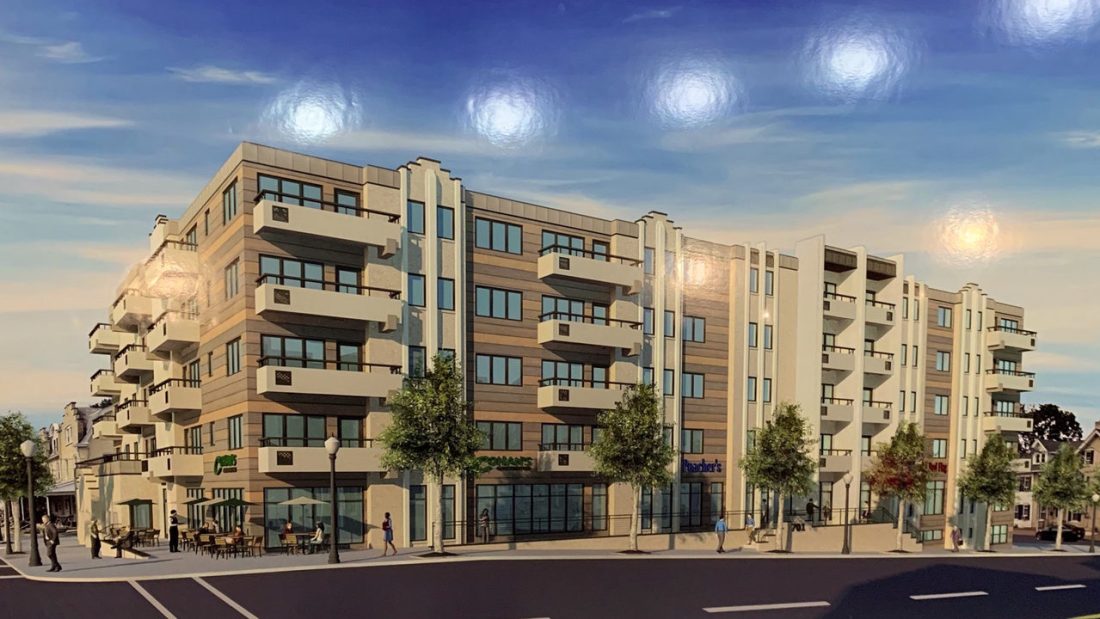
The developer seeks rezoning of two residences on Garrison St. as part of a proposal for a 5-floor mixed use building with first-floor commercial + 70-some apartments along New St. between Garrison and North.

Gadfly likes to have an image of the developer (a devil with horns?). The developer’s name is not familiar, but he must have been “at work” for a good while to accumulate that concentrated block of properties. Let’s take a look as he makes his brief presentation at Tuesday night’s Council hearing.

The developer owns the entire 700 block (sigh! makes you feel insignificant, doesn’t it? Gadfly’s house is 20ft. wide) of west New St and the two houses 11 and 15 W. Garrison.

The houses on New are zoned Central Business District, the Garrison houses residential.

The Garrison houses were CB but changed to residential in 2005. The developer’s asking to change them back.


Most of us have not witnessed a public hearing on a Zoning proposal, so let’s take a look at the interaction between Council and the developer to get a sense of the kind of questions that are asked and the kind of concerns there might be.

Especially regarding impact on the existing neighborhood.

We learn that the first floor must be “retail, restaurant, or personal services.”

Though there is the rendering of the project shown above, no specific plan has yet been officially submitted.

As the developer says, he is “early on” in a project — a “journey” — of many steps. He’s at “the very first step.”

So he was a bit vague about some details. For instance, the height of the building.

Parking (a reasonable amount of parking as a convenience) and a certain type of construction (reasonable cost) will limit the height, he said in response to concerns.

He has looked at the City Comprehensive Plan (nice!) and is following a desired use found there in the Center City area: high-density residential.

What kind of tenants does he seek? He’s working with a marketing and financing group doing a demographic study, but he did mention the possibility of federal government programs for veteran housing (some visible signs of sympathy for that).

See approx. minute 10 for Councilwoman Van Wirt raising concern for the integrity of the Garrison St. block.

Yes, that’s what we should think about next.

Festival UnBound


Celebrate Bethlehem’s great native artist Hilda Doolittle in this new play, part of Touchstone Theatre’s “Festival UnBound”

(27th in a series of posts on H.D.)

Finding H.D.:
A Community Exploration of the Life and Work of Hilda Doolittle

Bethlehem-born writer Hilda Doolittle — H. D. —  (1886-1961) is
the “Lehigh Valley’s most important literary figure.”

dollar sign

Contributions to fund the museum-quality portrait of H. D. by local artist Angela Fraleigh that will hang prominently in the library are REALLY lagging. Can you please help? Visit http://www.bapl.org/hd/


Doug Roysdon’s marionettes are fabulous — don’t miss!

H. D. marionette
World Premiere!
“The Secret”
A New Mixed-Media Play about H.D.
by Mock Turtle Marionette Theater
Sat Oct 5, 5 pm with talkback at 6:30 pm
Sun Oct 6, 1 pm with panel discussion at 2:30 pm
Mon Oct 7 @ 7:30 pm
Tues Oct 8 @ 7:30 pm

Touchstone TheatreFestival UnBound
321 East 4th Street, Bethlehem
From artistic director of Mock Turtle Marionette
Theater and chief writer Doug Roysdon, featuring
narrative, song, and puppetry. Directed by 

The Play:  The Secret begins one day, in late nineteenth century Bethlehem, when sixteen year-old, Helen Wolle, mother of H.D., entered a Moravian Seminary classroom to rehearse a song she looked forward to performing. Much to her shock and, in fact, trauma, she was roughly told to be quiet, to end “this dreadful noise.” by her pastor grandfather, Papalie. And Helen, who loved to sing so much and so well, would never sing again in public.

So begins The Secret, our community-inspired and community-produced celebration of Bethlehem’s great native artist, Hilda Doolittle. It is a play that follows H.D.’s poetic adventure to London, Greece and Vienna. Yet, the lessons and events of her Moravian childhood, memories that dramatically shaped her life and writings, fill the play as they did H.D.’s life and work. And so, as The Secret moves from myth and ritual to the devastating realities of the London air raids . . . it never entirely leaves Church Street.

The Project:  Over the past year, a partnership including The Bethlehem Area Public Library, the Lehigh University English Department, Bradbury-Sullivan LGBT Community Center, and Mock Turtle Marionette Theater has fostered a wide-ranging community initiative with a single unified goal. That is to assert poet and feminist visionary, Hilda Doolittle’s place as the most important and accomplished artist to hail from Bethlehem, Pennsylvania. In this, we strive to join other American communities who understand the importance of celebrating their gifted daughters just as they have always recognized their native sons. The Secret represents the culmination of the Finding H.D. Project, a year of programs featuring the many facets of H.D.’s artistic work.


Finding H.D.:
A Community Exploration of the Life and Work of Hilda Doolittle

Festival UnBound

Ten days of original theatre, dance, music, art and conversation designed to celebrate and imagine our future together!
October 4-13

Unfortunately, a familiar story-line: “Tension between development and history dominated Tuesday night’s Bethlehem City Council meeting”

(1st in a series of posts about 11 and 15 W. Garrison St.)

It’s deja-vu all over again, as someone said at last night’s Council meeting. Gadfly can hardly get a thread on one of these development situations finished before another one pops up. Use the news stories as a starting point for thinking about the Garrison St. matter.

Garrison St.a five-story, mixed-use building with 72 apts along the 700 block of N. New Street,
between North and Garrison

Sara Satullo, “Bethlehem neighbors want their block’s small-town feel to prevail over big-city apartment plan.” lehighvalleylive.com., September 17, 2019.

The residents of West Garrison Street have built a tight-knit community where kids are sent outside to play. They get homework help on neighbors’ porches and folks open their homes for dinner.

On Tuesday evening, the residents of the street implored Bethlehem City Council not to disrupt their way of life by rezoning two properties — 11 and 15 W. Garrison St. — from high-density residential to the central business district designation they held prior to a 2005 zoning change.

[Lauren Miller] asked city council what matters most to them: the community and people that reside in the city or economic development.

[Developer] Connell envisions commercial retail space fronting on North New Street along with the apartments and 74 parking spaces to the rear. While zoning does not require he provide parking, Connell said, he thinks it is crucial to market the project to tenants.

Councilwoman Dr. Paige Van Wirt said she’s concerned about the intrusion of development on a vibrant residential street.

“I really feel for these neighbors and I’m going to stand up for them,” [Bruce Haines] said. . . . This is all about integrity.”

[The properties] sit within the city’s Local Economic Revitalization Tax Assistance, or LERTA, tax abatement zone as well as a qualified opportunity zone, a capital gains tax incentive, created in the 2017 tax reform law. It is meant to encourage investment and development in targeted economically distressed neighborhoods. With LERTA, taxes on a property’s higher assessment, resulting from improvements, are phased in over 10 years rather than all at once.

Charles Malinchak, “Bethlehem residents say Garrison Street complex would ruin ‘wonderful’ neighborhood.” Morning Call, September 18, 2019.

The picture painted was of a tight, friendly neighborhood that would be lost forever if two properties on a street in Bethlehem were rezoned to allow for construction of a five-story apartment and retail complex.

“I’m someone who cares deeply about this neighborhood. … Everyone knows everyone’s name. It is something special, something beautiful. Kids sit on my porch and color. Say ‘no’ to changing the zoning,” an emotional Lauren Miller, a West Garrison Street resident, told council.

Miller rents one of the West Garrison Street homes owned by Connell and praised the historic character of the home she has lived in for more than three years. She questioned why there’s such a need to “tear down the old for the new. I want to live here and be a part of building this community.” Others from the neighborhood echoed Miller’s sentiments. “I don’t want this. It will bring a lot more people and we won’t feel safe anymore. Our block is like a big family,” West Garrison Street resident Cindy Toledo said.

“This is commercial intrusion into a wonderful neighborhood. This is about integrity of our zoning codes, our neighborhoods and government,” Hotel Bethlehem managing owner Bruce Haines said.

Stephen Althouse, “Potential downtown development causes tension in Bethlehem.” September 17, 2019.

Tension between development and history dominated Tuesday night’s Bethlehem City Council meeting.

The two properties are part of nine contiguous properties [Developer] Connell has acquired over several years on West North, North New and Garrison streets. The acquisitions are required to eventually implement his vision of an important urban redevelopment project.

During Tuesday night’s hearing, Councilwoman Paige Van Wirt said it should come at no surprise that she is “concerned about the loss of residential” properties. She directly asked Connell what would he do if the zoning was denied? Connell attempted to answer, pausing several times before eventually giving up. “I don’t think I could honestly answer that question,” given the situation, he said.

It was a question neighbors who attended the hearing Tuesday night hope becomes more than hypothetical. Speaker after speaker lamented the changes with various themes centering around how it would negatively transform a Bethlehem neighborhood. “This is a commercial intrusion into a neighborhood,” Bethlehem resident Bruce Haines said. “… Ultimately this decision is about integrity.”

Follow-up to and fallout from the Zoning Board nomination controversy (3)

(The latest in a series of posts on City government)

Council meeting tonight.

Two meetings ago — August 20 — we had the long “debate” over the Zoning Board nomination. Gadfly spent 9 posts on that, beginning here.

One meeting ago — September 3 — we had the follow-up to that “debate.” Gadfly devoted 2 posts to that, beginning here.

But he left that second post with a “to be continued,” a promise that should be fulfilled before the meeting tonight.

Gadfly wants to say something about Councilman Callahan and about President Waldron, but mostly about President Waldron.

Gadfly has said one of the purposes of his project is helping you know your elected officials better, especially so that you will be better informed when it comes time to vote (some Council members, you can be sure, will run for re-election, and, you know, some might even think of running for Mayor! Be prepared!).

Gadfly did not like the August 20 performance. He felt guilty, like a gaper at a car wreck. Stephen Antalics felt “deeply embarrassed.” People who reported to President Waldron found it “cringe-worthy.” Gadfly faulted BC. Not everyone did, of course.

But, though faulting BC, Gadfly has to admit that his “defense” at the September 3 meeting (as outlined by Gadfly here) was masterful. He began with testimonies approving his behavior; he made the solicitor acknowledge that the rules were on his side; he used direct audio evidence (stunning! ballsy!) to make his central point; and he APOLOGIZED. Gadfly was in awe of BC’s technique. And remembered that he has seen BC do the “Perry Mason” (look it up, young ‘uns!) thing before, especially leading Robert Novatnack down a path of one-word yes/no answers to make a point that supported his position in an aspect of the Martin Tower controversy. Gadfly must point out, however, that BC’s apology was framed by blaming Councilman Reynolds for starting the nastiness (BC was only reacting to provocation), and he not only did not back off but reiterated his unspecified charge on JWR. So we might put “apology” in quotes just to get us to think about it some more.

But it’s the punctuation (sorry, ever the English prof) that President Waldron put on this Zoning Board episode on which Gadfly would like to focus most attention.

The trials of leadership.

Here again is the “period” AW put on the episode (see the video here):

“I’m gonna try to enforce the rules moving forward fairly and consistently. That becomes challenging when rules are habitually broken, and I’m trying to give guidance and my guidance is pushed aside. I think everyone has a right to be heard, and I think they have a right to speak, from members of the public to members of Council. I’ve been criticized for having a light gavel in the past, and I can promise you I will continue to have a light gavel. I don’t think silencing people’s thoughts and opinions is a productive way to continue a conversation. With that being said, I do think there should be a level of decorum and respect for each other in the room. And I think at times at the last Council meeting that was not there. I did not get any feedback publicly that that was a positive conversation. In fact, many people reached out to me that I saw and said that it was cringe-worthy and it was embarrassing. I think the tone of that conversation wasn’t helpful, and it’s my opinion that I think we can do better and we must do better when we get in to the dangerous territory of accusing people of things on Council, whether that’s members of Council accusing each other of something or members of the public accusing, because that happens quite a lot, and I don’t gavel that down much the same way people go over the 5-minute time limit and I don’t gavel that down. I think people should be heard. Whether you agree with that opinion or not, the First Amendment is wide-ranging and it supersedes Roberts’ Rules of Order. But I would hope that we would have the respect for each other to adhere to those, so that the conversation can be productive. I hear a lot different kind of tone than I did last week, Mr. Callahan, and I appreciate that you were reflective on that, and I think open debate is a good thing. I think we should hold each other accountable for our thoughts and actions as well, and I think moving forward taking a little time to consider how our words are affecting other people in the room, it’s going to be beneficial. So I look forward to continuing this conversation publicly. Whether it’s warranted that people think the rules are being violated — Roberts’ Rules — which I think they are — I’m going to enforce them pretty liberally because I think the conversation should be open and fair, and I’m going to take remarks from members of Council if they want to give a little course correction and think that I should enforce the rules a little differently. I’ll listen to the majority of Council if they have a strong opinion that the rules should be enforced differently. Although I’m currently president of Council, I would welcome feedback from members of Council if they think I should have a different approach. And I’ll try to balance those in the future as we continue these conversations under new business.”

Gadfly is sympathetic. He administered a department of 60-some people for a decade.

All individualists, as professionals in the humanities, and especially the field of English are wont to be.

What kind of a leader is AW, at least as revealed in this episode?

AW realizes that he’s been criticized for being soft.

Gadfly has seen AW extend a long leash at times during public comment even when the audience is visibly restive.

Gadfly has benefited from that softness as he yacks on and on over his 5 minutes during public comment . He has even called AW Mr. SoftGavel in these pages.

He’s patient. Gadfly loved AW’s quip August 20 about potty-training twins.

But AW’s patience did reach a limit August 20, and Gadfly thinks Council might benefit from some rules — as suggested by Mr. Antalics and even invited by AW.

Hence, a modest proposal — actually a version of rules Gadfly has seen in Robert’s Rules.

  • a limit of 10 minutes, then others are given an opportunity to speak
  • after others have spoken or passed on the opportunity to speak, another 10 minutes
  • any further 10-minute time after that only with majority vote of the other Council members

Gadfly believes that AW’s instinct toward openness is right — if you are going to err, do it on the side of more communication rather than less — but August 20 showed that some broad rules are necessary when unpleasantness occurs.

Sunrise on the SouthSide (3): A Clean and Safe Environment

(Latest in a series of posts about Lehigh University and the Southside)

Sunrise on the Southside

Chapter 1: A Clean and Safe Environment

After a short break, Gadfly would now like to continue the slow walk through Lehigh University’s high quality production  “Sunrise on the Southside,” focusing today on chapter 1, “A Clean and Safe Environment.”

This project came to Gadfly’s attention just as we have been spending a lot of time on the Southside, a focus especially stimulated by the moving letter from the South Bethlehem Historical Society and the formation of Bethlehem Residents for Responsible Development.

The SouthSide Ambassadors — those people in the yellow uniforms cleaning streets and sidewalks!

Who are they? Where did they come from? Why are they there? What do they do?

Since the program was created in 2014 in partnership with Lehigh and the Bethlehem Economic Development Corp. (BEDCO), the Ambassadors have expanded their footprint on the South Side with support from the Community Action Development Corp. of Bethlehem.

  • “In a lot of people’s minds, it’s not clear who [the Ambassadors] work for, whether they work for the City of Bethlehem or whether they work for Lehigh University. And to me, that is a successful way to view it. They are out there to make the South Side better.” (Lehigh president John Simon)
  • Seven days a week in the South Side’s core commercial district, the Ambassadors are on the job from 7 a.m. until 11:30 p.m. Morning details focus on sweeping the sidewalks in an 18-block radius, pulling weeds from tree beds, picking up leaves, sprucing up. Later in the day, the Ambassadors focus on safety issues. The Ambassadors also provide plenty of hospitality—helping visitors with parking meters, directions and restaurant locations.
  • “Listen, it was pretty rough down here. It was dirty. Street lights were out. Curb lines were just covered with garbage, out almost 16, 18 inches from the curb. That doesn’t seem like a big deal when you’re in it every day, but when it’s gone, what a difference it made. Things have changed considerably. ” (Ambassadors Operations Manager Hector Lopez)
  • “Now we are starting to see a change in [people’s negative perceptions of the South Side] just because the sidewalks are clean.” (Lehigh assistant vice president for community and regional affairs Adrienne McNeil)
  • McNeil works with Lehigh’s Office of First-Year Experience on Faux Friday, when first-years eat at South Side restaurants as part of the effort to get them to check out the core business district. Last fall, she says, about 1,100 students participated.
  • Then, on the first Friday in October, McNeil leads one of Lehigh’s 5X10 (five programs over 10 weeks) series. Participating students meet her at Farrington Square, then they walk together to the Color Me Mine pottery place on Third Street, where they can make plates, bowls and mugs imprinted with the Lehigh logo. “Part of that is just showing them that Third and Fourth streets are close,” she says. “It’s a fun thing for them.”

 Gadfly invites comments on this powerful Lehigh public relations document as we go.

City Council meeting tomorrow night Tuesday September 17

Our next City Council meeting — the “face” of Bethlehem City government — occurs tomorrow night Tuesday, September 17, Town Hall, at 7PM.

This meeting is video-recorded and can be viewed LIVE or later at your convenience on the City’s website after the meeting at http://www.bethlehem-pa.gov > Quick Links > City Council Meeting Agendas and Documents.

You can find the meeting agenda here: https://www.bethlehem-pa.gov/citycouncil/meetings/index.html

As always, as long as he has flutter in his wings, Gadfly urges attending, one way or the other.

Gadfly in a muddle over 548

(9th in a series of posts about 548 N. New St.)

So the Planning Commission response to the proposal for a new building at 548 N. New St. saddened a reflective Gadfly in a different manner for a different reason.

There was no one Planning Commission position on the 548 design, but here is what Gadfly pieced together a couple of posts back from separate comments on the design by the three commissioners.

This is what Gadfly “heard” as a general rationale for approving the design:

548 is not in the historical district, which means that it’s not tied to the past but can be a catalyst for elevating and exciting and even beneficially controversial change, an indication of our commitment to modern progress that will benefit the City economically by attracting urban dwellers who, in the developer’s language, want to “live free” and who will spend money in the downtown.

Gadfly is aware of the legitimate problems with what we might call the “Boyd Theater” block of Broad Street. And of optimism about plans for 120 new apartments there.

He shares that optimism.

For a personal and selfish motive, Gadfly — wrestling with the downsizing demon — would love to see apartments that he would like and can afford in that section of town.

The Planners base their approval of the design precisely on the basis that it will be a change agent in that area:

  • “[548 is] not in the historical district”
  • “This is a new development and hopefully the rest will follow
  • “The design is going to elevate the architecture in the surrounding 70s-designed buildings in the future”
  • “It’s going to improve our overall outlook and image in terms of where we’re going and moving toward

The Planners have Gadfly envisioning this section of the future City in the image and likeness of the 548 style of architecture.

So which is it? Does the modern design of 548 blend in with and complement the historical architecture, as the developers see it? Or is it something new, a consciously chosen break with historical architecture that signals a move in a new direction, as the Planners see it?

Not only which is it, but which do we want it to be?

It’s the dramatic inconsistency of the two messages that bothers Gadfly.

In contrast to the developers, The PC celebrates difference and change and assumes more of it.

It almost sounds as if there is an official plan or consensus evolving of the kind of downtown residents we seek and the kind of downtown development we want.

In approving such dramatic change in architectural design, are the Planners in ad hoc fashion making policy, or are they reflecting principles already agreed upon?

Gadfly has heard the kind of residents we seek (“the type of clientele that we’re trying to have within our City”) as young professionals with disposable income who want to live and spend money in a walkable downtown.

And he guesses the assumption is that such folk will only be attracted by such modern design. Is that a testable assumption?

For it sounds from the PC words like we are moving toward a city with a distinct historical section and a distinct modern section.

Gadfly agrees generally that history is Bethlehem’s brand. So will we have a competing brand? Can a city have two brands?

Carrell-Smith felt baffled. Gadfly feels muddled.

And thus for Gadfly the key question is, where and when does the conversation about Beauty in Bethlehem take place, and who is there when it does?

For by the time that Scheirer and Carrell-Smith get thoughtfully to the microphone, it is too late. That’s what made Gadfly sad. The conversation train had left the station.

Gadfly hopes that conversation is taking place somewhere before the train has gone too far.

For this specific kind of comment from a Planning Commissioner really makes Gadfly anxious: “if nothing else, people who visit Bethlehem will have something more to talk about.”

O, my.

That does not seem responsible planning.

to be continued . . . (Gadfly can really beat a topic to death, can’t he?)

The 548 developers give Gadfly a headache

(8th in a series of posts about 548 N. New St.)

Gadfly began this thread on 548 N. New on September 10 by saying he “found himself very reflective after the Planning Commission meeting of August 26. And — to tell the truth — sad.”

Now that we have a complete overview of the players and the process, let’s put a foundation under those feelings, starting with a closer analysis of the developer rationale for the design.

Gadfly doesn’t feel the developer was prepared for the Planning Commission member’s question about the design.

And his answer was totally inadequate and, Gadfly thinks, insulting and dishonest.

Scheirer and Carrell-Smith deserved better. “We” deserved better.

The developers:

“We understand that [the 548 design] is modern, but when modern design is actually done right we feel it not only enhances it, not only complements it, but also enhances the historic architecture. So I mean, we feel that, we understand that people may not like this in the historic downtown, but this is invigorating type design . . . people want to live downtown, be downtown, live free, and spend money downtown. We feel this is, this is the way things are headed. We love design, we love Bethlehem, and we want to invest in Bethlehem . . . continue enhancing the downtown.”

  • We understand that it is modern, but when modern design is actually done right we feel it not only enhances it, not only complements it, but also enhances the historic architecture. To Gadfly, who has no architectural savvy, this is an astounding claim made totally without example or evidence or data, so it’s meaningless.
  • We understand that people may not like this in the historic downtown, but this is invigorating type design. Gadfly does not understand the relation between the first part of the sentence and the second. This is a type of non sequitur. Precisely what will be the nature of the invigoration, and how will it enhance the surrounding historic architecture? If the second part of the sentence is meant to mollify the antipathy of the people in the first part of the sentence, it is not clear how.
  • People want to live downtown, be downtown, live free, and spend money downtown. What does “live free” mean? Is the assumption here that a differently designed building would not attract such people? If so, no basis is provided for believing so. And Kim Carrell-Smith offered to provide data that historical architecture is an economic driver.
  • We feel this is, this is the way things are headed. To what does this refer? To directions in City planning? Or to trends in urban architecture? Or to what? Not clear. This statement is meaningless.
  • We love design, we love Bethlehem, and we want to invest in Bethlehem. Ends with a love feast. Kumbaya, my Planning Commission, kumbaya. Smoke screen hiding empty argument.
  • We try to be sensitive to the surrounding area [quote by the developer the night of the meeting]. Please. Pu-leeze.

For Gadfly, the developer response to the design question is non-sense.

Yet the Planning Commission did not blink.

The irony is that the developers could have made a good case on each point. Gadfly could write it for them. But there was no effort to do so. Their answer is manifestly skimpy.

And thus we find a rightfully “baffled” Kim Carrell-Smith, “baffled by the developer’s characterization that this modern building fits into the historic downtown and complements it.”

Gadfly feels justified in feeling the developers were insulting in treating “us” as empty heads.

But why does he feel they were dishonest as well?

Because, Gadfly feels, they must have known they should have been making the exact opposite case for their modern design but didn’t feel it would fly.

That modern design is so obviously different from the surrounding area that, if they were honest, they should have been “selling” its difference as a needed and necessary positive change agent in a section of the City that needed a boost.

For, after all, that’s what the Planning Commission did!

Yes, oh yes, my good followers, the Planning Commission made a case for the design 180-degrees from the creators of the design.

O, my aching head, says Gadfly.

to be continued . . .

The key voices in the 548 narrative

(7th in a series of posts about 548 N. New St.)

What good is an English major? What skill do English majors have? One thing Prof Gadfly used to say is that English majors are excellent close readers. They read closely; they listen closely. Gadfly has tried to listen closely and carefully to the case for and agin’ 548 N. New. He’s structured the key voices in the case in a flowing narrative here. Can you discern the plot?

It would be worth the while if in each town there were a committee appointed,
to see that the beauty of the town received no detriment.

Henry David Thoreau c. 1862

Who’s in charge of beauty in Bethlehem?
Gadfly

Was there any thought given to the architectural design?
To fit in to the rest of the neighborhood?
Planning Commission member

We try to be sensitive to the surrounding area.
the developer

When modern design is actually done right we feel it not only
enhances it, not only complements it, but also enhances
the historic architecture.
the developer

This is invigorating type design.
the developer

We feel this is . . . the way things are headed.
the developer

We love design, we love Bethlehem, and we want to invest in Bethlehem.
the developer

Everything we have asked them to do and contribute for
they have agreed to.

City Planning Department staffer

Your project will change the streetscape in that block
that has existed for 100 years.

Bill Scheirer

Other than market demand, and other than you want to build it, how
do you justify changing the streetscape there, the historic
streetscape so dramatically?

Bill Scheirer

I’m kind of baffled by the developer’s characterization that this
modern building fits into the historic downtown
and complements it.

Kim Carrell-Smith

Historical architecture and historical streetscapes are economic drivers.
Kim Carrell-Smith

What I would like to see the developers answer specifically is how
does your architect, how do you see this building blending in
with this neighborhood?
Gadfly

And moving and growing and moving forward, I think the fact that
it’s not in the historical district something like that would increase
foot traffic in our downtown, would draw in the type of
clientele that we’re trying to have within our City.
Planning Commission member

It’s going to improve our overall outlook and image in terms of
where we’re going and moving toward.
Planning Commission member

I think the design is going to elevate the architecture in the
surrounding 70s-designed buildings in the future.

Planning Commission member

Moving forward I think this will infuse a lot of excitement into the area.
Planning Commission member

Architecture is very subjective, and, if nothing else, people who visit
Bethlehem
will have something more to talk about.
Planning Commission member

I don’t do context.
Frank Gehry
World-class “starchitect” (star architect) — quoted by Jeff Speck

One of the things we’ve learned as new urbanists is that the prime ingredient
of urbanism is really public space and the public realm. So the urban plan comes
first and the building second. It becomes an issue of whether the building is a
monument or a piece of fabric. Then does this building dominate what’s in
place or does this building add to it or transform it?

New Urbanism architect Stefanos Polyzoides

Maybe the question should be, where and when does the
conversation about Beauty in Bethlehem take place, and
who is there when it does.

Gadfly

to be continued . . .

Bethlehem school kids’ art work adorns reusable tote bags in the battle against single-use plastic bags — order yours now!

(The latest in a series of posts relating to the environment, Bethlehem’s Climate Action Plan, and Bethlehem’s Environmental Advisory Council)

Beth Behrend is a member of the Bethlehem Environmental Advisory Council (EAC) and the guiding hand on the proposed ordinance to ban single-use plastic bags.

Beth EAC Totes

Gadfly:

At the end of last school year, I organized a drawing contest (Beth contest) in the Bethlehem schools with the theme “Designing for a Cleaner Future.” The purpose was to have students draw a picture that promoted a cleaner environment. Students could also include a motto or saying in their designs. I received over 100 submissions from kindergarteners to high school seniors. Four winners were chosen, and their designs were printed on reusable tote bags. These bags are being sold as a fundraiser to support environmental projects in the schools. We already have a 5th grade class who would like to use some of this money to start a pollinator garden at their school.

From left to right in the picture, the winners are a 3rd grader from Lincoln, a 7th grader from Nitschmann, a 5th grader from William Penn, and a senior from Liberty.

I sent a flyer to all principals and art teachers in the school district. Not all art teachers had an email posted on the BASD website, but a flyer was at least sent to the school’s email or principal’s email. Not all schools replied, and some replied but did not submit artwork. The youngest submissions were from kindergarteners and the oldest were high school seniors.

The bags are $8/each, and Gadfly followers can order bags (why not more than 1?) using the form attached: beth Order Form

Beth

Beth EAC Totes

It is Sunday, September 15, do you know where your local Climate Action Plan is?


The Planners speak up about the design of the 548

(6th in a series of posts about 548 N. New St.)

Who’s in charge of beauty in Bethlehem?
Gadfly

“How do you justify changing the streetscape there,
the historic streetscape, so dramatically?”
Bill Scheier

“I just ask, does this building fit into the character
of that neighborhood?”

Kim Carrell-Smith

In their final comments, the three Planning Commission members did address the issue of the design for the 548 raised by residents Scheirer, Carrell-Smith, and the Gadfly.

Which responses we will consider in the next post in this series (probably) as Gadfly begins to reflect on this entire process.

548 n. New st 2

But, first, give a listen to the Planning Commission viewpoints:

PC member 1:

  • “Mr. Gallagher used the words ‘moving’ and ‘growing’ and ‘moving forward’.”
  • “And, yes, even though the rendering does not show what’s currently there, and, yes, I would concur that I would like to see that as well, but moving and growing 10, 15, 20 years from now, I’m not sure if that picture was there of what is currently there, I can’t predict those buildings will still be there 10, 20 years from now.”
  • “And moving and growing and moving forward, I think the fact that it’s not in the historical district something like that would increase foot traffic in our downtown, would draw in the type of clientele that we’re trying to have within our City.”
  • “It’s going to improve our overall outlook and image in terms of where we’re going and moving toward, so, even though it’s not in the historical district . . . I would like to make a motion.”

PC member 2:

  • “The architectural design doesn’t bother me as much as the fact that this is a new development and hopefully the rest will follow, and I agree with [PC member 1] with what he’s trying to confer there . . . my biggest concern about the project right now is [one lane of traffic].”

PC member 3:

  • “I actually applaud the architectural design.”
  • “I think the design is going to elevate the architecture in the surrounding 70s-designed buildings in the future.”
  • “Moving forward I think this will infuse a lot of excitement into the area.”
  • “Architecture is very subjective, and, if nothing else, people who visit Bethlehem will have something more to talk about.”

Now we can see the elements of the Planning Commission affirmative position: 548 is not in the historical district, which means that it’s not tied to the past but can be a catalyst for elevating and exciting and even beneficially controversial change, an indication of our commitment to modern progress that will benefit the City economically by attracting urban dwellers who, in the developer’s language, want to “live free” and who will spend money in the downtown.

Does that seem a fair reading of the PC position? It’s risky to try to meld other people’s ideas together.

Chew on this.

to be continued . . .

Gadfly floats a solution

(5th in a series of posts about 548 N. New St.)

Who’s in charge of beauty in Bethlehem?
Gadfly

“How do you justify changing the streetscape there,
the historic streetscape, so dramatically?”
Bill Scheier

“I just ask, does this building fit into the character
of that neighborhood?”

Kim Carrell-Smith

In this next installment of “The Making of the 548,” Gadfly lept to his feet and commanded the podium-less microphone stage-left so that he was virtually speaking into what he thought were the inactive right brains of the City Planners.

Gadfly can’t figure out how to do a video-selfie, so you’ll have to settle for this still photo to go along with the audio, taken during the undercover phase of his gadfly training.

ejg-hat

  • “I’d like to hearken back to Mr. Stellato’s question about design.”
  • “I don’t think the Benners answered that question well.”
  • “You see the building without its context, without what’s on the left, without what’s on the right.”
  • “I think we have to think about how the building fits in to the neighborhood better.”
  • “What I would like to see the developers answer specifically is how does your architect, how do you see this building blending in with this neighborhood?”
  • “We can’t just look at the individual property.”
  • “I would actually like to see a form in whatever comes to you guys to start this process, a form that gives a space where the developer has to answer the question ‘How do you see the property blending in with its neighborhood,’ and I’d like to see a paragraph, or a page, or two pages in which the architect explains that to us.”
  • “The answer that you got, Mr. Stellato, has to do with the people who will be in the building, or this is the way that architecture is going for apartments — that’s off-point.”
  • “How does this design fit into the neighborhood — not historic district, but still I think we need an answer to that question.”
  • “I look at it . . . and I can’t see it blending in, but I’m an English prof, but an architect would say, ‘Hey, Gallagher, this is the way I see it fitting in, this is why I’m doing what I’m doing.”
  • “That’s the kind of answer I think we need.”

Gadfly hopes you enjoyed his three minutes in the spotlight.

But he wants to be sure you note two things that we will return to later:

  • he adopted the verb “blend” from his followers (in a comment to a recent post, Dana Grubb suggested “compatible” would be a good choice too)
  • he moves toward a possible solution to a (the?) problem in situations like this by requiring a statement from the architect

Gadfly resists the appellation (good SAT word) CAVE (a citizen against virtually everything). His natural instinct is to move toward solutions not just whimper and whine. You will note his “modest proposals” every once in a while.

But even Gadfly has to laugh at himself. His solution is so . . . “academic.” Write me (us) an essay, he says.

Chew on this.

to be continued . . .

“How do you justify changing . . . the historic streetscape so dramatically?”

(4th in a series of posts about 548 N. New St.)

Who’s in charge of beauty in Bethlehem?
Gadfly

No context needed. Just listen to these two fine resident comments on the proposal for the new building at 548 N. New St.

Bill Scheier:

  • “People tend to agree that there is a special quality of life in Bethlehem.”
  • “One of the components of that quality of life is the streetscape.”
  • “Your project will change the streetscape in that block that has existed for 100 years.”
  • “It is a dramatic change to the streetscape.”
  • “Other than market demand, and other than you want to build it, how do you justify changing the streetscape there, the historic streetscape so dramatically?”

The aforementioned Kim Carrell-Smith:

  • “I think that we are all pretty aware that Bethlehem’s brand, if we had one, would be history.”
  • “And I think that eliminating historical pieces of the streetscape bit by bit and replacing them with high-rises may miss that fact.”
  • “Historical architecture and historical streetscapes are economic drivers.”
  • “Bethlehem’s brand is history and its historical ambience, and that’s why the downtown was redeveloped with a historical feel in the 1970s, thanks to visionary City leaders who were really far ahead of their time in recognizing that historical preservation pays in many ways.”
  • “I think the New St. developers’ idea of demolishing this dignified brick twin . . . that was built around 1900 and replacing it with a glass and metal high-rise apartment, although perhaps appropriate for other communities and maybe other places in Bethlehem, is not in keeping with what makes Bethlehem’s downtown area, whether Southside or Northside, unique and appealing.”
  • “I’m kind of baffled by the developer’s characterization that this modern building fits into the historic downtown and complements it.”
  • “We are probably all in consensus that . . . the bank building . . . is not a great precedent or something to cite for the value of modernism or the scale in this area.”
  • “The design clearly [detracts from the historic district a block away].”
  • “Could apartments be constructed behind and hidden by a lower building?”
  • “Although a lot of people like to cite New Urbanism as a reason for urging density . . . currently most planners would agree that we’re kind of embracing a new New Urbanism these days where it calls for thoughtful density that fits into the character of the neighborhood.”
  • “And I just ask does this building fit into the character of that neighborhood?”

Chew on these.

to be continued . . .

“Everything we have asked them to do . . . they have agreed to”

(3rd in a series of posts about 548 N. New St.)

Who’s in charge of beauty in Bethlehem?
Gadfly

After “working with the City for roughly a year,” Garrett and Brandon Benner made this 12-minute presentation on new construction at 548 N. New St. to the Planning Commission on August 26.

Gadfly bets that almost none of his followers have ever witnessed a Planning Commission hearing. The City is now in the process of video-ing such hearings, and they will be available for viewing live as well as later.

But for now take a look at the Benner presentation through the roving unprofessional eye of an illegally loaned Sony held in Gadfly’s trembling senior’d hands.

At the head table are three Planning Commission members (one recused himself for this hearing) and two City planning staffers.

Look at what most of the discussion is about:

  • parking (there may be an unnoticed problem here, for early talk of the new Walnut Street garage calls for fewer spaces)
  • traffic
  • garbage
  • pedestrian safety
  • loading and unloading convenience
  • signals

And the Benner plan receives the City blessing: “Everything we have asked them to do and contribute for they have agreed to.”

The Benners are cooperative.

But who’s in charge of beauty in Bethlehem?

548 n. New st 2

One Planning Commission member — god bless ‘im — asked in a quiet voice what for Gadfly is the booming Ur-question, the question before all other questions:

“It’s a beautiful building to put between several brick buildings. Was there any thought given to the architectural design?  To fit in to the rest of the neighborhood?”

Gadfly believes that it’s Brandon Benner who answers:

“Actually, yeah, there is. We understand that it is modern, but when modern design is actually done right we feel it not only enhances it, not only complements it, but also enhances the historic architecture. So I mean, we feel that, we understand that people may not like this in the historic downtown, but this is invigorating type design . . . people want to live downtown, be downtown, live free, and spend money downtown. We feel this is, this is the way things are headed. We love design, we love Bethlehem, and we want to invest in Bethlehem . . . continue enhancing the downtown.”

Chew on this.

to be continued . . .


Late Night at the Zoning Hearing Board

(83rd in a series of posts on 2 W. Market St.)

Market

It was tedious last night at the Zoning Board Hearing in which the Market St. neighbors are challenging the validity of the ordinance that enables a professional office at 2 W. Market.

Procedural stuff.

Even Gadfly’s video camera pooped out before the nearly 4-hour hearing was over.

A tip o’ the hat to a couple Gadfly followers who attended for some or all of the proceedings.

Gadfly stuck it out. That’s why gadflies get the big money.

But, actually, Gadfly found the issues interesting. He’s pretty nerdy, you know.

He’ll summarize what went on, highlighting the issues, and then you’ll find video links so that you can taste the action.

First, remember that there were four long hearings on “2 W. Market” — two at the Planning Commission, two at City Council — at which probably over two-dozen people spoke (gave “testimony”) multiple times — and these are well covered on Gadfly with transcripts, audio , and video.

The process was paradise for Gadfly. All that citizen commentary! Totally aphrodisiac. Empowered residents voicing their opinions. How sweet it was!

What the Neighbors attorney (Stevens) wanted to do was “streamline” the proceedings before the Zoning Hearing Board by introducing a transcript of all of that testimony directly into the record. The attorneys for 2 W. Market (Preston) and the City (Deschler) objected.

For two reasons.

First, none of it was given under oath, and there was no cross-examination.

Second, the testimony was irrelevant.

Huh?

Yes, because — forcefully argued the Marketers attorney — what led up to the text amendment approved by Council doesn’t matter. All that matters is the amendment itself, and the effect it has or will have. The basis of Council’s approval does not count, only the fact of that approval embodied in the text amendment itself. The Zoning Hearing Board should not look backward, only forward.

That Marketer attorney is pretty shrewd. Have seen him in action before.

The Neighbors attorney said their case was based on the fact that Council made its decision on irrelevant considerations and did not do due diligence on the impact of the amendment. So how will the Board know that without the transcript.

You will see Gadfly’s camera nodding yes at these points.

But the ZHB voted not to include the testimony, meaning that the Neighbors attorney now has to “recreate” that testimony before the Board by bringing people in now under oath and subject to cross-examination.

Gadfly will testify under oath.

In fact, perhaps a dozen people for the Neighbors case will be called back.

Yuck.

So much time elapsed with these procedural matters that the Neighbors attorney could call only one witness to begin his case: Mary Rose Wilson. She answered a few questions from the attorneys, Mrs. Vergilio from the public, and a Board member.

The hearing was continued till Oct 24.

It might be Christmas before this is over.

Was the opposition to accepting a transcript of prior testimony a legitimate legal concern or a stall tactic?

The wheels of justice . . .

But at least our words will get in there. Gadfly was very worried about that. You might remember that the core of Gadfly’s belief was precisely that the testimony on which it appeared Council made its decision was misguided — focusing on the character of the 2 W. Market people and the money and care they poured into the house. They are good people and they spent a lot of money, but that can’t be a reason to bend the law.

———–

Video 1: Neighbors attorney Stevens makes his case to bring the the transcript of testimony from four prior meetings into the record to streamline the process.

Video 2: See City attorney Deschler at min. 3:31 but especially see Marketer attorney Preston for 4 mins. at 11:35 making the case for the irrelevance of the public testimony. This makes all “our” ideas irrelevant for this phase of the legal process. Preston is reluctant to even call it testimony. And he says what might be quite true, that the Neighbors are “seeking to investigate the legislative motives and methodologies,” which he thinks is a “wildly irresponsible undertaking”: “focus on the amendment itself”; “it stands or falls on it own terms”; “It doesn’t matter if there was an impure motive”; “The ordinance speaks for itself”

Video 3: Listen to the first 3 mins. especially as attorney Preston continues his argument for the irrelevance of “our” words: he finds “bizarre” that the ZHB is asked “to engage in a critique of City Council’s actions.” “The presumption is that the legislation is valid.” It doesn’t matter why a Councilperson voted. The focus should not be on what they were thinking but the effects of the ordinance. And there are rules “out there” to evaluate ordinances. Neighbors attorney Stevens presents his objections to those ideas here as well.

Video 4: And here look especially at mins. 4:05-6:14 for Preston’s reference to “standards the Court has developed” for judging such cases that do not include this testimony.

Video 5
Video 6
Video 7: Interesting that here you can get a bit of a taste about what those testifying will face. Mary Rose Wilson was, of course, a Neighbor witness. Look at the rather lame efforts of attorney Deschler to make her look inadequate. And the bit of a head-to-head with a neighbor holding the opposing view.

Neighborhoods are worth fighting for

(82st in a series of posts on 2 W. Market St.)

Zoning Hearing Board, Wednesday, September 11, Town Hall, 6PM
PLEASE BE THERE!

Gadfly finally with a little more time to go through the “history” of the 2 W. Market case in the 80+ posts and refresh himself on the details in case he should speak tonight at the hearing.

He encourages you to browse the posts. This is really a very interesting, informative, and widely relevant case.

Lots of citizen comments are recorded here — text, audio, video — democracy in action!

Gadfly himself was not in on the beginning of the case, which goes back 5-6 years and has been through the Courts at least twice (ultimately resulting in rulings against the Marketers).

There’s an epic battle of wills going on here.

Always remember, “Neighborhoods are worth fighting for.”

Here’s the spot where Gadfly enters the history.

The 2 W. Marketers seek to amend the “Streetcorner ordinance” (1304.04) to permit the use of their property as a professional office. 1304.04 then read, in part, thus:

Reuse of Corner Commercial Uses Allowed in the RT and RG Districts. The following uses shall be allowed in addition to uses allowed under Section 1304.01:

(a) As a special exception, uses that are small in scale, such as but not limited to a professional office, barber/beauty shop, retail store, nail salon, coffee shop, retail bakery, art gallery, real estate office, photography studio, green grocer, cafe, or antique store may be approved by the Zoning Hearing Board (“the Board”) provided all of the following requirements are met:

(1) The lot shall be at the corner of 2 streets. The primary building shall have an existing storefront character. This shall include such features as large first floor commercial window(s) and a main entrance at the corner or along one of the street facades abutting the commercial windows.
(2) At least a portion of the proposed business space shall have been occupied at one time by a principal lawful business use. This subsection 2 may allow a business use to be established even when a nonconforming use has been considered to have been abandoned.

The ordinance, as Gadfly understands it, was to enable corner properties such as the one on the left with once storefront commercial uses (which abound in our town when you think about it) to become commercial again (most have been turned into living space). The ordinance was not meant to apply to corner properties like 2 W. Market on the right.

The difference in the properties is obvious, isn’t it?

The 2 W. Marketers proposed an amendment to 1304.04 to make a commercial use there legal. Council approved the amendment. Then the Zoning Hearing Board ruled that the new amended ordinance applied to 2 W. Market and their business therein.

Not game-set-match yet. The neighbor group has filed a “Validity Challenge”: Validity Challenge redacted-filed JAN-19-10–hearing 9-11-2019-3 (always go to the primary source and see for yourself in Gadville).

Here are some of the points in the challenge. The amendment:

  • has no rational relationship whatsoever to the corner store provision,
    1304.04 of the Zoning Ordinance which pertains only to those corner
    properties that have an existing store front character and other unique
    architectural characteristics
  • has no rational relationship whatsoever to the spirit and intention of the
    corner store provision of 1304.4 to “Reuse” a former commercial use of a
    property; rather the Zoning Amendment impermissibly introduces an
    entirely new use of commercial office space into the RT and RG
    residential districts
  • reverses the progress in the historic neighborhood of converting commercial and multi-family dwellings to single family residential uses and otherwise violates the spirit and intention of the Comprehensive Plan

The legal challenge of course throws everything including the kitchen sink (tired x-English prof depending on cliches) at the Marketers, but to Gadfly the key points are a charge of a quid pro quo, a split between the City Planning Staff (withholding approval) and the Mayor (approval), serious deficiencies in the amendment of which the Council was aware (successfully fighting an end preposition — good work, Gadfly!) but voted anyway, and — the big gun — illegal “spot zoning” (the placing of a small area of land in a different zone from that of neighboring property).

Gadfly can not speak of a quid pro quo from any knowledge (though he would love to — how sensational!).

But the other points of the challenge make perfect sense to him.

Hence his position on the side of the neighbors.

There might be new Gadfly followers who weren’t here when the original thread was playing out — would you want to make comments?