Student Climate Action strike today, Payrow Plaza — can anyone go and report?

(The latest in a series of posts relating to the environment, Bethlehem’s Climate Action Plan, and Bethlehem’s Environmental Advisory Council)

Many Gadfly followers are committed to action on Climate Action. Student strike event today at 2PM Payrow Plaza.

Gadfly would like to cover but can’t make it.

Could one or more followers attend, participate, and send comments for posting here?

Michelle Merlin, “Lehigh Valley climate strikes planned for global day of action.” Morning Call, September 20, 2019.

  • Ashley Barrasso, a student and the president of the Climate Action Network at Northampton Community College’s Bethlehem campus, is also hoping people take note of the climate strike, including one at Payrow Plaza in Bethlehem.
  • She was inspired by Thunberg’s trip across the Atlantic, and realized that her group needed to participate in the global climate strike. One will take place at NCC’s campus from 10 a.m. to 1 p.m., and another in front of City Hall from 2 p.m. to 4:30 p.m. Lehigh University students are also planning a strike at 1 p.m. on campus and will move to Payrow Plaza.

It’s Friday, September 20, do you know where your local Climate Action Plan is?

The Garrison St. neighbors respond (2)

Festival UnBound
Ten days of original theatre, dance, music, art and conversation designed to celebrate and imagine our future together!
October 4-13

(4th in a series of posts about 11 and 15 W. Garrison St.)

Garrison St.

More beautiful Bethlehem voices–

Voices worrying about practical things like damage to foundations in an area in which there was a sinkhole, but mainly worrying about damage to community, serenity, peace, safety, beauty — yes, beauty (who’s in charge of Beauty in Bethlehem, Gadfly has asked).

Julie Cordero (17 W. Garrison)

  • It’s a safe place to live. It’s an affordable place to live.
  • I have two kids in the Bethlehem School district who walk to school.
  • How does breaking ground affect my foundation and foundations down the street?
  • My house is my heart, my home.
  • I don’t really see that as a feasible option to break ground for a 74-space parking garage . . .
  • I’m a disability advocate . . . we have people on our street who have wheelchairs and are on walkers. You gonna shut down Garrison St. [during construction] and make everyone walk?
  • Is this street going to be closed down for weeks on end?
  • Housing for veterans . . . I’m all for that . . . if it doesn’t carry on into Garrison St. which is a well-established family neighborhood.

Vanessa Torres (23 W. Garrison St.)

  • I come from New York. I left New York to get away from high-rises and buildings.
  • I left New York city to be in a calm, beautiful environment, and I love my neighbors, and I know everyone’s name,
  • But for that I just move back to New York city, a high-rise with so many families, such a busy environment.

_____ Toledo (18 W. Garrison)

  • I like a family.
  • We have community there.
  • We’re not going to feel safe there.
  • [Now] all the kids are outside playing, and we feel safe there.
  • So if there are two big buildings across the street, I know a lot of us won’t feel safe there.
  • [she speaks for others in the audience]
  • applause

Chewing? Next, comments from a couple of resident gadflies, who do not live in the neighborhood.

Festival UnBound

Puerto Ricans come to Bethlehem (again)

Festival UnBound
Ten days of original theatre, dance, music, art and conversation designed to celebrate and imagine our future together!
October 4-13

———

They came from Puerto Rico to Pa. after Hurricane Maria

We owe this interesting article to Councilwoman Olga Negron, whom followers will remember did a recent Bethlehem Moment, “Puerto Ricans come to Bethlehem.”

They are coming again, but as CW Negron says, now things are different.

  • To be sure, Puerto Rico residents have been relocating to Pennsylvania for decades, lured here by jobs in the steel mills, farms and factories. But the migration pattern in the wake of Hurricane Maria has been noticeably different.
  • Not everyone who has left the financially troubled island has needed social or Negronpublic assistance. These days, a substantial number of new arrivals from Puerto Rico are prepared to pivot directly into jobs, professions or college. “This migration is very different than any other before,” said Olga Negrón, a member of the Bethlehem City Council and the Latino Leadership Alliance of the Lehigh Valley. “Many of them are bilingual. They have professions or a level of education capacity to get higher paying jobs. They were ready to work. Ready to interview and get a job.”
  • Two years ago, Negrón, herself a Puerto Rico native, helped spearhead a grassroot effort to assist hurricane refugees find homes, schools and whatever public services they needed in the Lehigh Valley, which became a major destination for hurricane refugees. She found that a substantial number needed little assistance. “We are seeing a lot more at the professional level than we were used to in the last few years, maybe it’s because the influx has been going on for so long,” Negrón said.

CW Negron’s “Moment” awakened an interest in Gadfly to know more about local Puerto Rican historia, and didn’t Gadfly librarian and HomeworkGiver Tony Hanna send him a reference to a book precisely on that subject precisely at that time.

The space for the next Bethlehem Moment is now unexpectedly open, so Gadfly’s going to try to do another moment of Puerto Rican local history with its aid for next Council meeting.

Hmm, Gadfly is also curious about Portuguese in Bethlehem. In old news stories Gadfly has seen political meetings held at the Portuguese Club, and we still have one, don’t we? Gadfly wonders about the Bethlehem-Portuguese connection. Anyone help?

Festival UnBound

Sunrise on the SouthSide (4): Commercial Vitality

(Latest in a series of posts about Lehigh University and the Southside)

Sunrise on the Southside

Chapter 2: Commercial Vitality

We continue to look at the Southside through Lehigh University’s promotional “Sunrise” video. Their project came to Gadfly’s attention just as we have been spending a lot of time on the Southside, a focus especially stimulated by the moving letter from the South Bethlehem Historical Society and the formation of Bethlehem Residents for Responsible Development.

Images of Domaci, Godfrey Daniels, Joe’s Barber Shop, Color Me Mine, Lit, Banana Factory, etc.

  • The Domaci owners aren’t alone in their belief in South Bethlehem. While there are still empty storefronts to be filled, the South Side in recent years has attracted numerous entrepreneurs who have staked their success on a neighborhood they believe to be on the rebound.
  • Peron Development opened Five10Flats, an apartment and retail building, in 2018 on Third Street between Fillmore and Buchanan streets, across from Northampton Community College. The six-story Gateway at Greenway Park building was developed at Third and New streets, offering offices and retail space, including the top-floor restaurant Zest with its panoramic views.
  • Lehigh is an anchor tenant in the Gateway building, along with St. Luke’s University Health Network. The university relocated about 145 employees there from several campus locations, including its controller’s office, real estate services and the development and alumni relations offices. Additional Lehigh staff work a few blocks away in the Flatiron Building on Broadway.
  • You could look at it as moving Lehigh’s staff off campus, or you could view it as blurring the borders between campus and the town,” says Lehigh President Simon. “If you go into a lot of urban universities, [the borders are] blurred, and there are some buildings that have a lot of university employees and some that have businesses, and yet the campus still has an identity. But both can coexist in a very productive way.”
  • “I love being a part of this community,” [Color Me Mine owner Tara Nagabhyru] says. “I saw so much potential here.”
  • Like other business owners, Nagabhyru praised the efforts of the SouthSide Arts District, which pumped up the events calendar in its efforts to attract people to South Bethlehem. Also, Nagabhyru says, people like longtime business owner John Saraceno, who owns the building across the street and operates Saraceno Designs on the second floor there, offered practical advice and extended support when she opened her doors.


The Garrison St. neighbors respond (1)

Festival UnBound
Ten days of original theatre, dance, music, art and conversation designed to celebrate and imagine our future together!
October 4-13

(3rd in a series of posts about 11 and 15 W. Garrison St.)

Five Garrison St. neighbors affected by the zoning change proposal testified against it. Let’s look at the first two here: Lauren Miller and Mark Wood.

Gadfly hopes you will take full advantage of the video and not just browse the excerpts. You know Gadfly loves and respects the way Bethlehem residents comport themselves in these situations. Good examples here.

Lauren is emotional and speaks to ideals. Mark is straightforward and practical.

Put yourself in the position of the Councilmembers receiving this testimony. We always must remember that the developer has rights too. He doesn’t act or sound like a devil with horns. Tough decision. That’s why they get the big money (joke, remember Council is a part-time job and not especially well paid given the time and responsibility).

Think about what you would do. And why.

But wait a couple posts till you hear all the testimony. That’s the Gadfly way.

Lauren Miller (11 W. Garrison)

Lauren had a written text (Miller Re-Zoning Council Meeting), but she spoke forcefully and extemporaneously as well. Gadfly’s excerpts below come from both her prepared and extemporaneous words. There are several potential t-shirt slogans here!

  • I’m here for the best thing for our community.
  • If I would get what I wanted, I would say no to the changing of the zoning of my house.
  • I don’t want to live for what I want, I want to live for what is best for everybody.
  • Beautiful brick homes — just to build something new, I’m against that. I’m against tearing down something old to make something new for economical prosperity.
  • The house that I live in has beautiful windows that will probably never be made again in our time.
  • The brick building next to me . . . there’s a hidden door for when servants . . . used to take care of the household . . . a historical beautiful building.
  • My heart is to preserve what is old and to take care of it.
  • LOVE has been a part of transforming our block. Loving your neighbor as yourself transforms a block. It doesn’t matter what you build on a corner, if love isn’t there. It doesn’t matter how many businesses come in that raises the economy growth.
  • Loving one neighbor at a time will change our community, America and the world.
  • I don’t know what is best for our town and our growth in regards to what we decide to build.
  • The second leading cause of death in America is suicide, and it’s the highest in our teens. The neighborhood kids come over to my house, and I help them with their homework. Can we be a community that does that for our neighbors.
  • I know that when I live in the City in Philadelphia and there was a big building, nobody had time for each other, people just went from left to right, and no one had time just to have dinner with each other. This community has been starting to do that. And I hope to grow it more.
  • I want to live there, and I want to be a part of building this to be a family community.
  • Something special is happening on Garrison St. It’s just the beginning of something beautiful.
  • The community on Garrison St. is a family community. It’s a place where we have time to sit on our front porches and see how our neighbors are doing. That is something worth preserving. That is something worth caring about.
  • Great things are happening in this neighborhood, and bringing forth more housing to overpopulate this neighborhood will change the culture completely.
  • If you visit our community on Garrison St., you will find that it’s a place like the show ‘Cheers.’ It’s a place where everyone knows your name and sadly that’s a rare thing to find anymore.
  • Building a huge apartment complex on this corner will completely change what this community is about.
  • My question for this City is what matters most to them? Does the community and the people that reside here matter, or does ‘economical prosperity’ matter more?

Mark Wood (14 W. Garrison)

  • You’re looking at 120ft. as opposed to regular 2-story houses.
  • And the other problem I have is parking.
  • [The building is] not going to fit in that neighborhood. It’s going to look out of place.
  • If there’s a way that you can guarantee that the parking won’t suffer . . .

So chew on these testimonies. We’ll listen to several more neighbors next.

Festival UnBound

The developer plans for Garrison St.

Festival UnBound
Ten days of original theatre, dance, music, art and conversation designed to celebrate and imagine our future together!
October 4-13

(2nd in a series of posts about 11 and 15 W. Garrison St.)

Garrison St.

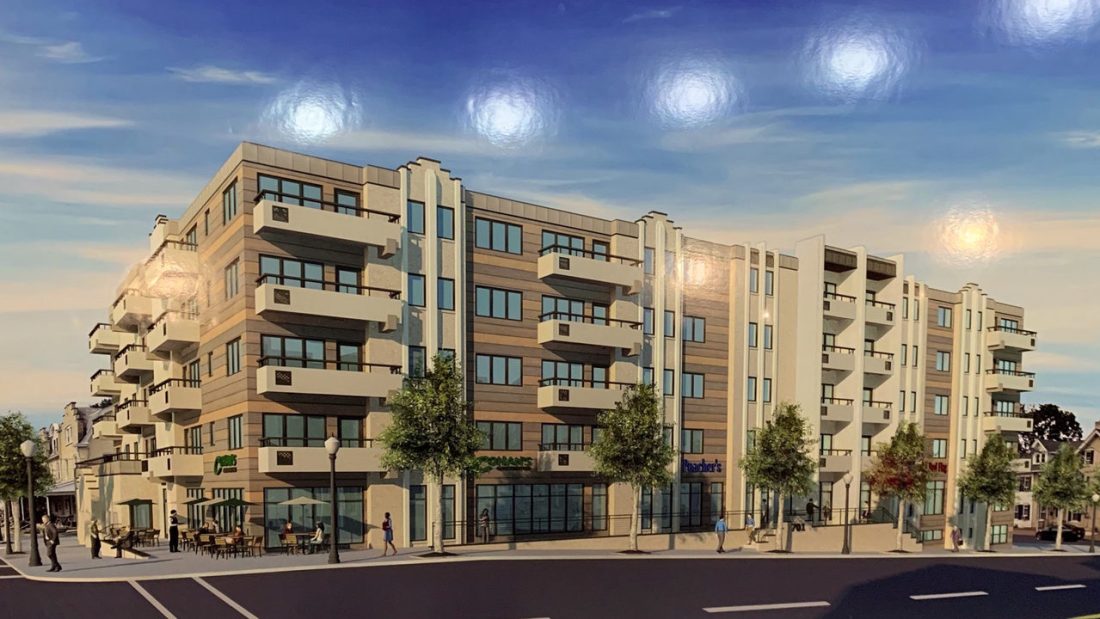
The developer seeks rezoning of two residences on Garrison St. as part of a proposal for a 5-floor mixed use building with first-floor commercial + 70-some apartments along New St. between Garrison and North.

Gadfly likes to have an image of the developer (a devil with horns?). The developer’s name is not familiar, but he must have been “at work” for a good while to accumulate that concentrated block of properties. Let’s take a look as he makes his brief presentation at Tuesday night’s Council hearing.

The developer owns the entire 700 block (sigh! makes you feel insignificant, doesn’t it? Gadfly’s house is 20ft. wide) of west New St and the two houses 11 and 15 W. Garrison.

The houses on New are zoned Central Business District, the Garrison houses residential.

The Garrison houses were CB but changed to residential in 2005. The developer’s asking to change them back.


Most of us have not witnessed a public hearing on a Zoning proposal, so let’s take a look at the interaction between Council and the developer to get a sense of the kind of questions that are asked and the kind of concerns there might be.

Especially regarding impact on the existing neighborhood.

We learn that the first floor must be “retail, restaurant, or personal services.”

Though there is the rendering of the project shown above, no specific plan has yet been officially submitted.

As the developer says, he is “early on” in a project — a “journey” — of many steps. He’s at “the very first step.”

So he was a bit vague about some details. For instance, the height of the building.

Parking (a reasonable amount of parking as a convenience) and a certain type of construction (reasonable cost) will limit the height, he said in response to concerns.

He has looked at the City Comprehensive Plan (nice!) and is following a desired use found there in the Center City area: high-density residential.

What kind of tenants does he seek? He’s working with a marketing and financing group doing a demographic study, but he did mention the possibility of federal government programs for veteran housing (some visible signs of sympathy for that).

See approx. minute 10 for Councilwoman Van Wirt raising concern for the integrity of the Garrison St. block.

Yes, that’s what we should think about next.

Festival UnBound


Celebrate Bethlehem’s great native artist Hilda Doolittle in this new play, part of Touchstone Theatre’s “Festival UnBound”

(27th in a series of posts on H.D.)

Finding H.D.:
A Community Exploration of the Life and Work of Hilda Doolittle

Bethlehem-born writer Hilda Doolittle — H. D. —  (1886-1961) is
the “Lehigh Valley’s most important literary figure.”

dollar sign

Contributions to fund the museum-quality portrait of H. D. by local artist Angela Fraleigh that will hang prominently in the library are REALLY lagging. Can you please help? Visit http://www.bapl.org/hd/


Doug Roysdon’s marionettes are fabulous — don’t miss!

H. D. marionette
World Premiere!
“The Secret”
A New Mixed-Media Play about H.D.
by Mock Turtle Marionette Theater
Sat Oct 5, 5 pm with talkback at 6:30 pm
Sun Oct 6, 1 pm with panel discussion at 2:30 pm
Mon Oct 7 @ 7:30 pm
Tues Oct 8 @ 7:30 pm

Touchstone TheatreFestival UnBound
321 East 4th Street, Bethlehem
From artistic director of Mock Turtle Marionette
Theater and chief writer Doug Roysdon, featuring
narrative, song, and puppetry. Directed by 

The Play:  The Secret begins one day, in late nineteenth century Bethlehem, when sixteen year-old, Helen Wolle, mother of H.D., entered a Moravian Seminary classroom to rehearse a song she looked forward to performing. Much to her shock and, in fact, trauma, she was roughly told to be quiet, to end “this dreadful noise.” by her pastor grandfather, Papalie. And Helen, who loved to sing so much and so well, would never sing again in public.

So begins The Secret, our community-inspired and community-produced celebration of Bethlehem’s great native artist, Hilda Doolittle. It is a play that follows H.D.’s poetic adventure to London, Greece and Vienna. Yet, the lessons and events of her Moravian childhood, memories that dramatically shaped her life and writings, fill the play as they did H.D.’s life and work. And so, as The Secret moves from myth and ritual to the devastating realities of the London air raids . . . it never entirely leaves Church Street.

The Project:  Over the past year, a partnership including The Bethlehem Area Public Library, the Lehigh University English Department, Bradbury-Sullivan LGBT Community Center, and Mock Turtle Marionette Theater has fostered a wide-ranging community initiative with a single unified goal. That is to assert poet and feminist visionary, Hilda Doolittle’s place as the most important and accomplished artist to hail from Bethlehem, Pennsylvania. In this, we strive to join other American communities who understand the importance of celebrating their gifted daughters just as they have always recognized their native sons. The Secret represents the culmination of the Finding H.D. Project, a year of programs featuring the many facets of H.D.’s artistic work.


Finding H.D.:
A Community Exploration of the Life and Work of Hilda Doolittle

Festival UnBound

Ten days of original theatre, dance, music, art and conversation designed to celebrate and imagine our future together!
October 4-13

Unfortunately, a familiar story-line: “Tension between development and history dominated Tuesday night’s Bethlehem City Council meeting”

(1st in a series of posts about 11 and 15 W. Garrison St.)

It’s deja-vu all over again, as someone said at last night’s Council meeting. Gadfly can hardly get a thread on one of these development situations finished before another one pops up. Use the news stories as a starting point for thinking about the Garrison St. matter.

Garrison St.a five-story, mixed-use building with 72 apts along the 700 block of N. New Street,
between North and Garrison

Sara Satullo, “Bethlehem neighbors want their block’s small-town feel to prevail over big-city apartment plan.” lehighvalleylive.com., September 17, 2019.

The residents of West Garrison Street have built a tight-knit community where kids are sent outside to play. They get homework help on neighbors’ porches and folks open their homes for dinner.

On Tuesday evening, the residents of the street implored Bethlehem City Council not to disrupt their way of life by rezoning two properties — 11 and 15 W. Garrison St. — from high-density residential to the central business district designation they held prior to a 2005 zoning change.

[Lauren Miller] asked city council what matters most to them: the community and people that reside in the city or economic development.

[Developer] Connell envisions commercial retail space fronting on North New Street along with the apartments and 74 parking spaces to the rear. While zoning does not require he provide parking, Connell said, he thinks it is crucial to market the project to tenants.

Councilwoman Dr. Paige Van Wirt said she’s concerned about the intrusion of development on a vibrant residential street.

“I really feel for these neighbors and I’m going to stand up for them,” [Bruce Haines] said. . . . This is all about integrity.”

[The properties] sit within the city’s Local Economic Revitalization Tax Assistance, or LERTA, tax abatement zone as well as a qualified opportunity zone, a capital gains tax incentive, created in the 2017 tax reform law. It is meant to encourage investment and development in targeted economically distressed neighborhoods. With LERTA, taxes on a property’s higher assessment, resulting from improvements, are phased in over 10 years rather than all at once.

Charles Malinchak, “Bethlehem residents say Garrison Street complex would ruin ‘wonderful’ neighborhood.” Morning Call, September 18, 2019.

The picture painted was of a tight, friendly neighborhood that would be lost forever if two properties on a street in Bethlehem were rezoned to allow for construction of a five-story apartment and retail complex.

“I’m someone who cares deeply about this neighborhood. … Everyone knows everyone’s name. It is something special, something beautiful. Kids sit on my porch and color. Say ‘no’ to changing the zoning,” an emotional Lauren Miller, a West Garrison Street resident, told council.

Miller rents one of the West Garrison Street homes owned by Connell and praised the historic character of the home she has lived in for more than three years. She questioned why there’s such a need to “tear down the old for the new. I want to live here and be a part of building this community.” Others from the neighborhood echoed Miller’s sentiments. “I don’t want this. It will bring a lot more people and we won’t feel safe anymore. Our block is like a big family,” West Garrison Street resident Cindy Toledo said.

“This is commercial intrusion into a wonderful neighborhood. This is about integrity of our zoning codes, our neighborhoods and government,” Hotel Bethlehem managing owner Bruce Haines said.

Stephen Althouse, “Potential downtown development causes tension in Bethlehem.” September 17, 2019.

Tension between development and history dominated Tuesday night’s Bethlehem City Council meeting.

The two properties are part of nine contiguous properties [Developer] Connell has acquired over several years on West North, North New and Garrison streets. The acquisitions are required to eventually implement his vision of an important urban redevelopment project.

During Tuesday night’s hearing, Councilwoman Paige Van Wirt said it should come at no surprise that she is “concerned about the loss of residential” properties. She directly asked Connell what would he do if the zoning was denied? Connell attempted to answer, pausing several times before eventually giving up. “I don’t think I could honestly answer that question,” given the situation, he said.

It was a question neighbors who attended the hearing Tuesday night hope becomes more than hypothetical. Speaker after speaker lamented the changes with various themes centering around how it would negatively transform a Bethlehem neighborhood. “This is a commercial intrusion into a neighborhood,” Bethlehem resident Bruce Haines said. “… Ultimately this decision is about integrity.”

Bethlehem Moment: Henrietta Benigna opens a girl’s seminary, 1742

(Latest in a series of posts on Bethlehem Moments)

Bethlehem Moment 13
City Council
September 17, 2019

Jim Petrucci
President, J. G. Petrucci Company, Inc., Asbury, N.J.

Read by Joseph Petrucci
 video

Bethlehem Moment: May 4, 1742

On May 4th, 1742, 16-year old Countess Henrietta Benigna, daughter of Count Zinzendorf, opened a girl’s seminary school in Germantown, Pennsylvania. Initially, the school taught 25 pupils and focused on reading, writing, religion, and the household arts. Seven weeks after the school was founded, it was moved to Bethlehem, Pennsylvania. Three years later, it was moved to Nazareth and then returned permanently to Bethlehem in 1749.

In 1785, the school expanded its charter, began accepting girls from outside the Moravian Church, and changed its name to Moravian Female Seminary. The school itself built a tremendous reputation. In fact, as president, George Washington personally petitioned for the admission of his great-nieces.  Eventually, in 1945, the Seminary was merged with a local boy’s school to form the coeducational institution we now know today as Moravian College.

As the first all-girls boarding school in the New World, the Moravian Female Seminary holds a special place in the history of education in America. Not only was it a school founded by women and for the benefit of women, but it was also one of the first schools in the New World to open itself to Native American children. This is the legacy of Henrietta Benigna. Henrietta founded the school on the basis that all deserve a quality education, and she did it in a time when that wasn’t a popular opinion. As various stakeholders in the City of Bethlehem today, we should feel proud of this moment in history and look to replicate the principles that Henrietta Benigna displayed back in 1742.

The J. G. Petrucci Company has been working in Bethlehem since the early 90’s, completing such projects as the Perkins on the Southside, the Moravian Health and Science Center, and ten projects in LVIPVII – including Curtiss Wright, Cigars International, and Synchronoss.

Resources

https://babel.hathitrust.org/cgi/pt?id=hvd.32044089399828&view=1up&seq=38

https://books.google.com/books?id=0gc1AAAAIAAJ&printsec=frontcover#v=onepage&q=Countess%20Benigna&f=false

https://www.mcall.com/news/local/bethlehem/mc-pictures-timeline-bethlehem-pa-history-20160610-photogallery.html

https://www.bapl.org/local-history/local-history-timeline/bellhouseschool/

https://www.moravianacademy.org/Our-Story/Our-History

https://www.geni.com/people/Countess-Benigna-von-Zinzendorf/6000000038018709862

Follow-up to and fallout from the Zoning Board nomination controversy (3)

(The latest in a series of posts on City government)

Council meeting tonight.

Two meetings ago — August 20 — we had the long “debate” over the Zoning Board nomination. Gadfly spent 9 posts on that, beginning here.

One meeting ago — September 3 — we had the follow-up to that “debate.” Gadfly devoted 2 posts to that, beginning here.

But he left that second post with a “to be continued,” a promise that should be fulfilled before the meeting tonight.

Gadfly wants to say something about Councilman Callahan and about President Waldron, but mostly about President Waldron.

Gadfly has said one of the purposes of his project is helping you know your elected officials better, especially so that you will be better informed when it comes time to vote (some Council members, you can be sure, will run for re-election, and, you know, some might even think of running for Mayor! Be prepared!).

Gadfly did not like the August 20 performance. He felt guilty, like a gaper at a car wreck. Stephen Antalics felt “deeply embarrassed.” People who reported to President Waldron found it “cringe-worthy.” Gadfly faulted BC. Not everyone did, of course.

But, though faulting BC, Gadfly has to admit that his “defense” at the September 3 meeting (as outlined by Gadfly here) was masterful. He began with testimonies approving his behavior; he made the solicitor acknowledge that the rules were on his side; he used direct audio evidence (stunning! ballsy!) to make his central point; and he APOLOGIZED. Gadfly was in awe of BC’s technique. And remembered that he has seen BC do the “Perry Mason” (look it up, young ‘uns!) thing before, especially leading Robert Novatnack down a path of one-word yes/no answers to make a point that supported his position in an aspect of the Martin Tower controversy. Gadfly must point out, however, that BC’s apology was framed by blaming Councilman Reynolds for starting the nastiness (BC was only reacting to provocation), and he not only did not back off but reiterated his unspecified charge on JWR. So we might put “apology” in quotes just to get us to think about it some more.

But it’s the punctuation (sorry, ever the English prof) that President Waldron put on this Zoning Board episode on which Gadfly would like to focus most attention.

The trials of leadership.

Here again is the “period” AW put on the episode (see the video here):

“I’m gonna try to enforce the rules moving forward fairly and consistently. That becomes challenging when rules are habitually broken, and I’m trying to give guidance and my guidance is pushed aside. I think everyone has a right to be heard, and I think they have a right to speak, from members of the public to members of Council. I’ve been criticized for having a light gavel in the past, and I can promise you I will continue to have a light gavel. I don’t think silencing people’s thoughts and opinions is a productive way to continue a conversation. With that being said, I do think there should be a level of decorum and respect for each other in the room. And I think at times at the last Council meeting that was not there. I did not get any feedback publicly that that was a positive conversation. In fact, many people reached out to me that I saw and said that it was cringe-worthy and it was embarrassing. I think the tone of that conversation wasn’t helpful, and it’s my opinion that I think we can do better and we must do better when we get in to the dangerous territory of accusing people of things on Council, whether that’s members of Council accusing each other of something or members of the public accusing, because that happens quite a lot, and I don’t gavel that down much the same way people go over the 5-minute time limit and I don’t gavel that down. I think people should be heard. Whether you agree with that opinion or not, the First Amendment is wide-ranging and it supersedes Roberts’ Rules of Order. But I would hope that we would have the respect for each other to adhere to those, so that the conversation can be productive. I hear a lot different kind of tone than I did last week, Mr. Callahan, and I appreciate that you were reflective on that, and I think open debate is a good thing. I think we should hold each other accountable for our thoughts and actions as well, and I think moving forward taking a little time to consider how our words are affecting other people in the room, it’s going to be beneficial. So I look forward to continuing this conversation publicly. Whether it’s warranted that people think the rules are being violated — Roberts’ Rules — which I think they are — I’m going to enforce them pretty liberally because I think the conversation should be open and fair, and I’m going to take remarks from members of Council if they want to give a little course correction and think that I should enforce the rules a little differently. I’ll listen to the majority of Council if they have a strong opinion that the rules should be enforced differently. Although I’m currently president of Council, I would welcome feedback from members of Council if they think I should have a different approach. And I’ll try to balance those in the future as we continue these conversations under new business.”

Gadfly is sympathetic. He administered a department of 60-some people for a decade.

All individualists, as professionals in the humanities, and especially the field of English are wont to be.

What kind of a leader is AW, at least as revealed in this episode?

AW realizes that he’s been criticized for being soft.

Gadfly has seen AW extend a long leash at times during public comment even when the audience is visibly restive.

Gadfly has benefited from that softness as he yacks on and on over his 5 minutes during public comment . He has even called AW Mr. SoftGavel in these pages.

He’s patient. Gadfly loved AW’s quip August 20 about potty-training twins.

But AW’s patience did reach a limit August 20, and Gadfly thinks Council might benefit from some rules — as suggested by Mr. Antalics and even invited by AW.

Hence, a modest proposal — actually a version of rules Gadfly has seen in Robert’s Rules.

  • a limit of 10 minutes, then others are given an opportunity to speak
  • after others have spoken or passed on the opportunity to speak, another 10 minutes
  • any further 10-minute time after that only with majority vote of the other Council members

Gadfly believes that AW’s instinct toward openness is right — if you are going to err, do it on the side of more communication rather than less — but August 20 showed that some broad rules are necessary when unpleasantness occurs.

Sunrise on the SouthSide (3): A Clean and Safe Environment

(Latest in a series of posts about Lehigh University and the Southside)

Sunrise on the Southside

Chapter 1: A Clean and Safe Environment

After a short break, Gadfly would now like to continue the slow walk through Lehigh University’s high quality production  “Sunrise on the Southside,” focusing today on chapter 1, “A Clean and Safe Environment.”

This project came to Gadfly’s attention just as we have been spending a lot of time on the Southside, a focus especially stimulated by the moving letter from the South Bethlehem Historical Society and the formation of Bethlehem Residents for Responsible Development.

The SouthSide Ambassadors — those people in the yellow uniforms cleaning streets and sidewalks!

Who are they? Where did they come from? Why are they there? What do they do?

Since the program was created in 2014 in partnership with Lehigh and the Bethlehem Economic Development Corp. (BEDCO), the Ambassadors have expanded their footprint on the South Side with support from the Community Action Development Corp. of Bethlehem.

  • “In a lot of people’s minds, it’s not clear who [the Ambassadors] work for, whether they work for the City of Bethlehem or whether they work for Lehigh University. And to me, that is a successful way to view it. They are out there to make the South Side better.” (Lehigh president John Simon)
  • Seven days a week in the South Side’s core commercial district, the Ambassadors are on the job from 7 a.m. until 11:30 p.m. Morning details focus on sweeping the sidewalks in an 18-block radius, pulling weeds from tree beds, picking up leaves, sprucing up. Later in the day, the Ambassadors focus on safety issues. The Ambassadors also provide plenty of hospitality—helping visitors with parking meters, directions and restaurant locations.
  • “Listen, it was pretty rough down here. It was dirty. Street lights were out. Curb lines were just covered with garbage, out almost 16, 18 inches from the curb. That doesn’t seem like a big deal when you’re in it every day, but when it’s gone, what a difference it made. Things have changed considerably. ” (Ambassadors Operations Manager Hector Lopez)
  • “Now we are starting to see a change in [people’s negative perceptions of the South Side] just because the sidewalks are clean.” (Lehigh assistant vice president for community and regional affairs Adrienne McNeil)
  • McNeil works with Lehigh’s Office of First-Year Experience on Faux Friday, when first-years eat at South Side restaurants as part of the effort to get them to check out the core business district. Last fall, she says, about 1,100 students participated.
  • Then, on the first Friday in October, McNeil leads one of Lehigh’s 5X10 (five programs over 10 weeks) series. Participating students meet her at Farrington Square, then they walk together to the Color Me Mine pottery place on Third Street, where they can make plates, bowls and mugs imprinted with the Lehigh logo. “Part of that is just showing them that Third and Fourth streets are close,” she says. “It’s a fun thing for them.”

 Gadfly invites comments on this powerful Lehigh public relations document as we go.

City Council meeting tomorrow night Tuesday September 17

Our next City Council meeting — the “face” of Bethlehem City government — occurs tomorrow night Tuesday, September 17, Town Hall, at 7PM.

This meeting is video-recorded and can be viewed LIVE or later at your convenience on the City’s website after the meeting at http://www.bethlehem-pa.gov > Quick Links > City Council Meeting Agendas and Documents.

You can find the meeting agenda here: https://www.bethlehem-pa.gov/citycouncil/meetings/index.html

As always, as long as he has flutter in his wings, Gadfly urges attending, one way or the other.

Gadfly turns 1!

Born September 16, 2018, just at this time — 2PM


Definition of gadfly
1: any of various flies that annoy livestock

2: a person who stimulates other people especially by persistent criticism
3: someone who challenges people in positions of power

———–

1,032 posts and 365 days later.

The ceremonial time to touch base with the beginning, with the original purpose, with the original spirit.

A time to take stock.

What is Gadfly about?

That introduction is pretty pompous, pretty idealistic, but I still subscribe to its essence.

And won’t rewrite. In fact, you can’t rewrite what is in effect the creating moment.

At that creating moment you aren’t really in control, and you can’t re-live it.

I still believe that the fantasies we have shape the lives we lead.

Mine is a Norman Rockwell fantasy of Bethlehem as the small town embodied in the “Freedom of Speech” painting and Rockwell’s other works.

A place of good will, a place of mutual respect, a place where residents care and participate, a place where leaders listen as they lead.

I try to run Gadfly as an example of democracy in action, a place for healthy dialog about issues that concern our city.

I love your voices, as I have tried to show you time after time.

I’m not sure I’ll change anything of substance in the upcoming year.

But I would like to see some changes:

  • more original posts from you, the followers — not just comments on my posts or the posts of others, but thoughtful, original, chain-starting posts


  • and this might be a bridge too far in the trust that can be built in just a year, but posts from our elected officials and city administrators providing facts, trying out ideas, sharing visions, correcting misconceptions, combating ignorance — trusting the value of what we can never have too much of, good communication, good conversation

“Good conversation builds community.”

Gadfly in a muddle over 548

(9th in a series of posts about 548 N. New St.)

So the Planning Commission response to the proposal for a new building at 548 N. New St. saddened a reflective Gadfly in a different manner for a different reason.

There was no one Planning Commission position on the 548 design, but here is what Gadfly pieced together a couple of posts back from separate comments on the design by the three commissioners.

This is what Gadfly “heard” as a general rationale for approving the design:

548 is not in the historical district, which means that it’s not tied to the past but can be a catalyst for elevating and exciting and even beneficially controversial change, an indication of our commitment to modern progress that will benefit the City economically by attracting urban dwellers who, in the developer’s language, want to “live free” and who will spend money in the downtown.

Gadfly is aware of the legitimate problems with what we might call the “Boyd Theater” block of Broad Street. And of optimism about plans for 120 new apartments there.

He shares that optimism.

For a personal and selfish motive, Gadfly — wrestling with the downsizing demon — would love to see apartments that he would like and can afford in that section of town.

The Planners base their approval of the design precisely on the basis that it will be a change agent in that area:

  • “[548 is] not in the historical district”
  • “This is a new development and hopefully the rest will follow
  • “The design is going to elevate the architecture in the surrounding 70s-designed buildings in the future”
  • “It’s going to improve our overall outlook and image in terms of where we’re going and moving toward

The Planners have Gadfly envisioning this section of the future City in the image and likeness of the 548 style of architecture.

So which is it? Does the modern design of 548 blend in with and complement the historical architecture, as the developers see it? Or is it something new, a consciously chosen break with historical architecture that signals a move in a new direction, as the Planners see it?

Not only which is it, but which do we want it to be?

It’s the dramatic inconsistency of the two messages that bothers Gadfly.

In contrast to the developers, The PC celebrates difference and change and assumes more of it.

It almost sounds as if there is an official plan or consensus evolving of the kind of downtown residents we seek and the kind of downtown development we want.

In approving such dramatic change in architectural design, are the Planners in ad hoc fashion making policy, or are they reflecting principles already agreed upon?

Gadfly has heard the kind of residents we seek (“the type of clientele that we’re trying to have within our City”) as young professionals with disposable income who want to live and spend money in a walkable downtown.

And he guesses the assumption is that such folk will only be attracted by such modern design. Is that a testable assumption?

For it sounds from the PC words like we are moving toward a city with a distinct historical section and a distinct modern section.

Gadfly agrees generally that history is Bethlehem’s brand. So will we have a competing brand? Can a city have two brands?

Carrell-Smith felt baffled. Gadfly feels muddled.

And thus for Gadfly the key question is, where and when does the conversation about Beauty in Bethlehem take place, and who is there when it does?

For by the time that Scheirer and Carrell-Smith get thoughtfully to the microphone, it is too late. That’s what made Gadfly sad. The conversation train had left the station.

Gadfly hopes that conversation is taking place somewhere before the train has gone too far.

For this specific kind of comment from a Planning Commissioner really makes Gadfly anxious: “if nothing else, people who visit Bethlehem will have something more to talk about.”

O, my.

That does not seem responsible planning.

to be continued . . . (Gadfly can really beat a topic to death, can’t he?)

The 548 developers give Gadfly a headache

(8th in a series of posts about 548 N. New St.)

Gadfly began this thread on 548 N. New on September 10 by saying he “found himself very reflective after the Planning Commission meeting of August 26. And — to tell the truth — sad.”

Now that we have a complete overview of the players and the process, let’s put a foundation under those feelings, starting with a closer analysis of the developer rationale for the design.

Gadfly doesn’t feel the developer was prepared for the Planning Commission member’s question about the design.

And his answer was totally inadequate and, Gadfly thinks, insulting and dishonest.

Scheirer and Carrell-Smith deserved better. “We” deserved better.

The developers:

“We understand that [the 548 design] is modern, but when modern design is actually done right we feel it not only enhances it, not only complements it, but also enhances the historic architecture. So I mean, we feel that, we understand that people may not like this in the historic downtown, but this is invigorating type design . . . people want to live downtown, be downtown, live free, and spend money downtown. We feel this is, this is the way things are headed. We love design, we love Bethlehem, and we want to invest in Bethlehem . . . continue enhancing the downtown.”

  • We understand that it is modern, but when modern design is actually done right we feel it not only enhances it, not only complements it, but also enhances the historic architecture. To Gadfly, who has no architectural savvy, this is an astounding claim made totally without example or evidence or data, so it’s meaningless.
  • We understand that people may not like this in the historic downtown, but this is invigorating type design. Gadfly does not understand the relation between the first part of the sentence and the second. This is a type of non sequitur. Precisely what will be the nature of the invigoration, and how will it enhance the surrounding historic architecture? If the second part of the sentence is meant to mollify the antipathy of the people in the first part of the sentence, it is not clear how.
  • People want to live downtown, be downtown, live free, and spend money downtown. What does “live free” mean? Is the assumption here that a differently designed building would not attract such people? If so, no basis is provided for believing so. And Kim Carrell-Smith offered to provide data that historical architecture is an economic driver.
  • We feel this is, this is the way things are headed. To what does this refer? To directions in City planning? Or to trends in urban architecture? Or to what? Not clear. This statement is meaningless.
  • We love design, we love Bethlehem, and we want to invest in Bethlehem. Ends with a love feast. Kumbaya, my Planning Commission, kumbaya. Smoke screen hiding empty argument.
  • We try to be sensitive to the surrounding area [quote by the developer the night of the meeting]. Please. Pu-leeze.

For Gadfly, the developer response to the design question is non-sense.

Yet the Planning Commission did not blink.

The irony is that the developers could have made a good case on each point. Gadfly could write it for them. But there was no effort to do so. Their answer is manifestly skimpy.

And thus we find a rightfully “baffled” Kim Carrell-Smith, “baffled by the developer’s characterization that this modern building fits into the historic downtown and complements it.”

Gadfly feels justified in feeling the developers were insulting in treating “us” as empty heads.

But why does he feel they were dishonest as well?

Because, Gadfly feels, they must have known they should have been making the exact opposite case for their modern design but didn’t feel it would fly.

That modern design is so obviously different from the surrounding area that, if they were honest, they should have been “selling” its difference as a needed and necessary positive change agent in a section of the City that needed a boost.

For, after all, that’s what the Planning Commission did!

Yes, oh yes, my good followers, the Planning Commission made a case for the design 180-degrees from the creators of the design.

O, my aching head, says Gadfly.

to be continued . . .

The key voices in the 548 narrative

(7th in a series of posts about 548 N. New St.)

What good is an English major? What skill do English majors have? One thing Prof Gadfly used to say is that English majors are excellent close readers. They read closely; they listen closely. Gadfly has tried to listen closely and carefully to the case for and agin’ 548 N. New. He’s structured the key voices in the case in a flowing narrative here. Can you discern the plot?

It would be worth the while if in each town there were a committee appointed,
to see that the beauty of the town received no detriment.

Henry David Thoreau c. 1862

Who’s in charge of beauty in Bethlehem?
Gadfly

Was there any thought given to the architectural design?
To fit in to the rest of the neighborhood?
Planning Commission member

We try to be sensitive to the surrounding area.
the developer

When modern design is actually done right we feel it not only
enhances it, not only complements it, but also enhances
the historic architecture.
the developer

This is invigorating type design.
the developer

We feel this is . . . the way things are headed.
the developer

We love design, we love Bethlehem, and we want to invest in Bethlehem.
the developer

Everything we have asked them to do and contribute for
they have agreed to.

City Planning Department staffer

Your project will change the streetscape in that block
that has existed for 100 years.

Bill Scheirer

Other than market demand, and other than you want to build it, how
do you justify changing the streetscape there, the historic
streetscape so dramatically?

Bill Scheirer

I’m kind of baffled by the developer’s characterization that this
modern building fits into the historic downtown
and complements it.

Kim Carrell-Smith

Historical architecture and historical streetscapes are economic drivers.
Kim Carrell-Smith

What I would like to see the developers answer specifically is how
does your architect, how do you see this building blending in
with this neighborhood?
Gadfly

And moving and growing and moving forward, I think the fact that
it’s not in the historical district something like that would increase
foot traffic in our downtown, would draw in the type of
clientele that we’re trying to have within our City.
Planning Commission member

It’s going to improve our overall outlook and image in terms of
where we’re going and moving toward.
Planning Commission member

I think the design is going to elevate the architecture in the
surrounding 70s-designed buildings in the future.

Planning Commission member

Moving forward I think this will infuse a lot of excitement into the area.
Planning Commission member

Architecture is very subjective, and, if nothing else, people who visit
Bethlehem
will have something more to talk about.
Planning Commission member

I don’t do context.
Frank Gehry
World-class “starchitect” (star architect) — quoted by Jeff Speck

One of the things we’ve learned as new urbanists is that the prime ingredient
of urbanism is really public space and the public realm. So the urban plan comes
first and the building second. It becomes an issue of whether the building is a
monument or a piece of fabric. Then does this building dominate what’s in
place or does this building add to it or transform it?

New Urbanism architect Stefanos Polyzoides

Maybe the question should be, where and when does the
conversation about Beauty in Bethlehem take place, and
who is there when it does.

Gadfly

to be continued . . .

Bethlehem school kids’ art work adorns reusable tote bags in the battle against single-use plastic bags — order yours now!

(The latest in a series of posts relating to the environment, Bethlehem’s Climate Action Plan, and Bethlehem’s Environmental Advisory Council)

Beth Behrend is a member of the Bethlehem Environmental Advisory Council (EAC) and the guiding hand on the proposed ordinance to ban single-use plastic bags.

Beth EAC Totes

Gadfly:

At the end of last school year, I organized a drawing contest (Beth contest) in the Bethlehem schools with the theme “Designing for a Cleaner Future.” The purpose was to have students draw a picture that promoted a cleaner environment. Students could also include a motto or saying in their designs. I received over 100 submissions from kindergarteners to high school seniors. Four winners were chosen, and their designs were printed on reusable tote bags. These bags are being sold as a fundraiser to support environmental projects in the schools. We already have a 5th grade class who would like to use some of this money to start a pollinator garden at their school.

From left to right in the picture, the winners are a 3rd grader from Lincoln, a 7th grader from Nitschmann, a 5th grader from William Penn, and a senior from Liberty.

I sent a flyer to all principals and art teachers in the school district. Not all art teachers had an email posted on the BASD website, but a flyer was at least sent to the school’s email or principal’s email. Not all schools replied, and some replied but did not submit artwork. The youngest submissions were from kindergarteners and the oldest were high school seniors.

The bags are $8/each, and Gadfly followers can order bags (why not more than 1?) using the form attached: beth Order Form

Beth

Beth EAC Totes

It is Sunday, September 15, do you know where your local Climate Action Plan is?


The Planners speak up about the design of the 548

(6th in a series of posts about 548 N. New St.)

Who’s in charge of beauty in Bethlehem?
Gadfly

“How do you justify changing the streetscape there,
the historic streetscape, so dramatically?”
Bill Scheier

“I just ask, does this building fit into the character
of that neighborhood?”

Kim Carrell-Smith

In their final comments, the three Planning Commission members did address the issue of the design for the 548 raised by residents Scheirer, Carrell-Smith, and the Gadfly.

Which responses we will consider in the next post in this series (probably) as Gadfly begins to reflect on this entire process.

548 n. New st 2

But, first, give a listen to the Planning Commission viewpoints:

PC member 1:

  • “Mr. Gallagher used the words ‘moving’ and ‘growing’ and ‘moving forward’.”
  • “And, yes, even though the rendering does not show what’s currently there, and, yes, I would concur that I would like to see that as well, but moving and growing 10, 15, 20 years from now, I’m not sure if that picture was there of what is currently there, I can’t predict those buildings will still be there 10, 20 years from now.”
  • “And moving and growing and moving forward, I think the fact that it’s not in the historical district something like that would increase foot traffic in our downtown, would draw in the type of clientele that we’re trying to have within our City.”
  • “It’s going to improve our overall outlook and image in terms of where we’re going and moving toward, so, even though it’s not in the historical district . . . I would like to make a motion.”

PC member 2:

  • “The architectural design doesn’t bother me as much as the fact that this is a new development and hopefully the rest will follow, and I agree with [PC member 1] with what he’s trying to confer there . . . my biggest concern about the project right now is [one lane of traffic].”

PC member 3:

  • “I actually applaud the architectural design.”
  • “I think the design is going to elevate the architecture in the surrounding 70s-designed buildings in the future.”
  • “Moving forward I think this will infuse a lot of excitement into the area.”
  • “Architecture is very subjective, and, if nothing else, people who visit Bethlehem will have something more to talk about.”

Now we can see the elements of the Planning Commission affirmative position: 548 is not in the historical district, which means that it’s not tied to the past but can be a catalyst for elevating and exciting and even beneficially controversial change, an indication of our commitment to modern progress that will benefit the City economically by attracting urban dwellers who, in the developer’s language, want to “live free” and who will spend money in the downtown.

Does that seem a fair reading of the PC position? It’s risky to try to meld other people’s ideas together.

Chew on this.

to be continued . . .

Gadfly floats a solution

(5th in a series of posts about 548 N. New St.)

Who’s in charge of beauty in Bethlehem?
Gadfly

“How do you justify changing the streetscape there,
the historic streetscape, so dramatically?”
Bill Scheier

“I just ask, does this building fit into the character
of that neighborhood?”

Kim Carrell-Smith

In this next installment of “The Making of the 548,” Gadfly lept to his feet and commanded the podium-less microphone stage-left so that he was virtually speaking into what he thought were the inactive right brains of the City Planners.

Gadfly can’t figure out how to do a video-selfie, so you’ll have to settle for this still photo to go along with the audio, taken during the undercover phase of his gadfly training.

ejg-hat

  • “I’d like to hearken back to Mr. Stellato’s question about design.”
  • “I don’t think the Benners answered that question well.”
  • “You see the building without its context, without what’s on the left, without what’s on the right.”
  • “I think we have to think about how the building fits in to the neighborhood better.”
  • “What I would like to see the developers answer specifically is how does your architect, how do you see this building blending in with this neighborhood?”
  • “We can’t just look at the individual property.”
  • “I would actually like to see a form in whatever comes to you guys to start this process, a form that gives a space where the developer has to answer the question ‘How do you see the property blending in with its neighborhood,’ and I’d like to see a paragraph, or a page, or two pages in which the architect explains that to us.”
  • “The answer that you got, Mr. Stellato, has to do with the people who will be in the building, or this is the way that architecture is going for apartments — that’s off-point.”
  • “How does this design fit into the neighborhood — not historic district, but still I think we need an answer to that question.”
  • “I look at it . . . and I can’t see it blending in, but I’m an English prof, but an architect would say, ‘Hey, Gallagher, this is the way I see it fitting in, this is why I’m doing what I’m doing.”
  • “That’s the kind of answer I think we need.”

Gadfly hopes you enjoyed his three minutes in the spotlight.

But he wants to be sure you note two things that we will return to later:

  • he adopted the verb “blend” from his followers (in a comment to a recent post, Dana Grubb suggested “compatible” would be a good choice too)
  • he moves toward a possible solution to a (the?) problem in situations like this by requiring a statement from the architect

Gadfly resists the appellation (good SAT word) CAVE (a citizen against virtually everything). His natural instinct is to move toward solutions not just whimper and whine. You will note his “modest proposals” every once in a while.

But even Gadfly has to laugh at himself. His solution is so . . . “academic.” Write me (us) an essay, he says.

Chew on this.

to be continued . . .

Touchstone Theatre’s “Festival UnBound” approaches — October 4-13

(Latest in a series of posts on the Arts)

Festival UnBound

Ten days of original theatre, dance, music, art and conversation designed to celebrate and imagine our future together!

Touchstone Theatre is truly one of those places that makes Bethlehem special.

Festival UnBound is designed “to use art to bring the community together to explore its future now that it is ‘unbound’ from the Steel.”

Festival UnBound celebrates where “we” — the Bethlehem community! — are twenty years after Steelbound (1999), the production that inspired it. Steelbound will play at the National Museum of Industrial History on September 25, with opening remarks beginning at 6:30p.


  • A “monumental brigade of volunteers” is needed for the Festival: Email mike@touchstone.org or fill out the volunteer form


Festival UnBound

“How do you justify changing . . . the historic streetscape so dramatically?”

(4th in a series of posts about 548 N. New St.)

Who’s in charge of beauty in Bethlehem?
Gadfly

No context needed. Just listen to these two fine resident comments on the proposal for the new building at 548 N. New St.

Bill Scheier:

  • “People tend to agree that there is a special quality of life in Bethlehem.”
  • “One of the components of that quality of life is the streetscape.”
  • “Your project will change the streetscape in that block that has existed for 100 years.”
  • “It is a dramatic change to the streetscape.”
  • “Other than market demand, and other than you want to build it, how do you justify changing the streetscape there, the historic streetscape so dramatically?”

The aforementioned Kim Carrell-Smith:

  • “I think that we are all pretty aware that Bethlehem’s brand, if we had one, would be history.”
  • “And I think that eliminating historical pieces of the streetscape bit by bit and replacing them with high-rises may miss that fact.”
  • “Historical architecture and historical streetscapes are economic drivers.”
  • “Bethlehem’s brand is history and its historical ambience, and that’s why the downtown was redeveloped with a historical feel in the 1970s, thanks to visionary City leaders who were really far ahead of their time in recognizing that historical preservation pays in many ways.”
  • “I think the New St. developers’ idea of demolishing this dignified brick twin . . . that was built around 1900 and replacing it with a glass and metal high-rise apartment, although perhaps appropriate for other communities and maybe other places in Bethlehem, is not in keeping with what makes Bethlehem’s downtown area, whether Southside or Northside, unique and appealing.”
  • “I’m kind of baffled by the developer’s characterization that this modern building fits into the historic downtown and complements it.”
  • “We are probably all in consensus that . . . the bank building . . . is not a great precedent or something to cite for the value of modernism or the scale in this area.”
  • “The design clearly [detracts from the historic district a block away].”
  • “Could apartments be constructed behind and hidden by a lower building?”
  • “Although a lot of people like to cite New Urbanism as a reason for urging density . . . currently most planners would agree that we’re kind of embracing a new New Urbanism these days where it calls for thoughtful density that fits into the character of the neighborhood.”
  • “And I just ask does this building fit into the character of that neighborhood?”

Chew on these.

to be continued . . .

“Everything we have asked them to do . . . they have agreed to”

(3rd in a series of posts about 548 N. New St.)

Who’s in charge of beauty in Bethlehem?
Gadfly

After “working with the City for roughly a year,” Garrett and Brandon Benner made this 12-minute presentation on new construction at 548 N. New St. to the Planning Commission on August 26.

Gadfly bets that almost none of his followers have ever witnessed a Planning Commission hearing. The City is now in the process of video-ing such hearings, and they will be available for viewing live as well as later.

But for now take a look at the Benner presentation through the roving unprofessional eye of an illegally loaned Sony held in Gadfly’s trembling senior’d hands.

At the head table are three Planning Commission members (one recused himself for this hearing) and two City planning staffers.

Look at what most of the discussion is about:

  • parking (there may be an unnoticed problem here, for early talk of the new Walnut Street garage calls for fewer spaces)
  • traffic
  • garbage
  • pedestrian safety
  • loading and unloading convenience
  • signals

And the Benner plan receives the City blessing: “Everything we have asked them to do and contribute for they have agreed to.”

The Benners are cooperative.

But who’s in charge of beauty in Bethlehem?

548 n. New st 2

One Planning Commission member — god bless ‘im — asked in a quiet voice what for Gadfly is the booming Ur-question, the question before all other questions:

“It’s a beautiful building to put between several brick buildings. Was there any thought given to the architectural design?  To fit in to the rest of the neighborhood?”

Gadfly believes that it’s Brandon Benner who answers:

“Actually, yeah, there is. We understand that it is modern, but when modern design is actually done right we feel it not only enhances it, not only complements it, but also enhances the historic architecture. So I mean, we feel that, we understand that people may not like this in the historic downtown, but this is invigorating type design . . . people want to live downtown, be downtown, live free, and spend money downtown. We feel this is, this is the way things are headed. We love design, we love Bethlehem, and we want to invest in Bethlehem . . . continue enhancing the downtown.”

Chew on this.

to be continued . . .


Who’s in charge of beauty in Bethlehem?

(2nd in a series of posts about 548 N. New St.)

“It would be worth the while if in each town there were a committee appointed, to see that the beauty of the town received no detriment.”
Henry David Thoreau c. 1862

Do we have such a committee?

Who’s in charge of beauty in Bethlehem?

Gadfly was thinking of that Thoreau recommendation as he sat in the cheap seats at the Planning Commission meeting August 26, the one in which the 6-story building at 548 N. New was approved.

548 n. New st 2

And he was thinking of a message that he has kept unanswered but undeletable in the top tier of his email queue since August 2 from a faithful follower who prefers to remain anonymous (but you know who you are, CB) in response to the design of Skyline West, just after he posted about it.

What an unattractive building!! Why can’t they design something that blends into the area/cityscape? Arggghhh…

Skyline

“Arggghhh,” the sound of an Adam’s Apple collapsing under a relentless tourniquet ruthlessly applied by some mad serial Strangler.

And he was thinking of how another faithful follower Kim Carrell-Smith used that same verb blend in a way that he hasn’t been able to shake, a verb that’s been nipping at his mental heels since June 17 (and that’s a long time to be nipped, let me tell you, blood was drawn).

One of the things that makes all of the Southside a cool and interesting place to live is that we have an eclectic blend of architecture, and we like it that way, it’s kind of cool, but what we don’t have are new things that completely depart from that old look of a neighborhood . . . those are just not ways houses were designed in the old days . . . part of the interesting features of the Southside are things that blend, they might be different but they blend . . . the biggest issue is scale that does not blend.

Blend . . . blend . . . blend . . . “Like the beat beat beat of the tom-tom / When the jungle shadows fall” in the classic Cole Porter tune.

Do those buildings blend with their surroundings?

Who’s in charge of beauty in Bethlehem?

to be continued . . .

Ron Yoshida reports . . .

(7th in a series of posts on Ron Yoshida’s pilgrimage)

https://88-photos.com/

Yoshida 5

We followed Ron on his henro, now let’s hear him–

Ron library 1

Gadfly still has a “Ganbi” stickie on his bathroom mirror: keep trying.

“Please wear the clothes of the Buddha’s great compassion.”

Kukai (Kobo Daishi)

Buddha: “I am the awakened one.”

  https://88-photos.com/

Another source for Bethlehem history

(Latest in a series of posts on local color and Bethlehem Moments)


The last two weeks there have been the kind of history stories dear to Gadfly’s heart in the Bethlehem Press.

Stories about the little things and people, the overlooked things and people.

By bethlehemhistory@gmail.com.

That’s Jason Rehm, Bethlehem native, Liberty grad ’07, a history major at Houghton College, whose final essay on Bethlehem history led Karen Samuels to facilitate his writing occasional pieces for the Bethlehem Press.

Which reminds me to encourage you to subscribe to the BP. BP is our community newspaper. And community is magic for Gadfly.

Subscribe to the BP, and be on the lookout for Jason’s essays.

Two very good things to do.

Jason Rehm, “Life during the Great Depression.” Bethlehem Press, August 27, 2019.

My grandfather, Woody Rehm, 88, grew up the sixth of seven children during the Great Depression. Like most families during that time, they were poor. The Rehms moved often, all over town and sometimes just down the street, looking for cheaper rent.

Jason Rehm, “Old Main Street fountain’s history explained.” Bethlehem Press, September 3, 2019.

The Eliza Richardson Fountain on Main Street has long been a mystery. Who was she and why does the fountain bear her name? Answers were hard to come by, but as various records were unearthed, they began to piece together a picture of a fascinating woman deserving to be remembered.