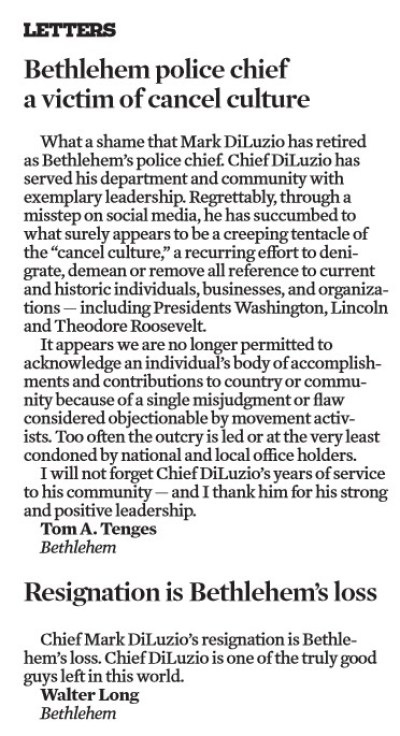
Cancel Culture Wins in Bethlehem Police Chief Case

Latest in a series of posts about the Bethlehem Police

Bud Hackett is a Bethlehem resident who raised 4 kids in the City. He recently became very interested in quality of life issues in the city and hopes to offer a balance to the approach City Council is taking.

Gadfly:

Two weeks ago Bethlehem police Chief Mark DiLuzio resigned, with much pressure from the Mayor and City Council, after he posted something stupid on his Facebook page.  He never should have posted an opinion on the optics of the National Basketball Associates (NBA) championship games. If you’ve watched the games, as I do, they’ve become become extremely political.  OK, their right to do so.

Problem is Chief DiLuzio seemed to be a pretty good police leader. I’ve never met him but did observe him in the past month as he and his team responded to City Council’s anti-police questioning in a series of meetings, including the August 7 City Council Public Safety Committee public meeting.

For those not aware of the developments, Bethlehem City Council had drafted resolutions, inspired, and delivered by the self-proclaimed radical left, held hearings, and generally appeased those groups wanting to “defund the police” in Bethlehem. More on City Council’s “pandering” in subsequent posts.

In preparation for the August 7 Public Safety meeting, Chief DiLuzio was asked to prepare three reports to explain police activity in the City – lots of data, ie., facts, about every aspect of police activity. Most observers of the presentation, as well as many Council members, thought the report was pretty good. In my opinion “Council was looking for problem with the police, and not finding a problem” in the Police presentation of the data and three reports.  I, for one, was happy to hear the presentations and felt our police are doing a pretty good job.

Chief DiLuzio made one of the most interesting comments of the 4-hour long meeting. In response to a comments/questions from Councilperson Mr. Reynolds, Chief DiLuzio departed from the prepared remarks and said something to the effect of “we need to look at the problems in a holistic way; economic conditions, health care, mental health issues, gangs, substance abuse – these are the underlying problems that cause people into actions that require police action” (not direct quote) . It was an “ad lib” comment from a 40-year police professional, someone who has probably “seen it all.”

DiLuzio showed an understanding of crime and bad behavior in the City that was truly insightful. A police leader with that kind of understanding is probably not the person you want to cancel. Yes, he is an older white male and that is not the profile of the politically correct looking police chief but that kind of insight and experience is a shame to dismiss.

Bud

The “history” of the Columbus monument discussion

Latest in a series of posts on the Columbus monument

For all Gadfly knows, the committee that the Mayor formed to discuss the issue of removing the Columbus monument from the Rose Garden has met and concluded its business. Gadfly hopes he hears not only what conclusion is reached but also what the nature of the back-and-forth was. That will be so interesting. And, again, Gadfly says that this relatively little visible issue raised by a petition with a 120+ signatures on it relates to our much more visible conversation about systemic racism.

Our mole in City Hall has provided the minutes of the discussion about the monument at City Council in 1992. You know that Gadfly loves the quality of our resident commentary and lives to amplify it. Even commentary done almost 30 years ago. Once again Gadfly says (with a smile) that the residents Joris Rosse and Michael Laughton are more “with it” than the members of Council.

Gadfly particularly notes Mr. Rosse’s suggestion of a statue for the Indigenous (mentioned in these pages recently by Peter Crownfield) and his invocation of sustainability and Mr. Laughton’s revelation that the selling of Columbus as an American hero is a relatively recent phenomenon. Gadfly wishes we had audio/video, for both Rosse and Laughton exhibit deep connection for the “little guy” in a sharp tone deserving of a Gadfly tip o’ the hat.

The Councilors exhibit the common arguments for erecting such monuments and, these days, for maintaining them: it was another time, everybody has flaws, we’re not focusing on the bad stuff, you can’t change history. Gadfly smiles at the image of Mr. Calvo — long, long time Council member and a bit of a “character” — gathering opinions as he ambles through town.

You might find this following bit of history interesting.

from the minutes of the City Council meeting August 4, 1992:

Joris Rosse, Creek Road, Bethlehem, took the podium to address the installation of a Christopher Columbus statue in the Rose Garden. Advising that 1993 has been declared by the United Nations as the Year of the Indigenous People, Mr. Rosse expressed the hope that it would be an appropriate counterpoint to the celebration of Columbus Day and Columbus, in particular, as a hero and as a famous person to be held up as an example. Mr. Rosse felt that one has to be extremely careful about who is held up to society as a role model. Mr. Rosse commented that Mr. Columbus’ fame came not just from the fact that he was a discoverer but that his name is associated with extreme atrocities. Observing that history books did not really delve into the matter, Mr. Rosse felt that there is no way Christopher Columbus should be held up as an example of somebody to be emulated, Mr. Rosse said he finds it totally inappropriate to foster the idea of having a statue of Christopher Columbus on public property. He continued on to say that, if the Knights of Columbus would like to promote Christopher Columbus, they have their own properties on which to place the statue. Mr. Rosse commented that, if Council were to approve a statue of Christopher Columbus to be located in a public park, they would also be ready to approve an alternate statue that would honor the original people who were on this continent prior to Christopher Columbus. Mr. Rosse expressed the feeling that, by installing a statue, it would be especially ironic since it would be promoting a man who exemplifies colonialism, racism, slave trading, atrocities, at a time when one should be thinking about how to live in a sustainable way on the planet. Mr. Rosse concluded it is his earnest hope that Council will think carefully about the Resolution on the Agenda this evening.

Michael Laughton, 2614 Shakespeare Road, Bethlehem, stated that Columbus left a trail of theft, rape, murder, and was personally responsible for 2 million deaths. He noted that, for nearly 400 years after Columbus set foot in the Americas, no one celebrated his memory. Mr. Laughton related that, for the Chicago World Fair about 1892, the myth of Columbus was generated in order to create a figurehead behind which to celebrate the European expansion, and the character of Columbus was romanticized which myth, he commented, has been perpetuated to this day. Mr. Laughton noted that, as the 500th anniversary of Christopher Columbus approaches this October, many people across the country are trying to set the record straight regarding the historical truth of Columbus’ character and the things he perpetuated against the indigenous people of America. Mr. Laughton proposed that it is insensitive and ignorant to be proposing erecting a statue of Columbus at this time. Quoting James Joyce who said “history is a nightmare from which I am trying to awake”, Mr. Laughton said as we approach the new millennium, the human race is trying in many ways to awaken from the nightmares of its history. Mr. Laughton felt that, to erect a statue to one of the most barbaric predecessors, could only serve to prolong our “fevered sleep.”

Mr. Rosse said he cannot “pretend to be not disappointed in the kind of support you people have displayed for criminal behavior.” Mr. Rosse said he cannot believe that Council can go on record supporting criminal behavior in a public park. Mr. Rosse said there is “not a single comment, not a single little alibi, not a single little sign of compassion for the people who have been wronged in this over all of these years.”

Mr. Loupos, stating that he respects Mr. Rosse’s concern, explained he does not think the issue was about Christopher Columbus and his human faults but it was for the contributions that he made. Mr. Loupos noted that, as one goes through history, weaknesses can be found in many individuals. Exemplifying that Thomas Jefferson had slaves, Mr. Loupos noted one could pick Out individuals throughout history who made great contributions but who had faults. Mr. Loupos commented that “we would not be here today if the contribution was not made that Columbus found the new world. Mr. Loupos continued on to observe that Council members gave the matter a lot of thought but there was no need for further discussion, as the matter had been discussed at the Committee meeting.

Mr. Rosse stressed that Christopher Columbus was carried back to Spain in chains because of the violence he committed against indigenous people and to his own people. Mr. Rosse said it does not make sense “to make this man into a hero.”

Mr. Ehrsam explained that the matter of the Christopher Columbus statue was discussed in Committee, and the statue will represent the discovery aspect of Columbus’ work, and the navigation that was involved. Mr. Ehrsam further observed that it was a different time frame, and that part of history cannot be changed. Mr. Ehrsam commented that the City is not alone in honoring the accomplishments of the man.

Mr. Calvo, stating that he respects Mr. Rosse’s serious feelings, said that he and other members of Council talk to the citizens of Bethlehem about directions and issues facing the City. Mr. Calvo stressed that he talked to many Bethlehem citizens about the Columbus statue and 95% of them supported the idea of the statue. Mr. Calvo noted he communicates with many residents in grocery stores, other stores, walks through town, and so forth, which is where he gets much of his input from citizens of Bethlehem on the directions that the City should be taking.

“It’s time to stop the war on police”

Latest in a series of posts responding to the Jacob Blake shooting

selections from Paul Muschick, “Lancaster shooting riot and LA deputies ambush: Stop war on police.” Morning Call, September 14, 2020.

A man with a knife charged at a cop in Lancaster on Sunday and the officer shot and killed him. Within hours, rioters hurled bottles and bricks at officers and damaged the police station.

Two sheriff’s deputies were shot in the head in an ambush in Los Angeles on Saturday. Protesters gathered outside the hospital where they were being treated, with at least one yelling, “I hope they … die.”

It’s time to stop the war on police.

The police aren’t wrong every time they kill or injure someone. Sometimes, their use of force is justified.

Whether it was justified in the Lancaster shooting will be determined by the district attorney. It’s already clear from the officer’s body camera video, though, that the confrontation differed vastly from others where unarmed Black men were killed by police.

This man, Ricardo Munoz, was armed and was charging at the officer. And the officer was alone at the time, as others hadn’t yet arrived at the home where a woman called for help, saying her brother was reportedly becoming aggressive with his mother and attempting to break into her house.

Critics may question why the officer didn’t wait for backup.

What if he had waited to approach the home and Munoz had stabbed someone inside? Then the officer would be criticized for not doing his job and protecting the public.

What if the officer stumbled and fell as Munoz chased him? Then he might have been killed or injured.

If cities defund their police, as many protesters are demanding, that could make this scenario more common as there may not be backup, or it may not arrive as swiftly. That makes it dangerous for everyone involved in a situation such as this.

In Los Angeles, the sheriff’s department said some protesters blocked entrances and exits at the hospital, though the Los Angeles Times reported that could not be independently verified.

Why were they even protesting there? The deputies didn’t do anything to anyone there. They were in surgery, fighting for their lives after being shot in the head while sitting in their vehicle.

Protesting at the hospital is an endorsement of the shooting. There’s no other way to look at it. If the protest was about the need to reform policing procedures, then it could have been held at the police station or City Hall.

For full disclosure, and as I’ve mentioned in previous columns, I’m the son of a retired police officer. I respect the job they do. It’s difficult, and the vast majority of them do it well.

They don’t deserve to have targets on their backs just because they’re wearing the uniform. They also shouldn’t expect their uniform to shield them when they do something wrong.

Lancaster’s mayor appealed for calm after Sunday’s late-afternoon shooting, but it didn’t work.

But if you want to express your displeasure about how officers have acted, pick better opportunities. The LA protest and Lancaster riot — when you throw bottles and other things at police and break windows, that’s a riot, not a protest — are just undermining the cause.

Police reforms included in the Breonna Taylor settlement

Latest in a series of posts responding to the Jacob Blake shooting

Louisville just settled the wrongful death civil suit with the family of Breonna Taylor for a record amount of money, but the settlement was not entirely about money. The Taylor family wanted police reforms. Since we hope that locally we will shortly be publicly discussing possible reforms and new systems of public safety, we are more interested in those “other” terms of the settlement. Here on Gadfly we’ve been trying to open our minds to all good ideas and the pros and cons about them.

What do you think of these reforms negotiated as part of the Taylor settlement?

“These are all the police reforms included in the Breonna Taylor civil suit settlement.” WLKY TV, September 15, 2020.

Community related

  • a housing credit program to encourage officers to live within the community
  • adding social workers
  • encouraging volunteering with community organizations while on duty

Search warrants

  • new request procedures
  • require EMS presence for forced entry warrants

Accountability

  • new procedures when money is seized
  • an early warning system to flag officers with disciplinary problems
  • random drug testing
  • new policy on records in an officer’s personnel file
  • new policy on cases where officer leaves the department before a personnel investigation is complete

We look inside the department for a new Police Chief

Latest in a series of posts about the Bethlehem Police

The Mayor is moving quickly to hire a permanent Chief of Police from a pool of four current officers. Council will vote on the Mayor’s choice at their next meeting October 6. Among reasons for hiring from inside were the department is “not dysfunctional,” there are qualified candidates, and hiring an outside candidate might be unfair to the candidate since a new Mayor is on the horizon. One can assume that Deputy Chief, now interim Chief Scott Meixell and Capt. Michelle Kott are two of the four. Perhaps insider followers can provide Gadfly with the names of the other two. Former Upper Macungie Police Chief Edgardo Colon is Latino, but one wonders if, besides the usual suspects, the search committee shouldn’t have contained 1) someone deeply conversant with some of the new ways of policing that are being discussed nationally and 2) someone from the general public. In offering the search committee the best of luck, Councilman Colon said, “Obviously we are having a lot of discussions, meetings, groups getting together, community groups to talk about policing.” That caught Gadfly, who’s been whining about the lack of visible movement after the August 11 Public Safety Committee meeting, by surprise. For it sounds like a lot’s been going on. Sigh. Nobody tells Gadfly nuthin’.

selections from Christina Tatu, “Who will be Bethlehem’s next police chief? City looking at four internal candidates, expects to decide by Monday.” Morning Call, September 15, 2020.

An internal search is underway for Bethlehem’s next police chief and a decision is expected next week, said Mayor Robert Donchez, who has accepted applications from four city officers interested in the job.

A hiring committee that includes Donchez, city solicitor William Leeson, Human Resources Director Michelle Cichocki, Business Administrator Eric Evans and retired Upper Macungie police Chief Edgardo Colon will conduct interviews this week.

Third Class City Code requires Bethlehem officials fill the position internally unless no qualified candidates can be found. It will be up to Donchez to recommend one of the candidates for approval by City Council, which will vote on the recommendation at its Oct. 6 meeting.

A letter went out last week inviting anyone with the rank of lieutenant, captain or deputy chief to apply. Applications were due Friday, Donchez said.

Donchez did not name the four candidates for the permanent job.

Donchez is confident the police department already has qualified candidates who know the city. In addition, Donchez’s term as mayor ends in 15 months. He thinks it would be unfair to ask a national candidate to relocate right before a change in administration.

“I don’t believe we need to go outside. There’s always room to improve, but we are not a police department that’s corrupt. We aren’t a dysfunctional police department,” Donchez said, noting the department is accredited at both the state and national levels.

Councilwoman Olga Negron previously told The Morning Call she thinks the city would be prudent to look beyond its own for leadership.

“This is a great opportunity to rethink how we police, and this might be a good opportunity to bring in someone from outside,” she said Sept. 4 when DiLuzio announced his retirement.

Councilwoman Paige Van Wirt said it’s most important to bring in a chief who is on board with creating a more diverse police force that can address the community’s concerns and work toward change.

While a person of color or a woman would offer some symbolic change, Van Wirt said during a Sept. 4 interview that can’t be the sole purpose for selecting an individual.

“This really is about finding the right person. They have to understand the issues and grapple with the issues and not just be a symbol,” she said.

Esther Lee, a longtime civil rights activist and president of the Bethlehem NAACP, said her group was not consulted on the city’s search for a chief, but she believes hiring someone already in Bethlehem’s ranks would be best.

“I think communities ought to have police and their chiefs be more local,” she said, adding that most people in the community aren’t familiar with the city’s police officers, and hiring someone through a national search could add to that disconnect.

Lee hopes the city will include a member of the Black community on its hiring committee.

Donchez said he talked to Lee about who would be on the hiring committee and went with Colon, who is Latino, because of his experience as a police chief and because Colon grew up in Bethlehem.

Gadfly marks his second anniversary

Gadfly marks his second-year anniversary today and the 2, 275th post.

Gadfly tips his hat to his thoughtful followers.

It’s a Gadfly mission to help you be the best voter you can be, and he looks forward to the next election.

This is a good time to say again that Gadfly plans to end his run after the 2021 election.

But he hopes that someone will take over.

Every community needs a Gadfly.

The blog is consciously set up “impersonally” rather than in my name so that a change-over would be seamless.

Gadfly would be interested in receiving inquiries from people interested in donning the wings.

Ed

Ketch up with what’s happenin’ at the Bethlehem Food Co-Op

Latest in a series of posts on the Bethlehem Food Co-Op

Great momentum going for the Bethlehem Food Co-Op, a community enterprise
aligned with the Gadfly mission. Have you joined yet?

Bethlehem Food Co-Op

Bethlehem Food Co-Op to share info and updates
The public is invited to “Ketch-Up with the Bethlehem Food Co-Op”, an online Zoom gathering scheduled for Thursday, Sept. 17 at 7 p.m.
The session will include a presentation about the group’s efforts to bring a full-service, community-owned grocery story to the north downtown area of Bethlehem. Lease negotiations are underway for the undisclosed location.
The co-op is a member-based organization, with each paying a one-time equity payment; this entitles them to vote on decisions about the organization and its operations. There are currently over 700 households that are members.
The Sept. 17 session will also share information about the co-op’s efforts in the area of education, community involvement, supporting local businesses and producers, and addressing issues of food insecurity in our area.
The co-op will meet for its Annual Meeting on Monday, Oct. 5 at 6:30 p.m. via Zoom.
For information on how to attend the Sept. 17 session, visit bethlehemfood.coop/calendar.
Contact: Carol Burns, 610-428-9649

Another episode: officials call for stronger social services to help avoid deadly confrontations with police

Latest in a series of posts responding to the Jacob Blake shooting

selections from “Video: Officer running away while shooting man with knife in Lancaster.” Associated Press, September 14, 2020.

A police officer fatally shot a man with a knife in Lancaster after his sister said she called police to get him involuntarily committed, leading to street protests and vandalism in what the city’s mayor called a “heartbreaking day.”

Police posted the officer’s body camera video on social media, showing the man chasing the officer down a sidewalk with a knife before he was fatally shot.

Police eventually used tear gas early Monday to disperse hundreds of protesters who took to the streets of the diverse city of 59,000 people in the heart of Pennsylvania Amish country following the shooting death of Ricardo Munoz on Sunday afternoon.

Munoz, 27, was mentally ill — diagnosed with bipolar disorder and schizophrenia — and hadn’t been taking his medications, his sister told Lancaster Online.

Rulennis Munoz, 33, said she had called a crisis intervention organization and a police non-emergency number to get her brother involuntarily committed.

“He had an episode. He was just incoherent and acting out,” she said. “I called to find out what the procedure was to get him some help.”

Authorities did not immediately explain why an officer was dispatched, although Munoz was facing four counts of aggravated assault after he was accused last year of stabbing four people, including a 16-year-old boy in the face, following a fight.

The body camera video posted by police late Sunday showed the officer fire several shots while running away from Munoz, who then falls to the ground.

Protesters gathered outside the police station and, in video posted to social media, they chanted, “Hands up, don’t shoot,” “No justice, no peace” and “What do we want? Justice! When do we want it? Now!”

It was unclear how motivated protesters were by racism, as they have been in other cities where deaths at the hands of police have stoked protest. Court papers list Munoz’s race as white.

The officer who shot Munoz was placed on administrative leave, the mayor’s office said in a statement, calling it “a heartbreaking day for our city.”

“I grieve for the loss of life and know that there are more questions to be answered as the investigation continues,” Mayor Danene Sorace said in the statement.

City officials called for calm and stronger social services to help avoid deadly confrontations with police.

The city council president, Ismail Smith-Wade-El, said that more long-term investments must be made in crucial human services, such as mental health care support for adults, housing, crisis intervention and social workers.

“I cannot help but wonder, if Mr. Munoz got all the care he needed years ago, could we possibly be in a different place, could his family and could that officer all be in a different place,” Smith-Wade-El said in a news conference Monday.

A vision of Bethlehem as anti-racist city

Latest in a series of posts about the Community Engagement Initiative

In his comments during the August 11 Public Safety Committee meeting, Councilman Reynolds enunciated a powerfully moving vision for the City:

“The Community Engagement Initiative is [about] looking at the ways that
we as a community can end systemic racism and create an equitable city.”

Gadfly isn’t sure anyone has remarked on that vision. It was perhaps easy to miss in Councilman Reynolds’ characteristically passionate machine-gun delivery. Or maybe we have become cynical about big ideas. But it hit him smack in his Idealism gland. He feels it should have been the headline in the August 12 local media.

Just think about it.

A goal of ending systemic racism and creating an equitable city.

A vision of Bethlehem as anti-racist city.

It makes Gadfly’s loins leap.

It made Gadfly call the Reynolds/Crampsie Smith resolution that includes the Community Engagement Initiative “audaciously ambitious.”

The murder of George Floyd was tragic, horrendous.

But it tapped our conscience, and triggered (yet another) national reckoning with race, triggered (yet another) attempt to deal with “America’s original sin.”

And it put a fire in Councilman Reynolds’ belly.

Take 5 mins, 16 seconds and listen to the Councilman at the June 3 City Council meeting, the first one after George Floyd’s death

  • I think that the fact that everybody in this country just about agrees that what happened to George Floyd was horrorific, it was a tragedy, it was an injustice unlike what we have seen on camera for a long, long time.
  • But there’s also a difference between not doing something wrong and doing what’s right. And I think that’s part of the conversation we need to have in the city.
  • we need to start with the understanding that we don’t have the same experience in this country based on our skin color. We don’t. And I think as a government we need to be creating institutions that are equitable and fair.
  • It’s just not enough to be against racism, but we need to pro-actively be anti-racist.
  • It is not enough just to say what happened in Minnesota is wrong. It is not even enough just to say that we can have peaceful demonstrations here. It’s gonna be enough when people that are in marginalized communities are able to look at us as our elected officials and look at things we’ve done and say, you know what, they made things better.
  • It falls on every public institution, every governmental institution to make sure that we understand both the history, the pain, the anger, the frustration, and we need to be committed to creating better, fairer institutions that are equitable and that our citizens can look at and say that they believe them.

It is this dynamic vision of Bethlehem as an anti-racist city that fuels Gadfly’s impatience that you have seen him express lately.

Things seem to be going too slow for him.

Enough of the thinking that we should be totally in listening mode, that change is slow and incremental, that Bethlehem can’t change the world.

Gadfly thinks often of this line from the comment by Anna Smith at the August 11 Public Safety meeting — one of the best of the lot, Gadfly feels —

“We are at an important moment in our community’s history,
and we have an opportunity to do something truly momentous.”

Let’s get to it.

Regarding the difference between being not racist and being anti-racist, Gadfly refers you to the wonderful short video we watched a week or two back.

Visions of Bethlehem

Latest in a series of posts about the Community Engagement Initiative

Bear with your long-winded Gadfly as he sets the stage for his next post or two on the Community Engagement Initiative, willya?

In the run-up to the election in May 2019, Gadfly provided a prompt and asked 6 of the 7 candidates for Council seats (one was unable to participate) to do a mini-essay each week for 8 weeks preceding the election. To help us know them better. To help us get beyond the yard signs and the meet-and-greet patter and the Candidate Night stump speeches. 8 essays each. Due Saturday noon. Gadfly remembers that Grace good-naturedly (he thinks) beat him up over rumpling her festive Friday nights.

The candidates were wonderful. Imagine doing that in a busy campaign season on top of their day jobs. It said a lot about them. Gadfly was extremely grateful for the cooperation. And it was very instructive for voters. Gadfly followers were much appreciative. Gadfly hopes to do the same as his swan song before the next election, especially since the mayoral office is on the ballot.

In Gadfly’s mind, the climactic prompt was the most important. At the end he asked the candidates to rise above the routine and mundane topics on which much election conversation and debate is based and talk about their “visions” of the City. Gadfly encouraged them to strive to be poets rather than politicians. It was probably the toughest prompt. It asked them to engage with us voters on a quite different level than their views on parking rates and such. And he doesn’t believe they had “canned” answers.

Gadfly loved their varied answers, their varied visions, and he repeats them here, even those of the unsuccessful candidates, for Will Carpenter and David Saltzer are worthy to be remembered for what they contributed to a good race.

Visions appeal to our highest instincts.

Gadfly repeats their visions here as a frame for thinking in the next post or two of this series of the goal of a Community Engagement Initiative.

The job of a leader is to have a vision that inspires citizens, that connects with citizens, that engages citizens. Sometimes that vision is capsuled in a slogan. What is your vision of/for Bethlehem?

Will Carpenter

Bethlehem is a gem. We are very fortunate to have inherited what we have from past leaders. Many, many business leaders, residents, and city employees work to make what we have so special. Our first obligation is to respect that work and the needs of our current tax payers. Where is the sense in giving public funding to attract new businesses that harm existing ones? We must define what we value in our community and make policy to promote and protect those values.

This has always been a place where hard working people can afford to live, find good jobs and attend great schools. To protect this we need strong leadership to value and attract more than just high-end developments. Neighborhoods should have a seat at the table when new projects are considered. If a project is not supported by the surrounding neighborhood citizens, their concerns should be addressed before a project can move forward. At the very least, contested projects should not be awarded public funding or tax incentives.

Our historic city is uniquely situated for smart growth —  or exploitation. Our geographic position, natural and historic beauty makes us attractive to businesses and investors. We should both protect and take advantage of this and make Bethlehem better for everyone — with projects that help fund solid infrastructure and connectivity, improve air and water quality, and so on to allow us all pursue our livelihoods on equal footing.

We must respect our past as we forge our future.

Michael Colon

Moving forward I want to keep making Bethlehem a place where natives want to stay and out-of-towners want to move to. As many industrial towns across this country lost their economic anchors, like a steel mill, they saw a mass exodus. Even as recently as my high school and college years, I’d have to hear from friends that Bethlehem did not appeal to them. Reasons included lack of career opportunities, a perception of a rusty old steel town, or simply “nothing to do.” Through its reinvention and revitalization, Bethlehem has come out of the shadow of the Bethlehem Steel celebrating strong technology, arts, education, healthcare, and small business sectors. We are unique in how we’ve redefined what Bethlehem is and what it will continue to be. This energy revitalizes a community and brings it together. I envision more community hubs and events growing that bring out neighborhoods. The expanded Tunes at Twilight concert series, the upcoming 3rd season of the West Side Farmer’s Market, the Recreation Bureau’s Movies in the Park, all the events put on by the Downtown Bethlehem Association and SouthSide Arts District. I envision us to keep diversifying our economy, supporting the quality of life for all who live here, and fostering the sense of one big community. When we stop moving, the rust comes back.

David Saltzer

The Historic City of Bethlehem, The Christmas City, The Steel City, all of these make Bethlehem unique, and all of these describe this great city’s ideals and history. This city is rich in its history, which needs to be preserved and continue to be taught to the next generation, as well as new residents and visitors. I have concerns that we are losing some of that history by allowing buildings to be built that do not fit into the neighborhoods or blend in with the beautiful architecture of the city. We need to look into rehabilitating some of these beautiful remaining structures and reusing them rather than destroying them and building new “box” structures. We are on the cusp of an exciting time and have the opportunity to do some phenomenal things to bring affordable housing into the city and attract businesses that will work with the city to maintain some of the history while providing good jobs with a livable wage. These initiatives will attract people to live, work, and reinvest in the city, allowing it to grow and create new history. Bethlehem-present has the ability right now to make Bethlehem-future something that our previous generations would be proud of and happy to call home.

Walkability and bikeability are important issues. How can we make that more enjoyable and safer for everyone in the city? The city has applied for a grant to have a study done on this initiative. I am excited to see what the study shows and what the recommendations are.

J. William Reynolds

During my time on City Council, I have tried to lay out a vision for what our community needs to be moving forward. I included my vision for our city in my Bethlehem 2017 initiative when I proposed making our city more progressive and investing in several areas in which I felt we could do more. We needed to focus on the issues that will determine our success in the 21 st century and do so by creating opportunities for our citizens to be involved in helping to create the solutions to the problems of the 21st century.

We need to focus on the issues that matter to our residents – climate, neighborhood reinvestment, technology, the efficiency of government. That focus starts with planning
that includes creating long-term strategies for our community and our city. That planning isn’t just elected officials sitting around talking. It involves government
leveraging the best asset we have – the passion of our citizens.

Our community is at its best when we have everyone working in the same direction on an issue. Our NorthSide2027 neighborhood meetings are a great example of that.
Families, long-time residents, small business owners, community groups coming together to work on planning what the future of their neighborhood can be. This is the
vision that I have always had for our city – our neighbors coming together to positively talk about what we are as a community and what we can be. We are going to need
more of that to make sure Bethlehem never loses what makes our city what it is.

Grace Crampsie Smith

My vision is captured in the following: “Embrace our rich heritage as we build our future.” Given Bethlehem’s rich cultural and architectural history, it is fundamental to maintain a balance between preserving the city’s past, honoring the people and businesses that built this city, and promoting progress in our diverse community. Bethlehem is a city that has never been stagnant. We are unique in that for centuries Bethlehem has constantly evolved and re-invented itself in the arts, education, and business while never losing sight of its heritage. Maintaining a balance between our past and future will remain a constant challenge, yet an achievable one. The Steel Stacks is a fine example of connecting the past and the future. While many steelworkers had concerns re: this project, it has a good mix of preservation of the industry that built this city and the addition of a great cultural center for the city. As we move forward, it is imperative to honor and build upon our unique past, while incorporating modern and smart growth.

Paige Van Wirt

I think Bethlehem has been held in a paradigm of development that is left over from the early years when Bethlehem Steel closed: any development is good development.  I think this is an outdated notion and does not reflect the reality that we are a unique city, poised for a development boom, with a diversified tax base and beautiful downtowns, architecture, and geography.  We are in this strong position in part due to the hard work of our previous city leaders. However, this economic engine must now be harnessed and directed to create a city that respects our downtowns, demands excellence in the plans and vision of the investors in our city, and hews to the notion that a great city comes from incremental, healthy organic growth of codependent businesses, and does not run after the next large, bright shiny object.

I see a walkable Bethlehem, including a pedestrian bridge project if found to be feasible, that attracts young people to stay here, or to relocate to here, because of our wonderful quality of life. I see a Bethlehem that emphasizes alternative means of transportation, including walking on our future repaired sidewalks, with increased residential density downtown to support our small businesses. I see a Bethlehem that uses data to drive decisions, not campaign donations. I see a Bethlehem that respects the environment and uses the power of the government to pilot green initiatives that have worked for other cities. I see a Bethlehem that prioritizes the development of affordable housing through targeted zoning changes which will spur construction in this price range. I see a Bethlehem, emboldened by the involvement of its citizens in local government, that is innovative, fiscally prudent, adaptive of best practices and determined to provide a joyous quality of life for all our citizens, a Bethlehem where the citizens know their voices matter, and will be heard.

George Hrab @Live from IceHouse Tonight, Tuesday 7PM

Latest in a series of posts on the Arts in Bethlehem

SUPPORT YOUR LOCAL ARTISTS AND ARTS INSTITUTIONS

Live from the IceHouse Tonight presents George Hrab

Multi-instrumentalist, singer, songwriter, story teller, science advocate, producer, composer, and heliocentrist George Hrab has written and produced six independent CDs and a concert DVD; published two books; recorded over six-hundred and fifty episodes of an award-winning podcast; emceed countless science conferences; was a TEDx speaker; has been the drummer and musical director with The Philadelphia Funk Authority for over twenty years; and has even performed for President Clinton. He’s traveled to four continents promoting critical thinking, science, and skepticism through story and song. Join him on Tuesday as he performs virtually from his favorite venue in the world, Bethlehem’s famous IceHouse.

Performance will stream on the IceHouse Tonight facebook page and our new IceHouse Tonight YouTube channel.

Live from IceHouse Tonight delivers local arts to your living room. Presenting a diverse selection of virtual performances, the series is part of the larger IceHouse Tonight series, which features over 100 events each year.

The series is proudly sponsored by Fig Bethlehem magazine.

SUPPORT YOUR LOCAL ARTISTS AND ARTS INSTITUTIONS

What shape will the Community Engagement Initiative take and when?

Latest in a series of posts about the Community Engagement Initiative

Councilman Reynolds — co-sponsor with Councilwoman Crampsie Smith of the July 7 resolution that urged a Community Engagement Initiative — has been the prime articulator of the goals and possible shape of the CEI.

It might be instructive for us to revisit his two main statements about the CEI:

July 7: ‘Reynolds rationale for the resolution”
August 11: “Councilman Reynolds on the Community Engagement Initiative”

Let Gadfly summarize for you key points about the Community Engagement Initiative articulated by Councilman Reynolds:

  • Goal: “The Community Engagement Initiative is not about our police department; it is about a different kind of conversation and looking at the ways that we as a community can end systemic racism and create an equitable city.”
  • Shape: “There can be two types of meetings, one type of meeting could be run by the City of Bethlehem similar to [the Public Safety meeting] . . . The second type of meeting, though, could and needs to be run by organizations and groups in our community . . . [schools, churches, social justice organizations]. . . . It is important that City Hall or Council doesn’t control all of these meetings.”

Let’s talk about the shape of the CEI now and the goal in the next post.

Meetings run by the City

Let’s think about this first type meeting. Since it’s run by the City (but “who” is that, as Gadfly’s last post asks?), this aspect of the CEI should be easier to set up, and Gadfly wonders why we haven’t already seen some progress here. What would these meetings be about? Councilman Reynolds already has a good idea. When he has spoken about the intertwining tendrils of systemic racism, he machine guns a litany of subject areas. In fact, the July 7 resolution itself contains a litany of agenda items. Topics for CEI meetings run by the City could include mental health, addiction, poverty, inclusionary housing, affordable housing, zoning, transportation, education, policing, employment practices. Thoughtful people might create such a list of the tendrils of systemic racism, consult about setting priorities, set priorities about which areas/issues to tackle first, and begin calling residents and people with special knowledge or expertise together to suggest the kinds of policies and legislation that would work to eradicate (he says boldly) racism in each area. Each meeting could be tasked to generate a list of ideas as well as a list of legislation. Gadfly feels that this type meeting has the best chance for getting things done quickly, and he wonders — ha! since, of course, he doesn’t have to do any of the work — why it isn’t up and running already.

Meetings run by community groups

The goal of these meetings, says Councilman Reynolds, could be letting people share their experiences . . . whatever organizers of the meetings want. The decentralized nature of these meetings by design requires the host organization to set the agenda, control questions, etc. We’re talking here about schools, churches, the Boy’s and Girl’s Club, New Bethany, and so forth. The agendas here would be set by the individual community groups. It is not clear to Gadfly how these meetings will be stimulated. It is not clear to Gadfly how substantive ideas from these meetings will get back to Council, it is not clear how the community groups will be assured that their ideas will get back to Council, for some Council members have already said that they will do their best but that for sure they would not be attending all such meetings. And the more meetings there are, the more successful the CEI catches on with community groups, the less likely Council will have much direct involvement at the grass roots level. If “we” succeed in sparking a thousand, a hundred, a dozen, a half-dozen “points of light,” how is the loop closed and how are the ideas generated brought back to Town Hall for action? Councilman Reynolds stated that he had his own ideas, but that it was important that others be heard. Gadfly gets the need for wide engagement, gets the need to assure that the agenda is open, but at this point Gadfly worries that there won’t be cohesion and looks to hear more about how this type meeting will work as part of the CEI. The danger is that people are invited to talk, nothing comes of the talk, and civic participation loses even more ground. You might remember Gadfly astounded that after 27 people called in to the Public Safety Committee meeting August 11, they were promised no follow-up, just a kind of vague “we’ll get back to ya,” and at the subsequent Council meeting one week later there was (he thinks) no substantive mention of the Public Safety meeting at all, no mirroring of all that citizen input. Where did that several hours of citizen comment go? Poof.

Gadfly is not sure if Councilman Reynolds was saying that there could be two types of meetings running concurrently. That does seem too much. Maybe he was throwing his full weight behind this second type. If so, Gadfly feels it will take more organization than he’s heard of so far, and he worries that time to meaningful action will spin out too far. But maybe that’s not a problem for many of you. Being an old feller, Gadfly has a more acute sense of the value of time than others. But all of us probably believe that the sooner racism is stemmed the better. Let’s get started.

Comments invited as always.

to be continued . . .

Protests have a wider reason than raising awareness

Latest in a series of posts responding to the George Floyd killing

Gadfly:

Thanks for the great job you do promoting discussion and thought about local issues.

I saw the transcript of my City Council recording [the August 11 Public Safety Committee meeting]. To facilitate accuracy I am including the original text.

But first, let’s talk about the group promoting defunding the police, “Black Lives Matter.” While many of the recent protestors are truly interested in supporting minority rights, “Black Lives Matter Inc” contrary to its name, is at i’s core, a Marxist organization admittedly led by trained Marxists easily verified by a quick web search. It is funded to the tune of $1.3 billion by organizations from around the globe as well as by well-intentioned but misled corporations. Much of the money raised because of the George Floyd video just as easily may be funneled to French radicals or to the Congo, but not, you notice, to the devastated local black communities. It is international and has connection to the TIDES Foundation and others. By the way, Marxist movements historically are responsible for the deaths of 170,000,000 civilians, not counting deaths during war.

The violence you see today didn’t begin with the death of the vicious felon George Floyd , it began in 1999 or maybe even earlier when Marxist-Socialists protested the World Trade Organization meeting in Seattle demonstrating in what was called a “black box”. This is a collection of radicals all dressed in black with masks and helmets or head coverings. They paraded down the main streets damaging businesses, setting fires in trash cans, and smashing windows. Because of the complicity of the elected officials there, the police were regularly restrained from intervening and when they did the mob mingled and dispersed, their nondescript clothing making it impossible to arrest the vandals among them.

This type of activity went on occasionally for years since then. ANTIFA was the next progression. Same outfits, same tactics, but even more violent attacking individuals, often including the same radicals. Twenty years BEFORE George Floyd!

They were waiting for a video like George Floyd’s.

If raising awareness of injustice was the reason for the protests, how long would it have taken to raise awareness? But if the overthrow of our government is the goal then arson, destruction, intimidation, violent confrontation, and even extortion as we see in many cities is in order.

THERE IS NO APPEASING RADICALS.

This may seem far-fetched  . . . I’m sure it did to the people in Portland and Seattle too. But things eroded little by little.

First the language changed. They started using phrases like social justice and systemic racism. If we’re going to have discussions let’s define the words and discuss whether the problem is real or imagined. What is social justice? There are about 18,000 police departments in the US. There were 13 or 14 unarmed blacks killed in 2019. Does that sound systemic? When 4.4 million random stop and frisks were conducted in New York City, during the period from 2004 [to] 2012, even though Blacks were disproportionately singled out, the incidence of further police action was less for Blacks than for whites. Is that SYSTEMIC racism??

If you are rightly willing to condemn actions like those of ANTIFA and reject strategies of BLM like the dissolution of the family and defunding of police, say so, strong and clear at the beginning of this process Otherwise you are complicit in the lawlessness.

Socialism has a unwavering pattern. Venezuela was a prosperous country with rich oil supplies but with a lot of problems in their government. They saw Socialism as the solution to their problem. About 6,000 people a year are murdered by Venezuelan “law enforcement” in a country 12 times smaller than the US that has banned private gun ownership. There are no zoos, starving citizens have slaughtered the animals for food. There are no pets for the same reason. One of the leaders of Black Lives Matter, Opal Tometi, praised and posed with Venezuela’s Marxist Socialist Nicholas Maduro.

If Black Lives Matter wanted to be inclusive and healing they wouldn’t bristle at the phrase All Lives Matter. While many of the young people in good faith have responded to the BLM slogan others engaged WITH EVIL INTENT, let me leave you with a question. Would an organization whose goal is the empowering of black citizens trash and burn its black community to the ground?

Thanks again,
George Roxandich

Bethlehem City Council meeting tomorrow tonight Tuesday, September 15, 7PM

logo Latest in a series of posts on City Government logo

Click for public comment instructions, agenda, and etc.!

Our next City Council meeting — the “face” of Bethlehem City government — occurs tomorrow tonight Tuesday, September 15, at 7PM.

You can find all the information that you need to follow along and participate through the link above.

You can watch the City Council Meeting on the following YouTube channel:
https://www.youtube.com/channel/UCRLFG5Y9Ui0jADKaRE1W3xw

Of interest:

  • There’s a hearing on a private zoning amendment at 2105 Creek Road. Always tricky.
  • Another zoning matter. Follow-up on last meeting’s discussion of a change to enable a grocery store at Center and Dewberry.
  • Maybe info from the Mayor on plans for hiring a new Chief of Police.
  • Maybe info on discussions of changes in public safety and of the new Community Engagement Initiative.

And there’s always the unexpected.

As long as he has flutter in his wings, Gadfly urges attending City Council.

Be informed. Be involved.

Gadfly’s insomnia

Latest in a series of posts about the Community Engagement Initiative

Gadfly was up early this morning. Before the paper delivery man, before even the Word of the Day (“purport”) appeared in his in-box.

Part of that has to do with his 80-year-old plumbing.

But the main part has to do with nagging questions about our Community Engagement Initiative.

Gadfly knows you will envy him so smooth and settled a life that during a pandemic, the last 50 days of a nation-gripping-ripping presidential election, and ongoing concern over his sagging mental and physical powers that it’s the CEI that makes him lose sleep.

But there you go.

Gadfly’s excited about the CEI, very excited. People all over the city, underheard people especially, gathering, speaking, a social spreading of a positive kind, a spreading of dreams, ideas, concerns, problems, energy, enthusiasm. A powerful bubbling up of citizen participation. Democracy in action.

But he still doesn’t get it yet.

Forget that in the exact words in the resolution that passed July 7 in the Year of Our Lord 2020, he reads that “the City Council of the City of Bethlehem urges the Mayor and his Administration to collaborate with the City of Bethlehem Police Department to create a public space and forum,” that is, to create the “Community Engagement Initiative.” There is no sign that is happening. There is no sign that “the Mayor and his Administration” is doing that. And it seems it is only the anal-retentive Gadfly that is worrying about this little detail about who is to set up the CEI, or only the anal-retentive Gadfly who even remembers this little detail.

Sigh.

But the reason the anal-retentive Gadfly is exercising his anal-retentiveness over this detail is that he thinks we need to know who is responsible for the CEI. He thinks we need to know whom we should hold responsible, whom we should hold accountable for whether or not the CEI happens, for whether or not it is productive. Is it Councilman Reynolds? Is it Councilwoman Crampsie Smith? Is it both Councilman Reynolds and Councilwoman Crampsie Smith? Is it Council as a whole? Is it community organizations?

Where does the buck start and stop?

And something’s missing for Gadfly — visible organization, a visible plan.

If it’s there, if it’s happening, it’s not visible, at least to Gadfly. Yet.

So what got Gadfly up early this morning (it’s 4:58 as he writes) is the fact that here we are on the brink of another Council meeting, and he is afraid we are not going to hear any more in a concrete way about the extremely exciting notion of a Community Engagement Initiative.

Gadfly’s putting this in the queue for 8:00AM posting. No sense disturbing your sleep as his has been disturbed.

to be continued . . .

Wake up this Monday morning with this happy alarm clock!


Gadfly loves this happy, bouncy video and the message it so beautifully conveys. He’s wanted to post it for a long time. May our merchants please survive. Make sure you hang in there for the Mayor at the end. So good, so cute. Mr. Mayor!

Lawmakers should make it easier for body cam footage to be seen (and some thoughts on a new Chief of Police)

Latest in a series of posts about the Bethlehem Police

One hopes this issue is on the agenda when we discuss possible improvements in the way we do public safety. Perhaps a resolution to the state legislature?

And Gadfly’s been thinking about how Chief DiLuzio’s retirement might affect such discussions about the way we do public safety. Gadfly the Whiner has been looking for quicker action. Will the fact now of an interim chief further delay such discussions? Will some voices want to delay till a new Chief is hired, perhaps making his or her views on changes part of the interview process? Hmmm, let’s think further about a new Chief — hire from inside or outside? Is interim Chief Meixell a “natural” choice for the permanent position, or will we want to go outside the department? And then there’s Capt (“Dr.”) Michelle Kott — female and now leading the professional standards division in the department, certainly an area on which attention needs to be focused these days. Interesting time ahead!

selections from Paul Muschick, “Daniel Prude’s death illustrates why police videos should be public.” Morning Call, September 12, 2020.

The moments that led to the death of Daniel Prude remained a mystery for six months. He died after struggling with police in Rochester.

It turns out, Prude was held to the pavement with a hood over his head. That was revealed this week only after officer body camera video was released.

His final moments may have remained a mystery forever, if he had died after struggling with police in Pennsylvania.

That’s because it’s much more difficult to obtain body cam footage here.

Unlike in New York state, body cam and other police videos are not subject to Pennsylvania’s public records law, the Right-to-Know Law.

Our lawmakers should make it easier for these recordings to be seen by the public.

The release of audio and video recordings are governed by a 2017 law that authorized police to wear body cameras. That law allows police and other law enforcement agencies to withhold recordings for many reasons.

Agencies can deny a request if a recording contains potential evidence in a criminal matter; information pertaining to an investigation; or confidential or victim information, and if “reasonable redaction” wouldn’t remove that information.

Those are broad categories, which makes it rare for footage to be released.

It’s not even easy to ask for a video.

You can’t request one via email, letter or fax. The law requires requests to be made only by “personal delivery” or certified mail. If a video was recorded inside a residence, the request must identify everyone who was present, unless their identities are unknown and aren’t “reasonably ascertainable.”

And you don’t have much time to ask — only 60 days from when the recording occurred.

There is an appeal process if a police department refuses to release a video. But there’s a financial hurdle to take that road. It costs $125 to file an appeal with the county court.

Legislation is pending that could make it easier to obtain police videos in Pennsylvania. Unfortunately, it has not been considered since it was introduced nearly a year ago.

House Bill 1903 by Rep. Dan Miller, D-Allegheny, would make videos not recorded by body cameras, such as dashboard cameras, subject to the Right-to-Know Law.

Regarding body cam videos, the bill would give people 180 days to request them, and allow requests to be made by regular mail, email and fax. It would change the appeal process, giving jurisdiction to the state Office of Open Records instead of county court.

That’s important, because it removes the matter from the criminal justice system.

Miller said in a legislative memo that allowing body cameras was a positive step toward protecting police and citizens, but the “lack of transparency” undercuts the law’s benefits.

It does. It’s time for Pennsylvania to change that.

Further thoughts on Chief DiLuzio’s retirement

Latest in a series of posts about the Bethlehem Police

Reprinted from Councilwoman Van Wirt’s Facebook page:

I think this is absolutely the right question. “The real question is if the mayor has confidence in the chief to lead the conversation between our community and law enforcement,” Reynolds said. City Council has no power in appointing the Police Chief- this lies exclusively with the Mayor. But I do think it is important for City Council to give voice to legitimate concerns over the Police Chief’s leadership ability. My confidence in the Chief’s ability to not just lead his force, but to even want to participate in helping Bethlehem find a path forward through these serious and very real problems, has been further eroded. I do not think social media situations like this one are just a matter of a ‘poor choice’ but rather lets us see into the unvarnished truth of Chief’s Diluzio’s real feelings about protesting structural racism, (nobody cares) and his ability to embrace and understand Bethlehem’s modern day challenges and issues.

Morning Call, September 4

“Bethlehem police Chief Mark DiLuzio abruptly retired Friday, five days after reposting an offensive Facebook meme that prompted a public scolding by the mayor. ‘I do agree that it compromised my position. I figured, the hell with it — I’ll just retire now,’ DiLuzio said, noting he had planned to retire at the end of the year.” (Gadfly notes that the Chief suggests that his reason for re-posting the image was that “Both the movie and Seinfeld are two of my favorite shows.” Neither in his apology letters to Council, the message on his Facebook page, nor in this interview several days later does he recognize and acknowledge that the image itself is racially insensitive and apologize for his original choice.)

Your turn to comment on the Columbus monument

Latest in a series of posts on the Columbus monument

Gadfly’s interest over the past several posts on this topic has been to try to make sure we have a more complete picture of the kind of man Columbus was than our historical hagiography has traditionally let on. If we’re going to talk about him, if we’re going to erect a monument to him, we need to know who he was. He was indeed an “imperfect man.” Seriously so.

But conversation about the monument is the kind of conversation, tough as it is, our community should have in this time of national reckoning about race. It can be the subject of that good conversation that builds community. And Gadfly hopes that is going on in the committee Mayor Donchez formed to respond to the concerns of a sizeable number of residents.

The Bethlehem Columbus monument is, Gadfly would surmise, little known and little visible. Gadfly bets many people are surprised that we have a Columbus monument.

The Easton Columbus monument that has been the subject of significant controversy recently is 9ft tall, stands on a pedestal perhaps equally high, is part of the Karl Stirner Arts Trail, and resides on high-traffic Riverside Dr.

The Bethlehem monument is relatively small and resides in a quiet pastoral spot sort of behind and off to the side of the first home replica along 8th Avenue in the northeast section of the Rose Garden. With its adjacent bench, the monument invites meditation rather than the awe that the Easton monument seems to demand (see April Gamiz’s great gallery of Easton photos here).

The Bethlehem monument would seem to focus on Columbus as navigator.

And here is its inscription: “Presented to the citizens of Bethlehem to commemorate the 500th anniversary of the discovery of America.”

Our Columbus monument was approved by our Fine Arts Commission and received brief debate at City Council August 4, 1992, before being approved by a 6-0 vote. One resident said, “Columbus left a trail of theft, rape, and murder. You don’t praise criminal behavior.” A second said, “There’s no way that this man should be held up to our young people as someone who should be emulated,” adding the issue was what type of person was symbolized. Councilman Mike Loupos pointed to Thomas Jefferson as slave owner and focused on Columbus as explorer: “We wouldn’t be here today if it wasn’t for him discovering the New World.” Councilman Otto Ehrsham added, “we’re not alone in honoring the accomplishments of the man.”

The controversy about Columbus was much in the news at the time, so no one could be unaware of it. There was, in fact, an interesting major article in the Morning Call about how schools in the Lehigh Valley were dealing with the controversy over Columbus in their curricula. The Bethlehem-area Italian-Americans who created the monument handled the controversy this way: “This monument, [we’re] sure, is going to upset some people. We’re sorry if we’re upsetting anyone. But this is America, which is a beautiful Italian word by the way, and we can thank people like Columbus and the people who followed him for giving us the opportunity to voice our opinions.”

What do you think?

Gadfly knows some of his followers will be at the Rose Garden Farmers Market this morning — why not seek out the monument and give the controversy some thought.

Gadfly invites your responses.

Pandemic pause for Polk

Latest in a series of posts on parking

Selections from Christina Tatu, “Bethlehem’s Polk Street Garage is on hold, even after steelworkers memorial was moved from the site.” Morning Call, September 12, 2020.

The high-profile corner of Third and Polk streets is seen as the key to unlocking development in a neighborhood dotted with parking lots and former Bethlehem Steel buildings that are now vacant.

The authority received $2.5 million in state grants and last year authorized taking out a loan for the project, which will be built on land the authority purchased for $2.1 million from the Sands casino, now Wind Creek Bethlehem.

The project calls for a five-story building in front of the garage to be constructed by Peron Development and J.G. Petrucci Co. that would include 32 luxury apartments on the top floors and a store on the first floor. Fernstrom said that portion of the project is separate from the garage and still in negotiation.

On Friday, John Callahan, director of business development for Peron, said he was unaware the parking garage had been placed on hold. The retail and residential portions of the project can’t move forward until the garage has been built, he said.

Many parking spaces have already been leased, he said.

The authority has a lease agreement with Northampton Community College for 300 spaces. Lehigh Valley Charter High School for the Arts committed to 45 spaces; Peron committed to 33 spaces and another 35 were set aside for the retail tenant.

“I don’t see where the demand goes away as a result of COVID,” Callahan said. “My understanding is it takes nine to 10 months to build the garage. We are building for the future and allowing further development. This will have a major impact on businesses, more specifically the community college.”

Thinking about Columbus in Bethlehem (6)

Latest in a series of posts on the Columbus monument

What right had the first discoverers of America to land, and take possession
of a country, without asking the consent of its inhabitants, or
yielding them an adequate compensation for their territory?”
Washington Irving’s “gigantic question”

1492 Conquest of Paradise
dir. Ridley Scott, 1992 

see the first contact scene, min. 47:00 – 53:40

Unfortunately, the English language version of this 1992 Ridley Scott film “1492 Conquest of Paradise” is not available for free on YouTube. But, fortunately, there is little dialogue in the scene Gadfly would like you to watch. But here is that dialogue. Note especially Columbus enacting the ritual of possession and signing the Notary’s book in the Latin form of his name: “Christ bearer.”

Columbus: There!
Sailor: Land Ho!

Columbus: By the grace of God, in the name of the gracious majesties of Castilla and Aragon, by all the powers vested in me I claim this island and name it San Salvador.

————

The Gadfly seminar is almost over.

Let’s jump from John Vanderlyn in 1847 to premier filmmaker Ridley Scott’s epic 1992 film to celebrate the quincentennial of Columbus’s “discovery” of America.

In this film and in especially the short scene of the discovery moment (mins. 47-53:40), we see the hard, pervasive work of systemic racism in play again.

Scott focuses on the weary almost defeated Columbus, the man who has given all for his dream of a successful westward voyage. We pity him. Our heart aches for him. He has worn himself near death on his impossible quest. But land is close. The impossible achievement is near. As the sailor in the background methodically chants the ever lessening depth of water as the shore approaches, Columbus is aroused — can it finally be true? — till he triumphantly utters as if to himself, “There!” And on cue the fog parts and the New Edenic World magically appears as if by some miracle — “Land Ho!” The incredible dream is dream no more but glorious reality. Columbus, however, is subdued not ecstatic — his demeanor dramatically contrasted to that of his crew — humbled by his own achievement, and his first act on shore is to kneel as if to give thanks to God who is the real power in his success.

This is all Ridley Scott’s creation, mind you, there is nothing in the sources on which to base this characterization of Columbus. Scott is telling us how we should view Columbus as he slow motions our hero to shore. Columbus’s first act is an act of adoration and thanks. He’s without doubt a good guy. And Scott even characterizes Columbus with a sense of reluctance as he enacts his absurd role in the absurd ritual of possession (we almost think such an act is normal!), signifying in signing his name as “Christ bearer” that he is an instrument of a Divine Plan (soak in the Vangelis music that coats the whole process with supernatural tones!).

This is amazing stuff! But what is most amazing is that Scott consciously and candidly violates historical fact by showing the beach empty. The New World, this Eden, exists for our taking. Not one of the “innumerable” Taino that the real Columbus describes, some of whom were literally present at touchdown, are there. Why? It would seem obvious that Scott did not feel he could bring off a scene of such arrogant possession-taking by Columbus literally in front of Indigenous people for modern audiences. It would show racism at the very moment of our birth. And we couldn’t take that. So he falsifies. Creating a false image of an empty land that we might legitimately have a right to fill up. Imprinting our minds with a racially palatable untruth. Fake news.

So such at this moment is the definitive cultural image of the founding of our nation.

This is an example of how the cultural machinery to suppress people of color works in the construction of our history.

Thinking about Columbus in Bethlehem (5)

Latest in a series of posts on the Columbus monument

What right had the first discoverers of America to land, and take possession
of a country, without asking the consent of its inhabitants, or
yielding them an adequate compensation for their territory?”
Washington Irving’s “gigantic question”

John Vanderlyn, Landing of Columbus (1847), United States Capitol Rotunda,
Washington, D.C.

The setting of the painting is a narrow beach at the edge of a wooded bay or inlet. Columbus, newly landed from his flagship Santa Maria, looks upward as if in reverent gratitude for the safe conclusion of his long voyage. With his left hand he raises the royal banner of Aragon and Castile, claiming the land for his Spanish patrons, and with his right he points his sword at the earth. He stands bareheaded, with his feathered hat at his feet, in an expression of humility. (Artist of the Capitol)

———-

Gadfly believes that all people want to better themselves.

Gadfly believes that it is hard to keep people down.

Gadfly believes that it takes real systematic work to keep people down.

Gadfly believes that forces in the nation have done that hard work to keep people of color down.

Gadfly believes that people of color are surrounded by walls of systemic oppression.

Gadfly is happy to hear that on June 22, 2020, our president admitted that systemic racism exists.

Gadfly hopes that those white people who doubt the existence of systemic racism are paying attention.

———–

Let’s look to our Capitol Rotunda for an example of the cultural machinery, the hard work, that supports systemic racism.

You know the Rotunda, it’s where our dignitaries lie in state.

You saw it most recently when John Lewis lay in state there.

You also know it from your trips to Washington with your kids and grandkids.

You walk through the Rotunda at the beginning of your tour. Or you may have queued up there waiting for your tour to start.

The U.S. Capitol Rotunda is a holy place, a sacred place, a revered place. Gadfly calls it our “Holy of Holies.”

On the walls of the Rotunda are 8 large paintings of historical scenes. Large paintings. Huge paintings. 20 x 20. They dwarf you.

One of those paintings is John Vanderlyn’s Landing of Columbus (1847).

There is our official recognition of how we should feel about Columbus and how we should feel about the origin of our country.

There is our hero taking possession of the “New World” humbly, with gratitude, patriotic and religious symbols abounding.

But where are the owners of that land, people whom he described in the First Letter we just looked at as “innumerable”?

Imagine people of color in our Holy of Holies wondering about their place in our nation.

Every day the Vanderlyn painting quietly joins in the hard, pervasive work of keeping people of color down.


And don’t get Gadfly started on the Pocahontas painting there.

Thinking about Columbus in Bethlehem (4)

Latest in a series of posts on the Columbus monument

What right had the first discoverers of America to land, and take possession
of a country, without asking the consent of its inhabitants, or
yielding them an adequate compensation for their territory?”
Washington Irving’s “gigantic question”

Welcome back to the Gadfly seminar on Columbus.

Did y’do yer reading assignment yesterday?

Time to compare notes.

Columbus’s Diario, October 11, 1492

So Columbus kept a journal/diary/log book on his voyage from August 1492 to March 1493. He spent only about one day at the point where he made first contact with the “New World.” For most of his time on this first voyage he was on the move, mapping, charting, and, especially, looking for gold. In this entry on the October 12 touchdown, Gadfly’s eyes and mind go ineluctably to the part of Columbus’s concluding assessment of the Taino people he encountered where he says that “they should be good servants and intelligent, for I observed that they quickly took in what was said to them.” What are the Taino good for? To be good servants. To be — drum roll — slaves. Enslavement is what Columbus envisions from the get-go. Though the Taino are, according to Columbus’s own words, peaceful people full of “good will,” and thus one can envision the possibility of harmonious relations between peoples of totally different cultures, Columbus’s mind is focused on his domination of them. Their lack of clothes, their body paint, their purported lack of religion, their inability to “speak” (in Spanish) show that the Taino are uncivilized — Columbus is not one whit curious about their culture, about what a new culture might teach him — thus virtually demanding domination for their own good, and Columbus’s focus on their feeble armaments not only marks their feeble level of human advancement but promises ease of domination. The other part of Columbus’s concluding assessment of the Tainos is the ease with which they will be converted. Columbus is a Catholic, a member of the one true religion, who has a mandate from the Catholic Sovereigns of the Catholic nation of Spain to make Catholics, that is, to save souls, as part of his mission. The Tainos are heathen, damned, who will — by love or force — be redeemed from moral darkness, converted into new beings, erasing their own worthless character and culture in the process.

Do I have all that right, gang? Are you seeing what I’m seeing? If so, it’s not a pretty picture.

Columbus’s First Letter, April 1493

So what we have here is Columbus’s official final report on his first voyage to the “New World” addressed to his bosses, to his financial backers, the King and Queen of Spain (though, to be sure the implied audience of the Diario is also this same King and Queen). Like all such final project reports, Columbus is quick to highlight the successes of the journey –to prove that their money was well spent! — but also to lay the basis for funding for another trip. We see the age-old cycle of business reports. This letter is remarkable for several things. First, for the revelation that Columbus took possession of every island for Spain by reading a proclamation at a public ceremony right in front of the Taino owners — “no one making any resistance,” of course, because they had absolutely no idea what was going on. Incredible. What balls! That act of formal and legal possession had to be certified by a Notary who was part of the crew and ultimately filed in the Home Office in Spain should some other country contest ownership. Second, Columbus immediately embarks on erasing Taino culture by giving every place a new name, a Spanish name. Columbus knows the Taino call the site where he touched down first Guanahani, but he renames it San Salvador. Insidious. The power of naming is a primal power. The Spanish have it. Columbus layers his map over the Taino map and renders their presence invisible. What balls! The third remarkable thing in this letter is a rhapsodic Columbus swooning over the natural beauty of the part of the world he “discovered.” What he describes is an Eden (which many vacationers among Gadfly followers can still to this day attest), and Columbus temporarily falls under a magical spell that rests in stark contrast to his role as profiteer providing “as many heathen slaves as their majesties may choose to demand” and “as much gold as they have need of.” Ultimately, this Columbus is the serpent in the garden, ruining all.

The letter was successful. Columbus’s funding continued. As did the oppression of the Taino and the raping of Eden.

The Columbus picture album

As you can imagine, the news of “discovery” of a New World was paradigm shattering, and interest in knowing more was high in the Old World. The printing press was still a relatively new resource, and Columbus’s letters were rather quickly published in book form and distributed widely — and sometimes with images like the ones here. Columbus, of course, would have had nothing to do with the creation and choice of these images to accompany his text, but they are a gauge for us of what the culture saw in Columbus’s work and what it anticipated in the future from it. “In composite,” Gadfly asked you yesterday, “what story do such images tell?” The first image depicts the Indigenous people as “fearful and timid” before the advance of the Spanish symbolized in the powerful ship, that marvel of modern technology and high civilization, in the foreground that acts as a kind of portal for the first contact scene displayed in the rear. And after that there is no sign in the images of the Indigenous people at all. None. The culture for which Columbus is the long extended arm turns the inhabitants of the New World into ciphers, writing over their maps and literally removing them from the landscape.

So, to bring us back to this cultural moment of racial reckoning in Bethlehem and the reason for this excursion into history, is Columbus the kind of man we should be honoring and heroicizing? Is his mission one with which we are proud to be aligned?

Terrible destruction and genocidal waves resulted from events Columbus set in motion.

Gadfly thinks again of the soft, thoughtful reminder of Joyce Hinnefeld, Clerk of the Lehigh Valley Meeting (Quakers), each Sunday morning: “we worship together on land that was originally the land of the Lenape people.”