Was that a “Public Meeting” on the closing of Packer Ave.?

logo Latest in a series of posts about Lehigh University and the Southside  logo

Olga Negron is a Bethlehem City Councilwoman.

Gadfly:

I agree with Dana, and I’m concerned the consequences are more negatives than positives. Also, I still can’t believe they called that a “Public Meeting”  — more than half of attendees were city administrators, Lehigh employees, or project-related staff,  and the other half was in great majority Lehigh students. I wonder how they advertised it. I doubt the community knew about it. At least families from Broughal Middle School should have been made aware.

Olga

Closing Packer Ave.: “the community’s concerns should carry the most weight”

logo Latest in a series of posts about Lehigh University and the Southside logo

Dana Grubb is a lifelong resident of the City of Bethlehem who worked 27 years for the City of Bethlehem in the department of community and economic development, as sealer of weights and measures, housing rehabilitation finance specialist, grants administrator, acting director of community and economic development, and deputy director of community development.

Gadfly,

As you know, I also attended [the open meeting on closing Packer Ave. January 23], and I think it’s important to recognize that 4 Councilmembers (Van Wirt, Negron, Crampsie-Smith, and Colon) were also in attendance along with several city administrators and interim parking authority executive director Steve Fenstrom. This is not the first time that Lehigh has pitched the idea of closing this section of Packer Avenue, and I can remember former Bethlehem Deputy Fire Commissioner Gene Novak adamantly opposing this probably 20 years ago. My observations are that Lehigh University’s immediate desire is not being dealt with as comprehensibly as is necessary; Broughal Middle School student pedestrian safety is critical to this ever advancing; the BPA’s loss of 60+ metered spaces means $141,000 loss in revenue for an agency that relies on system-wide revenue to support its parking garage expansion projects; there does not appear to be any concern about the need to close this from Lehigh Students; little mention of less intrusive traffic calming measures took place; there was a shortage of base line accident (vehicular and pedestrian) data; and historically the Southside community is mistrustful of Lehigh University’s motives. At initial and face value, this appears to be an uphill proposal, and it is my belief that the community’s concerns should carry the most weight.

Dana

Meeting on closing Packer Ave.: “no one bubbled over with excitement”

logo Latest in a series of posts about Lehigh University and the Southside logo

Charles Malinchak, “Bethlehem mayor: ‘No decision has been made to close Packer Avenue. Period.’” Morning Call, January 24, 2020.

Should Bethlehem’s Packer Avenue be temporarily closed to vehicles for a few blocks around Lehigh University? City and university officials held a public forum Thursday night [January 23] to discuss the question.

Packer Avenue fronts Lehigh University on the city’s South Side and the stretch of road poised to be open only to pedestrians would be from Vine to Webster streets from March 16 to the end of April.

Don’t get lost in visions of a spring stroll in the middle of Packer, because at this point it is only a idea, and according to Mayor Robert Donchez, who made a presentation at the forum at Broughal Middle School, “Let me be very clear. No decision has been made to close Packer. Period.”

About 50 people attended the presentation that lasted more than an hour, during which many asked questions about the impact the closure would have on South Side traffic, but no one bubbled over with excitement.

Lehigh University Associate Vice President of Facilities Brent Stringfellow was the lead speaker, who said closing the road could help dissolve the divide between the university and the South Side neighborhoods. “It’s an opportunity to shift the gravity and bring a more integrated community. Packer Avenue was a borderline,” he said.

Donchez said the city has developed a good relationship with the university and the idea of ceding the road to only pedestrians is not new. “This has been something talked about for 20 to 25 years,” he said.

One point made was the closure could enhance safety on a street with foot traffic predominated by Lehigh students.

Parking on Packer was another issue raised, and according to Bethlehem Parking Authority Interim Executive Director Steven Fernstrom the road has 64 metered spaces.

Another concern was whether the closure would create considerably more traffic on the surrounding streets, which Stringfellow said would also be a subject included in the Pennoni study.

Another area still being worked on is a method of getting community feedback about the plan now and when it is in place.

One person not feeling the excitement was Lehigh senior Nancy Kim, who said she didn’t see the safety angle of the plan and thought more crosswalks might be more beneficial. She also thought the closure appears to benefit Lehigh more than the South Side.

to be continued . . .

The potential for a new relationship with our river

logo Latest in a series of posts on Walkability and Bikeability logo

“I think of no natural feature which is a greater ornament and treasure to this town than the river. . . . yet the town, as a corporation, has never turned any but the most purely utilitarian eyes upon it — and has done nothing to preserve its natural beauty.”
Henry David Thoreau, “Huckleberries” (c. 1861)

Pedestrian bridge

x-posted from Councilwoman Paige Van Wirt’s Facebook page:
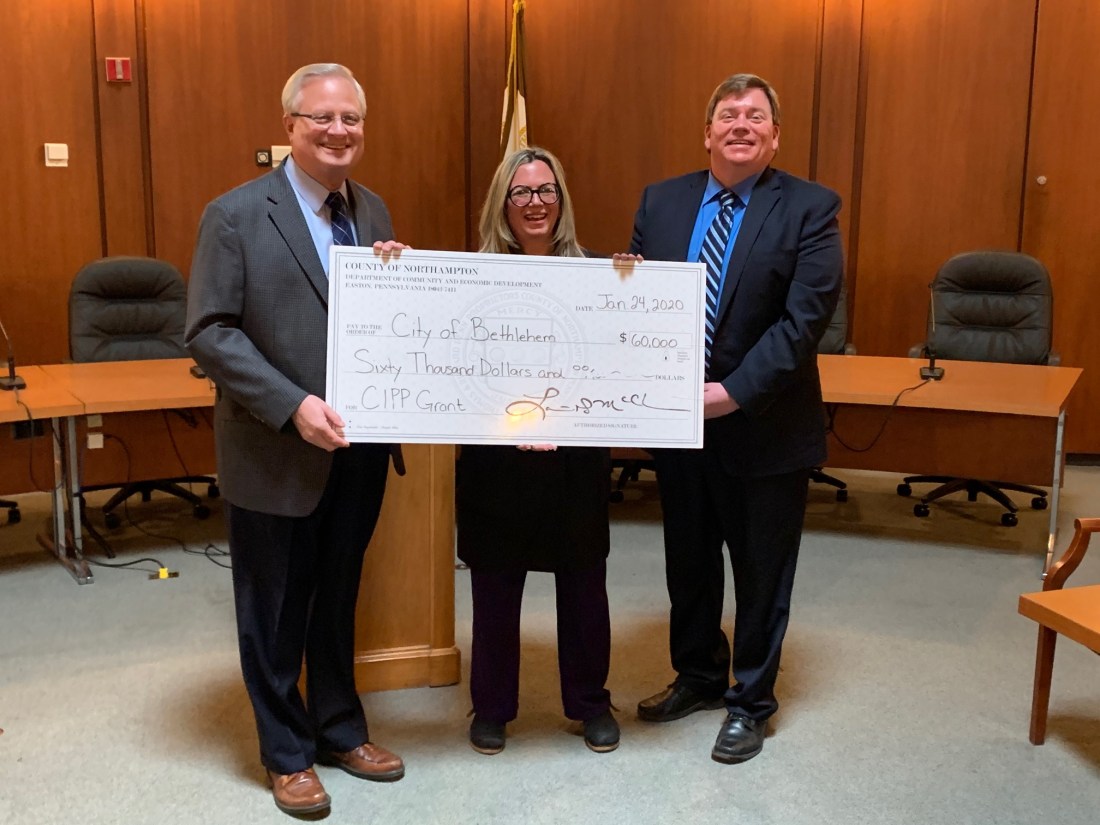
Thanks to County Executive Lamont McClure who presented the city with $60,000 for the Bethlehem Pedestrian Bridge Feasibility Study. Thanks to Mayor Bob Donchez for his support. For over a century, Bethlehem’s relationship to the river has been dominated by industry. Just as Bethlehem is reinventing itself, a potential pedestrian bridge could create a new relationship with our river. Pedestrian bridges drive development and can create a vigorous link between North and South Bethlehem. Many citizens of Bethlehem, including Breena Holland and Mary Foltz with the Southside Initiative, Doug Roysdon and Don Miles with the Sierra Club, and Tony Viscardi with Lehigh University’s Department of Art, Architecture and Design, have done much work toward the idea of the bridge, and this is a strong step towards exploring that vision. Thank you- and let’s go get some data! — with Lamont McClure Jr.
———-
That said, not everybody is cozy with the bridge idea. These comments on the City Facebook page have been heard around the Gadfly water-cooler.
  • If the quality of ice removal/prevention on the sidewalks of the current bridges is any indication of how a new pedestrian bridge will be maintained, save the money.
  • We have three bridges in town that you can walk across. Why we need to flush money down the toilet when we need so many other things is beyond me.

Gadfly invites you to browse back through the Walkability and Bikeability thread for past discussion on the matter of the bridge.

Support your local arts!

logo Latest in a series of posts on the Arts in Bethlehem logo

hear Gadfly read Walt Whitman

“Jetblack Sunrise”
by Michael Fegely
8PM, Jan, 24-26
The Charles A. Brown Ice House
56 River St. (Sand Island)

Kathy Lauer-Williams, “Original play based on Walt Whitman’s poetry opens at Ice House.” Morning Call, January 21, 2020.

Premier by local artist this weekend — don’t miss!

logo Latest in a series of posts on the Arts in Bethlehem logo

hear Gadfly read Walt Whitman

There’s an original play premiering in Bethlehem this weekend.

Original.

Local talent.

Part of the IceHouse Tonight series.

Gadfly wants to begin to pay more attention in these pages to local arts and artists — the kinds of things that aren’t heavily advertised or covered in the local press and want and deserve our support.

What should he cover? Let him know.

And who is able to post substantively (not just performance info) on such events?

Frankly, the IceHouse Tonight series has not been on Gadfly’s radar. Maybe the same for many of you.

The Ice House is a beautiful venue, local treasure (and let’s take a moment to remember the great Charlie Brown).

Original work by local artist — always beautiful too.

“Jetblack Sunrise”
by Michael Fegely
8PM, Jan, 24-26
The Charles A. Brown Ice House
56 River St. (Sand Island)

Kathy Lauer-Williams, “Original play based on Walt Whitman’s poetry opens at Ice House.” Morning Call, January 21, 2020.

Allentown’s Michael Fegely has long been fascinated with the poetry of American icon Walt Whitman. His 2016 one-man play “Whitman by Fire” was based on Whitman’s “Leaves of Grass.”

Now Fegely is premiering a new theatrical interpretation of Whitman’s work in “Jetblack Sunrise,” which comes to Bethlehem’s Ice House this weekend and to Easton’s Nurture Nature Center in February.

In Behlehem, “Jetblack Sunrise” is part of the IceHouse Tonight series, and brings to life “the soaring, enigmatic work of America’s greatest poet.”

The intimate hour-long production is staged simply, and tells the story of a former soldier struggling to grasp his place in his country, his place among mankind, and ultimately his place in all of time.

The creators say they have developed a new way to communicate Whitman’s poetry to “unscrew the locks” and “embrace your soul” so that audiences embark on a brief odyssey of the mind — from the smallest blade of grass to the reaches of the cosmos — along the way finding their shared humanity, and awakening our familiar self in its immortality.

Fegely stresses that the performance is not a poetry reading of Whitman’s work. However, every line and word is drawn from an 1855 first edition of the poet’s “Leaves of Grass” and the 1856 poem “Song of the Open Road.” The title comes from a line in “Song of Myself,” one of the poems in “Leaves of Grass.”

Fegely and Amenda used lines and passages from the poetry to create an original active through-line that is brought to life on stage, while remaining absolutely true to the poet’s grand thoughts. They say in this way the audience “shares in the revelation of his vision as it is brought into the present to live among us.”

More info on Lehigh University’s proposed “Packer Avenue Promenade”

logo Latest in a series of posts about Lehigh University and the Southside logo

TONIGHT!

Pilot study: temporary closing of Packer Avenue
Public meeting from 6 to 8 p.m. Jan. 23 at the
Broughal Middle School Auditorium

Nicole Radzievich, “Should Bethlehem close this major street near Lehigh University?” Morning Call, January 16, 2020.

Gadfly’s trying to get some preliminary info out there for those who want to attend the meeting tonight — so that you can have some questions in mind.

Gadfly was able to get this PowerPoint prepared for presentation at our Environmental Advisory Council last May. It gives us a quicker way of grasping the gist of Lehigh University’s “Packer Avenue Promenade” project than the link to the full Lehigh report Gadfly gave you earlier.

Packer Promenade – Environmental Advisory Council

Also, here is an audio recording of the EAC meeting at which two Lehigh grad student contributors to the report discussed some of their findings. Old timers will recognize and enjoy the distinctive voice and style of Mike Topping, long-time City employee.

You will hear that the promenade is associated with Lehigh’s already implemented plan to be a walking campus and that the impact on Zoellner Arts Center seems to be a major concern

The Southside face of Lehigh is obviously changing with its “Path to Prominence” program.

There’s a bit of a building boom going on. There’s a new building well underway at Webster and Morton. And one going through the approval process at Webster and Packer.

One should also remember that South New Street from the Fahy Bridge up to Lehigh’s Farrington Square is due for a makeover.

Lots going on. We can’t lose sight of the good things Lehigh does for the Southside. Followers might remember that Gadfly enjoyed taking a leisurely, multi-post walk through the Sunrise on the Southside documentary.

But, as a follower just said to him, Lehigh looks out for itself.

One issue with the promenade might be parking. The two new buildings in the area mentioned above take off over 150 parking spaces. A small parking lot on Packer Ave. will be lost by the promenade. Street parking along Packer will also be lost.

At a Planning Commission meeting two weeks or so ago, Lehigh said that it has a surplus of 2000+ parking spaces on campus overall, 400+ on lower campus adjacent to the promenade, and 100+ in the Zoellner parking zone.

Gadfly suggests Lehigh be sworn under oath on those numbers.

Just sayin’.

The goals of the proposed “Packer Avenue Promenade”: knitting together the northern and southern halves of lower campus, improving the safety and mobility of pedestrians

logo Latest in a series of posts about Lehigh University and the Southside logo

TONIGHT!

Pilot study: temporary closing of Packer Avenue
Public meeting from 6 to 8 p.m. Jan. 23 at the
Broughal Middle School Auditorium

Nicole Radzievich, “Should Bethlehem close this major street near Lehigh University?” Morning Call, January 16, 2020.

Impeachment closed early Wednesday night, and Gadfly found himself reading through the interesting “Sustainability Impact Assessment” the Lehigh class did on closing Packer Ave. between Vine and Webster and creating “The Packer Avenue Promenade.”

The study focused on six areas: sense of place, local business and the arts, the natural environment, traffic and transportation, pedestrian mobility, and safety and emergency access.

Lehigh “tasked” this graduate class to do the study, and Gadfly wonders if enough consideration was given to impact on the residential neighborhoods around Lehigh.

But then, he thought, are there really any residential neighborhoods left to be affected?

Has Lehigh sprawl finally succeeded in snuffing out the residential neighborhoods?

Anybody want to comment on that?

Here is a random collection of soundbites from the report that kinda jumped out at Gadfly.

  • The goals of the proposed Packer Avenue Promenade project are to knit together the northern and southern halves of Lehigh University’s Asa Packer Campus and improve the safety and mobility of pedestrians.
  • One of the main concerns with the proposed closing of Packer Avenue to vehicular traffic is the impact it will have on the local community and its relationship to Lehigh University.
  • Packer Avenue is currently a relatively heavily traversed road with metered parking on both sides of the street. It is used primarily by people affiliated with the university, with university Transportation Services estimating that over 70% of the cars parked on Packer Avenue are Lehigh University affiliated.
  • The Packer Avenue Promenade project follows a pattern of eliminating vehicle traffic from roads on the interior of campus. University Drive, Memorial Drive, and Library Drive, all now pedestrian walkways, have been closed to cars over the years.
  • With ongoing potential to improve “town-gown” relations, we recommend that Lehigh University utilize this space to hold programming that is not only for the Lehigh University community, but also invites and includes all communities in Bethlehem.
  • By making it more difficult or unpleasant to access Zoellner, we risk reducing utilization and attendance. This would have a significant financial impact on Zoellner itself, and would also impact any businesses that depend upon patronage associated with Zoellner events.
  • With the traffic shunted from Packer Avenue to East 4th Street, an increase in congestion can be expected on East 4th Street and is indeed welcomed by local businesses. Conventional wisdom would dictate that congestion impedes growth, but this is not necessarily the case. In fact, economic growth is correlated with congestion until a threshold of 15-minute delay per trip is achieved.
  • To improve upon the 2005 committee, and in order to work towards greater cohesion and communication between the Lehigh University and Bethlehem communities, committee members should also represent Bethlehem community members and institutions. This might ensure that affiliates of neighboring institutions, such as Broughal Middle School and St. Peter’s Evangelical Lutheran Church, are not only aware of developments in the Packer Avenue Promenade project, but that they can also voice their concerns, ideas, and opinions regarding mobility and access.
  • The proposed project is expected to improve pedestrian safety from assault and crime because Lehigh University would be able to replace and alter the lighting and design of the area, once Packer Avenue is transferred from the city to Lehigh University.
  • The proposed project does not degrade emergency access for ambulances, fire trucks, and service vehicles on Packer Avenue with respect to accommodating service and emergency vehicles on the promenade and emergency vehicle response times.

Next Gadfly will post discussion of the promenade by Lehigh student contributors to the report at our Environmental Advisory Council back in May.

“Enforcing Robert’s Rules will not in any way suppress ideas. . . . The purpose of Robert’s Rules is to get things done in a meeting”

logo Latest in a series of posts on City Government  logo

Bill Scheirer is an economist who grew up in Bethlehem, spent 40 years in DC, and retired here in 2003. He is a life member of the Committee of 100 on the Federal City and was on the Mayor’s Task Force for the City of Bethlehem Comprehensive Plan, Zoning Ordinance, and Zoning Map.

Gadfly:

Just as it takes three things to go wrong simultaneously for an airliner to crash, it takes only two things to go wrong for a lack of decorum and civility at the city council: a disruptive councilperson and a “soft gavel.” Enforcing Robert’s Rules will not in any way suppress ideas, because any actionable idea can be expressed without insulting another person or impugning their motives. The purpose of Robert’s Rules is to get things done in a meeting. In order to do so, the Rules eliminate time-consuming arguments about process, and eliminate the inflammatory comments described above, which can lead to responses that are sometimes inflammatory in themselves, and to a meeting that can end up, in the extreme, in a fist fight, which happened once in a Lehigh Valley Township. There is a reason why Robert’s Rules are followed in almost every deliberative body in the United States of America and have lasted for well over 100 years. This reason is to actually get things done in a meeting. After the meeting, you can shift to the First Amendment.

Bill

A Lehigh study on the proposed Packer Ave. closing

logo Latest in a series of posts about Lehigh University and the Southside  logo

Pilot study: temporary closing of Packer Avenue
Public meeting from 6 to 8 p.m. Jan. 23 at the
Broughal Middle School Auditorium

Nicole Radzievich, “Should Bethlehem close this major street near Lehigh University?” Morning Call, January 16, 2020.

Here is a “Sustainability Impact Assessment” on the proposed Packer Ave. closing performed by a Lehigh University graduate class a year ago.

Gadfly always says go to the primary sources. Let’s try to take a look before tomorrow night’s meeting (of course, the only other call on our time is an impeachment — history unfolding before our eyes).

Packer Avenue Promenade Project: Sustainability Impact Assessment (May 2019)

Conclusion

Sustainability considers impacts on human, environmental, and economic well-being. A Sustainability Impact Assessment (SIA) is an expansion of the traditional Environmental Impact Assessment (EIA) and represents a vital step toward ensuring that sustainability is adequately addressed during the project assessment process.

Lehigh University is exploring the possibility of closing Packer Avenue to traffic and converting it into a pedestrian promenade. In Spring 2019, Lehigh University graduate students conducted an SIA for this potential project. SIAs offer a comprehensive guide for decision-makers by laying out positive and negative impacts of a project as well as recommendations for mitigating negative impacts.

SIAs encourage using assessment tools most appropriate to the stakeholders and the impact being assessed. The Packer Avenue Promenade SIA identifies six key categories for assessment. Methods of assessment were tailored to each category and included literature reviews, interviews with experts and stakeholders, online surveys, and quantitative data collection. Local businesses, restaurants, and arts organizations were also interviewed.

The proposed project may have both positive and negative impacts. Among the most significant are improved aesthetics and prospective student experience, decreased stormwater runoff and greenhouse gas emissions, reduced exposure of students to harmful vehicular emissions, and impacts to accessibility and mobility. Our recommendations include, but are not limited to, addressing potential parking issues at
Zoellner Arts Center, implementing bioswales with appropriate vegetation, conducting further traffic studies that include the broader South Side area, appointing an implementation committee that includes non-Lehigh community members, providing alternative accessible transportation options, implementing programming in the new space to improve communal sense of place, and using tactical urbanism to test the road closure for effectiveness and approval before implementing the proposed project.

SIA is a new concept within minimal implementation requirements that provides Lehigh University and the City of Bethlehem the opportunity to be leaders in an emerging policy movement with global implications. Assessing the effects on community, environment, and economic well-being will promote Lehigh University and the City of Bethlehem as leaders in sustainability.

President Waldron indicates he hasn’t “been deaf to the criticisms of my style” and that maybe he will be “a bit more” aggressive

logo Latest in a series of posts on City Government logo

At City Council last night, President Waldron once again responds to concerns about his soft-gavel style:

  • I take this position seriously; I’m honored to serve for another term.
  • I stand by my legacy in the work that I did in my role over the last two years and hope to build on that.
  • I will continue to encourage as much public comment as possible as well as healthy debate among members of council.
  • I have brought in the live-streaming in an effort to get more people engaged.
  • I have made attempts to interact a bit more with the speakers in a way . . . to try to answer some questions whenever it is appropriate and try to have a small dialog.
  • I haven’t been deaf to the criticisms of my style of allowing a very long leash and using a soft gavel, and I’ll continue to try to reflect on that in ways to help guide the conversation in a more positive and productive way.
  • I’m serious in my commitment to listening to my members of Council and hearing their feedback on my management of the meetings.
  • I would say that generally most of the criticisms directed at me for not managing a specific member of Council and not silencing them or gaveling them down.
  • Which I think is a fair criticism; however, I have made attempts to guide that conversation to be a bit more productive, and those attempts have not been successful.
  • Ultimately I think if there’s a single bad actor, that doesn’t reflect negatively upon Council.
  • I think that reflects upon that individual, and those comments are representative of that certain person, not of the entire Council.
  • I will, however, try to continue and maybe a bit more aggressively help try to push that conversation to a productive one.
  • It’s my hope that everybody can continue to work together, we have a generally good working relationship among Council and the administration, and I hope that we can continue that over the next two years.
  • I think the City is in great shape, and a lot of that has to do with these relationships.
  • I thank members of Council and the public for their support.
  • I am very open to having a dialog and a conversation about how we can continue to improve things here at City Council meetings as well as in the City as a whole.

Bethlehem Moment: The Portuguese in Bethlehem

logo Latest in a series of posts on Bethlehem Moments logo

Bethlehem Moment 20
City Council
January 21, 2020

audio

Bethlehem Moment: 1860-1880, the Portuguese come to Bethlehem

Portuguese Heritage

Portuguese Heritage: Adding to the Fabric of South Bethlehem
by Armindo P. Sousa
“Southern Exposure,” Winter 2009

Dana Grubb reads selections from the above newsletter issue, compliments of the South Bethlehem Historical Society, in particular the late Armindo Sousa and Ken Raniere, who authored the newsletter.

City Council meeting tonight!

logo Latest in a series of posts on City Government logo

Our next City Council meeting — the “face” of Bethlehem City government — occurs tonight Tuesday, January 21, Town Hall, at 7PM.

These meetings are video-recorded and can be viewed LIVE or later at your convenience on the City’s website after the meeting at https://www.bethlehem-pa.gov/Calendar.

The YouTube channel for live or archive viewing is “City of Bethlehem Council.”

Find the Council agenda and documents here: https://www.bethlehem-pa.gov/Calendar/Meetings/2020/City-Council-Meeting/51

Tonight there’s a resolution to gather info for a short-term lodging ordinance and a request for the Public Safety committee to look into the recent marijuana ordinance among other things.

And, as always, as long as he has flutter in his wings, Gadfly urges attending City Council live or virtually — one way or the other.

Participate. Be informed.

“The future of this City comes down to our ability to work together and establish relationships”

logo Latest in a series of posts on City Government logo

“These decisions [president, vice president] are much, much less important than the overall relationship between the members of Council, the members of Council and the public, and the members of Council and the administration, and the potential for great things to happen in this room comes down to our ability to work together.”
Councilman Reynolds, January 6, 2020

Council meeting tonight. Gadfly was disappointed in Council last time. As were some of you. Now time to listen to the words of the “elder statesman.”
Onward!

A modest proposal: requiring training in Roberts’ Rules of Order

logo Latest in a series of posts on City Government logo

“When a person becomes either a Council member or president of Council,
are there any guidelines to their being mentored or coached to their learning
the Roberts’ Rules of Order?”

Peg Church, January 6, 2020

Fair question from a reasonable resident.

And the answer is “No.”

Following Church’s lead, Gadfly would like to make a modest proposal:

that every Council member be required to attend a training seminar in Roberts’ Rules of Order every year.

  • this new requirement could be coupled with the requirement of an annual ethics seminar
  • this requirement would be for all council members, not just the officers
  • though the Solicitor is usually thought of as the expert on Roberts’ Rules and the arbiter of Roberts’ Rules, knowledge of the rules empowers each council person
  • of special emphasis in such a seminar would be the deportment of all members of a meeting
  • such a seminar could usefully include examples of proper and improper meeting behavior
  • one can even imagine members of the public interested in such a seminar

to be continued . . .

Gadfly as soft-gaveler

logo Latest in a series of posts on City Government logo

President Waldron values freedom of speech, wants open discussion, and manages with a soft gavel.

And he’s taken some heat, with some justification, perhaps.

Gadfly empathizes with, sympathizes with President Waldron.

He ran a classroom that way for fifty years, a department that way for ten years, and tries to run this blog that way now.

Ruling with a hard gavel is much easier.

But not as productive, not as rewarding if building community is part of your goal.

Gadfly has already said a few posts back that he did not personally see President Waldron’s managerial style/philosophy as a factor so grave as to disqualify him from the presidency.

He knows from long experience that you do not get through the Shoals of Soft-Gavelment without some bruises, and sometimes serious bruises.

(Ha! If Gadfly wanted a reason for disqualification, it would be that climactic tie-breaking vote after hours and hours of testimony in one of the agonizing chapters of the 2 W. Market saga — a vote given WITHOUT REASON. Aiiii, Mr. President, Gadfly will never forget the feeling of that knife in the heart!)

So Gadfly would shift your focus on the reason for a breakdown in decorum on Council from President Waldron to Councilman Callahan.

In Gadfly’s relatively brief tenure, Councilman Callahan has referred to some residents as CAVE people (Citizens against Virtually Everything), publicly revealed a fifteen-year past indiscretion of another resident, mansplain’d a councilwoman, continually implied backstage maneuvering, suggested unethical behavior by a councilman, suggested unethical behavior by a City administrator, suggested unprofessional behavior by the Mayor, engaged in rude interactions with at least three of the councilpeople, exclaimed derogatorily that he “knew the game” of a councilman, and explained that Council actions against him were conspiratorially orchestrated.

That’s a manload of decorum-busting to handle.

Surely some of the responsibility for the breakdown in decorum and shadowing of the City image that we’ve recently seen some residents forcefully complain about must be attributed to Councilman Callahan.

Gadfly would not assign the whole reason for the breakdown in decorum on the Council and resultant darkening of the City reputation to the soft-gavel management style of President Waldron.

Not by a long-shot.

Gadfly’s been there in his shoes, been there behind his gavel.

The humane impulse of the Soft-Gaveler is to educate, to transform, to absorb the disruptive force. Not to silence or destroy it.

And sometimes it doesn’t work.

But sometimes it does. Gadfly knows from experience.

English Department

The happy, cohesive Lehigh University English Department ca. 1990
chaired by soft-gloved Gallagher

And as far as the City’s image or reputation goes, Gadfly feels pretty good how the year ended in that respect.

Councilman Callahan’s loss of the Parking Authority liaison assignment was, in effect, an act of censure by Council, an act that in Gadfly’s mind moved toward improving the City’s image and reputation.

An act cousin to the hard-gloved gavel those vocal residents have sought.

Though, since another councilman introduced the motion, whether President Waldron had an active role in that move, he doesn’t know.

to be continued . . .

Take-aways from President Waldron’s responses to criticism about his gavel philosophy

logo Latest in a series of posts on City Government logo

Waldron applause lines:

Gadfly finds a lot to applaud. For Gadfly, President Waldron frames his gavel theory in precisely the right terms. He is open to participation, acknowledges different points of view, believes in dialog, doesn’t believe in censoring.

“I think that people should have the ability to speak their mind as long as they are doing it in a respectful way, and I think that disagreement is good because it shows different points of view and perspectives.”

“we should be able to have a positive conversation in which we respectfully disagree with each other.”

“I think that a healthy dialog starts with the ability to express yourself, and if you don’t like what someone else is saying, I don’t think censoring their speech is the right thing. I think topping it with better speech, more accurate, or a different point of view is a fine thing to do.”

“I think everyone has a right to be heard, and I think they have a right to speak, from members of the public to members of Council. . . . I don’t think silencing people’s thoughts and opinions is a productive way to continue a conversation.”

“I don’t think limiting ideas that you are not in agreement with or unpopular is not the way to a healthy dialog. I think that you combat unpopular ideas with better ideas.”

“More conversation is always a good thing, whether you agree with those ideas or not, I think knowing what someone else thinks and having the ability to understand and allowing them to articulate is a positive thing whether you like those ideas or you think they are terrible. I think everybody should have an opportunity to be heard.”

” . . . to see how we can allow for an even more productive dialog that would make people feel as included as possible, open up City Hall to as many residents as we can get here, and to hear their input as well.”

Applying the theory:

While applauding President Waldron’s gavel-theory, Gadfly feels that, early on anyway, he fell far short in practice, in the application of that theory — and is certainly pollyannish in his assessment of what had happened on the ground. For instance, President Waldron apparently did not see what was plainly visible to the majority of us in the cheap seats in last year’s ragged personal interaction between two Council members. And Gadfly believes he can say with certainty that President Waldron totally misread the outcome of the interaction with Mr. Antalics he references.

“I went back and did some research on some of the minutes and some of the things that were said by members of council and by members of the public, and I just don’t see a lot there as far as violation of Robert’s Rules. Personal attacks, I think, is a term getting thrown around for political reasons. I think there’s a healthy debate, and I think there’s respect for each another on Council. We may not agree with each other, and that’s fine, and that comes down to the vote some times, and I like to think that we can move forward professionally. But I think there is a decorum here, and I don’t think that there has been a lack of professionalism.”

“if you don’t like what someone else is saying, I don’t think censoring their speech is the right thing. I think topping it with better speech, more accurate, or a different point of view is a fine thing to do, just like Mr. Antalics and I did this evening.”

Homage to the First Amendment:

Gadfly thinks that President Waldron’s invocation of the First Amendment as the basic engine of his gavel theory/philosophy creates problems, since, in Gadfly’s mind, he seems to use it to justify all kinds of speech in any kind of way. Gadfly wished President Waldron hadn’t gone “there” at all. Gadfly feels the sentiment in the room is that, yes, Roberts’ Rules should be followed, even if applied a bit flexibly, and especially in terms of decorum. Lack of “decorum” seems more the problem than unpopular ideas, and Roberts’ Rules speaks to that. At first, President Waldron seems to confuse the issues of content and conduct.

“I think that the First Amendment is strong and well in this room, and I have great respect for it to the point that I respect it over Robert’s Rules.”

“you might think that we should follow Robert’s Rules to the ‘T,’ but my view is . . . ”

“I give great respect to Robert’s Rules, but I think the First Amendment . . . will trump Robert’s Rules any day of the week. So if you want to point to Robert’s Rules and say these are the rules we are supposed to be following, I do respect those, however . . . ”

“the First Amendment is wide-ranging and it supersedes Roberts’ Rules of Order.”

Evolution of practice:

That said, President Waldron evolved over the year, later admitting Roberts’ Rules were violated, recognizing problems with decorum more, describing those problems vividly, calling for improvement, and even seeming to find some improvement.

“I don’t think silencing people’s thoughts and opinions is a productive way to continue a conversation. With that being said, I do think there should be a level of decorum and respect for each other in the room. And I think at times at the last Council meeting that was not there. I did not get any feedback publicly that that was a positive conversation. In fact, many people reached out to me that I saw and said that it was cringe-worthy and it was embarrassing. I think the tone of that conversation wasn’t helpful, and it’s my opinion that I think we can do better and we must do better when we get in to the dangerous territory of accusing people of things on Council.”

“Whether it’s warranted that people think the rules are being violated — Roberts’ Rules — which I think they are — I’m going to enforce them pretty liberally because I think the conversation should be open and fair.”

“I hear a lot different kind of tone than I did last week, Mr. Callahan, and I appreciate that you were reflective on that.”

“I think moving forward taking a little time to consider how our words are affecting other people in the room, it’s going to be beneficial.”

Involvement of Council colleagues:

President Waldron is open (and will continue to be) to “counseling” and suggestions for change from his colleagues, but so far, contrary to some strong voices among the residents, the message is that he’s doing a “fine job.”

“I’m going to take remarks from members of Council if they want to give a little course correction and think that I should enforce the rules a little differently. I’ll listen to the majority of Council if they have a strong opinion that the rules should be enforced differently. Although I’m currently president of Council, I would welcome feedback from members of Council if they think I should have a different approach. And I’ll try to balance those in the future as we continue these conversations under new business.”

“I did reach out to members of Council, and I did speak to everyone about their views. . . . During my conversations with everybody on Council, I didn’t receive any negative feedback about my style or my management of running the meetings, which I took to heart, and I took that advice to mean that I was doing a fine job running the meetings.”

“I have asked members of Council publicly and privately whether they did have any feedback for me in the management of the meetings, and I have received a little bit of feedback but nothing to the point where anybody felt that I should take a different approach to the way that I manage and I try to keep order in the room. It is an imperfect science. It is an imperfect science, and it is a difficult balancing act from moment to moment, but I am willing to continue those conversations with members of Council if I am elected to serve as president to see how we can allow for an even more productive dialog.”

———-

What did you see in President Waldron’s “defense” of his soft-gavel style?

to be continued . . .

Popularity: setting the record straight

logo Latest in a series of posts on City Government logo

Stephen Antalics is Gadfly #1.

Distinguished Scholar,
[who is more scholar than Gadfly #1?]

I submit the following data to set the record straight as to who was the more popular Council president nominee with the general public.

There were claims that the large showing of support for Ms Negron for council president  at the recent council meeting did not represent the true will of the public-at-large.

The claim by some was that Mr.Waldron was the more popular.

Nov. 7, 2017, official election results do not confirm that claim.

Negron –    4,277   votes
Evans –      4,125      ”
Callahan – 3,990      ”
Waldron – 3,705      ”

Ms Negron was clearly the most popular choice. It appears that Mr. Waldron was the least popular of those seeking election.

Please share this with all on your blog, please.

Stephen

President Waldron responds: “There’s been calls for me to gavel down other members of Council when they are speaking”

logo Latest in a series of posts on City Government logo

President Waldron has been admirably on the record and transparent in his response to criticism of his gavel-style, and it is important that we hear his own words.

January 2, 2019

I also want to make a couple general remarks which I’m sure some other members of council will want to jump in on once we get to new business about some of the accusations of some of the rules of Robert’s Rules, and my opinion on that. I spoke to Mr. Spirk about it, and I went back and did some research on some of the minutes and some of the things that were said by members of council and by members of the public, and I just don’t see a lot there as far as violation of Robert’s Rules. Personal attacks, I think, is a term getting thrown around for political reasons. I think there’s a healthy debate, and I think there’s respect for each another on Council. We may not agree with each other, and that’s fine, and that comes down to the vote some times, and I like to think that we can move forward professionally. But I think there is a decorum here, and I don’t think that there has been a lack of professionalism. There’s been calls for me to gavel down other members of Council when they are speaking, and I don’t see myself doing that in 2019. I think that the First Amendment is strong and well in this room, and I have great respect for it to the point that I respect it over Robert’s Rules. I think that people should have the ability to speak their mind as long as they are doing it in a respectful way, and I think that disagreement is good because it shows different points of view and perspectives. Again, you may not agree with that assessment, and you might think that we should follow Robert’s Rules to the “T,” but my view is that we should be able to have a positive conversation in which we respectfully disagree with each other. That is not prone to personal attacks just because we use each other’s names. That doesn’t mean that it is a personal attack. It’s just a differing of opinion. . . . I give great respect to Robert’s Rules, but I think the First Amendment, as Mr. Spirk would agree, in court rulings is that the First Amendment will trump Robert’s Rules any day of the week. So if you want to point to Robert’s Rules and say these are the rules we are supposed to be following, I do respect those, however, I think that a healthy dialog starts with the ability to express yourself, and if you don’t like what someone else is saying, I don’t think censoring their speech is the right thing. I think topping it with better speech, more accurate, or a different point of view is a fine thing to do, just like Mr. Antalics and I did this evening. And we can respectfully disagree on a different point of view, but that’s part of the process, I think.

September 3, 2019

I’m gonna try to enforce the rules moving forward fairly and consistently. That becomes challenging when rules are habitually broken, and I’m trying to give guidance and my guidance is pushed aside. I think everyone has a right to be heard, and I think they have a right to speak, from members of the public to members of Council. I’ve been criticized for having a light gavel in the past, and I can promise you I will continue to have a light gavel. I don’t think silencing people’s thoughts and opinions is a productive way to continue a conversation. With that being said, I do think there should be a level of decorum and respect for each other in the room. And I think at times at the last Council meeting that was not there. I did not get any feedback publicly that that was a positive conversation. In fact, many people reached out to me that I saw and said that it was cringe-worthy and it was embarrassing. I think the tone of that conversation wasn’t helpful, and it’s my opinion that I think we can do better and we must do better when we get in to the dangerous territory of accusing people of things on Council, whether that’s members of Council accusing each other of something or members of the public accusing, because that happens quite a lot, and I don’t gavel that down much the same way people go over the 5-minute time limit and I don’t gavel that down. I think people should be heard. Whether you agree with that opinion or not, the First Amendment is wide-ranging and it supersedes Roberts’ Rules of Order. But I would hope that we would have the respect for each other to adhere to those, so that the conversation can be productive. I hear a lot different kind of tone than I did last week, Mr. Callahan, and I appreciate that you were reflective on that, and I think open debate is a good thing. I think we should hold each other accountable for our thoughts and actions as well, and I think moving forward taking a little time to consider how our words are affecting other people in the room, it’s going to be beneficial. So I look forward to continuing this conversation publicly. Whether it’s warranted that people think the rules are being violated — Roberts’ Rules — which I think they are — I’m going to enforce them pretty liberally because I think the conversation should be open and fair, and I’m going to take remarks from members of Council if they want to give a little course correction and think that I should enforce the rules a little differently. I’ll listen to the majority of Council if they have a strong opinion that the rules should be enforced differently. Although I’m currently president of Council, I would welcome feedback from members of Council if they think I should have a different approach. And I’ll try to balance those in the future as we continue these conversations under new business.

January 6, 2020

I did reach out to members of Council, and I did speak to everyone about their views. . . . During my conversations with everybody on Council, I didn’t receive any negative feedback about my style or my management of running the meetings, which I took to heart, and I took that advice to mean that I was doing a fine job running the meetings, and I think if I were to continue as president of Council I would have a very similar approach to the way I ran the meetings in the last two years. I will stand by my record of service in the way I have run meetings. I have been criticized a bit for allowing people to speak too much. But that’s a criticism I will take. Whether that’s members of council or members of the public. I do have what is called a soft gavel, and I think in my opportunity to limit speech I have chosen repeatedly not to do that. I don’t think limiting ideas that you are not in agreement with or unpopular is not the way to a healthy dialog. I think that you combat unpopular ideas with better ideas, and that has been my approach to running and facilitating these meetings, and I would bring that to the table if I was elected to serve a second term. . . . More conversation is always a good thing, whether you agree with those ideas or not, I think knowing what someone else thinks and having the ability to understand and allowing them to articulate is a positive thing whether you like those ideas or you think they are terrible. I think everybody should have an opportunity to be heard. I have asked members of Council publicly and privately whether they did have any feedback for me in the management of the meetings, and I have received a little bit of feedback but nothing to the point where anybody felt that I should take a different approach to the way that I manage and I try to keep order in the room. It is an imperfect science. It is an imperfect science, and it is a difficult balancing act from moment to moment, but I am willing to continue those conversations with members of Council if I am elected to serve as president to see how we can allow for an even more productive dialog that would make people feel as included as possible, open up City Hall to as many residents as we can get here, and to hear their input as well.

to be continued . . .

What’s the rap against President Waldron’s soft-gavel philosophy?

logo Latest in a series of posts on City Government logo

What are “you” saying in answer to that question?

Gadfly loves your voices. Let’s go to the tape:

  • “One of the things that concerned me over the last several months is a breakdown in order and decorum . . . so much so that this has been recorded multiple times in the [press].”
  • “While for the most part the meetings proceed normally, the departures are having a disproportionate negative impact on working relationships and Council’s reputation.”
  • “Council members have been unfairly challenged to choose between engaging at the risk of escalation or answer with silence.”
  • “It’s the responsibility of the president to assert control and to maintain decorum. And that hasn’t happened.”
  • “Council has to work together to get business done. Divisiveness and rancor follow when personal attacks are tolerated.”
  • “Public confidence is also affected when this spills out into the public.”
  • “The Council’s reputation is at stake.”
  • “It’s very important to follow the rules and maintain respectful demeanor during meetings. This is the president’s job.”
  • “Subjective freedom of speech can involve personalities.”
  • “This body suffered a tremendous deterioration in its image by the free allowance of subjective freedom of speech to allow members of Council to attack one another . . . unabated, creating a serious problem in terms of our opinion of them “
  • “What needs to happen is strong powerful control of subjective freedom of speech to prevent that kind of character assassination. It’s happened.”
  • “It will be interesting if a slightly heavier gavel will make a difference in the Council climate.”
  • “This is a shame . . . a big shame. . . . I’m very ashamed of a few of you, very ashamed.”
  • “If you can’t work with each other, you shouldn’t be here. . . . to be a City Council person . . . and put people down  in the paper . . . that is not the type of representation we need.”
  • “Sometimes the softer hand doesn’t work, especially when you are attacking your own members.”
  • “Listen to the concerns of everyone who has spoken out . . . . Listen to the fact that you have rules.”
  • “It does not look good for this City if you are fighting amongst each other . . . and it’s in the paper.”
  • “You also realize these recordings are on youtube. Everybody in the world can see them.”
  • “Really think about your actions before doing them, because I have pride in my City.”
  • “People have to realize that everybody is watching you. You are representing us.”
  • “All I ask is that you respect each other.”

Can we distill the comments and agree that there are three main concerns with the soft-gavel style:

  • There’s been a breakdown in decorum
  • that impedes Council work
  • and damages the City’s reputation

Now let’s look at President Waldron’s response.

to be continued . . .

Trap Neuter Release programs for feral cats

Gadfly has several times recommended Bethlehem native Alison Steele’s Radical Moderate blog — always interesting, always substantial.

This week’s subject of feral cats especially caught his attention because every few months we have a moving speaker at Council meetings wondering about City programs for stray animals.

And there are certainly such felines in Gadfly’s neighborhood. How about yours?

Gadfly had never heard of Trap Neuter Release programs.

This info could be useful.

Closing Packer Ave.: the true test will be if there is some sort of emergency on Third or Fourth Streets

logo Latest in a series of posts about Lehigh University and the Southside logo
Dana Grubb is a lifelong resident of the City of Bethlehem who worked 27 years for the City of Bethlehem in the department of community and economic development, as sealer of weights and measures, housing rehabilitation finance specialist, grants administrator, acting director of community and economic development, and deputy director of community development.

Pilot study: temporary closing of Packer Avenue
Public meeting from 6 to 8 p.m. Jan. 23 at the
Broughal Middle School Auditorium

Nicole Radzievich, “Should Bethlehem close this major street near Lehigh University?” Morning Call, January 16, 2020.

Gadfly,

Lehigh is concerned with Lehigh. The Mayor and City Council must be concerned about the entire city and, in this particular instance, the nearby Southside environs. This isn’t the first time the University has floated this idea, and in the past the concept was panned by public safety officials. Today it is more than that, especially given increased development throughout the Southside and the resultant traffic gridlock that results along the Third and Fourth Streets corridors at various times. Packer Avenue has provided a third east/west option for drivers on the Southside, and with increased congestion elsewhere the jury is still out on how beneficial this would be for Bethlehem, for this lifetime Bethlehem resident. There’s a lot more to this equation than what Lehigh University is pitching. The true test during this 45 day period will be if there is some sort of emergency (God forbid) on Third or Fourth Streets that stops through traffic and how the Packer Avenue closure will affect the ability for motorists and commerce to continue to flow.

Dana

Resolution on short-term lodging coming to Council Tuesday

logo Latest in a series of posts on Airbnb and short-term lodging  logo

The phenomenon of Airbnb/short-term lodging/short-term rentals has been an acute issue for some people in the Northside Historic District, but it is also a concern for others as the “Town Square” essay by Paul Peuker that we published yesterday shows. In fact, Gadfly has concerns relative to his own neighborhood. (Click on Airbnb or Short-term lodging under Topics on the right-hand Gadfly sidebar for previous posts.)

New legislation for the zoning code that has been working its way to City Council was discussed at the Planning Commission on January 9 and will come to Council Tuesday night in the form of a resolution to collect all kinds of information before enacting the legislation.

10o Resolution-Short Term Lodging Zoning Text Amendments (2)

At the moment Gadfly doesn’t have copies of the two exhibits mentioned in the resolution coming forward Tuesday, but here is an “unclean,” marked up draft of the latest revision of the proposed new addition to the zoning ordinance (Housing Ordinance 1741 on short-term lodging has been in operation for a year or two).  The January 9 Planning Commission recommended no changes in this draft. It just may be a bit confusing for you to read.

Here is the City Planning Director helpfully summarizing for the PC (and for us!) the background leading to the upcoming resolution and proposed legislation:

Here to Gadfly’s mind are some key components of the draft zoning legislation that followers might be interested in:

  • Owner-occupied (a big concern in the Northside Historic District): Short Term Lodging use is only permitted in an owner occupied single family dwelling existing and occupiable by persons as of January 1, 2020 or, for lots exceeding one( 1 )acre in size,in an accessory or outbuilding structure existing and occupiable by persons as of January 1 ,2020.
  • Parking: Two offstreet parking spaces are required for the dwelling. One additional space is required if more than one room is rented. These off-street requirements shall not apply to any short term lodging facility in a CB Zoning District.
  • Number of rooms: No more than 2 rooms on any lot may be offered for rent in any short term lodging facility regardless of the size of the structure or number of bedrooms.
  • Renovation: No exterior alteration or expansion shall be made to any building for purposes of furnishing or expanding short term lodging, except as may be required for purpose of sanitation, handicapped accessibility, historic rehabilitation or safety.

Bruce Haines and the Gadfly had suggestions for changes and questions, but since the upcoming action by Council is just a resolution to collect information, Gadfly will save that information for a later post.

But what are you seeing and thinking? Responses invited.