

(Latest in a series of posts on Bethlehem Manor and Neighborhoods)
Gadfly assumes that you (well, most of you ) are like him and have never had the opportunity to look “inside” a zoning hearing, the place and the process where so much important to the quality of life in our neighborhoods is decided.
Thus, over a few posts, he’d like to talk about the Bethlehem Manor (815 Pennsylvania Avenue) proposal to expand the number of beds 70% in their assisted living/personal care facility via a new addition to the original building.


After approval by the Planning Commission on July 11, the proposal was denied by the Zoning Hearing Board August 14. Bethlehem Manor will appeal that decision to Northampton County Court.
This is an interesting case for us to look at.
Bethlehem Manor is located in the old Rosemont School. After some controversy, Bethlehem Manor’s proposal to re-purpose the school as an assisted living/personal care facility was granted in 2016, and the facility opened in May 2017, just over two years ago.
Re-purposing an unused school building, we might all generally agree, is a good thing.
Personal care facilities, we might all generally agree, are good things.
What is rather surprising in this instance, what is immediately attention-getting is the — would you disagree? — huge percent of the proposed increase in beds and, perhaps as well, the short time since the original request was proposed.
Surely, this is a case in which Bethlehem Manor must be called upon to make a very strong supporting case.
But who will “force” them to do so? Who will provide the necessary friction to make sure the proposed change is good for the Rosemont neighborhood?
Perhaps like me, some of you will say “the City.” You will say the City looks out for “us.” Well, not so fast.
Take a look at this detailed letter from the City responding to the Bethlehem Manor proposal.
Lots there.
But looks like the City can only be depended upon to hold Bethlehem Manor’s feet to the fire in terms of technical requirements. There is nothing in the City response relative to what we might call “quality of life” aspects.
So, no, “people” issues are up to us. Though, as far as Gadfly knows, the City is mandated to help public awareness by — at least seven days prior — posting notices of hearings in the newspaper, providing notices (regular mail) to adjoining property owners, providing notices to property owners within 300 feet. Also, proposers must likewise post notices of hearings in conspicuous spots on their properties at least one week ahead.
Now Gadfly has more than once heard residents complain they were not “aware” of issues and hearings. Gadfly is realist enough to know that many people simply don’t pay attention and that the City can not always be blamed for their ignorance, but — especially since better ways to communicate with residents is being studied right now — there might be improvements in this system in this new technological age in which people are accessing information in different ways.
So, it’s up to “us” to be aware of what concerns us and to take active measures.
And so, in this case, neighborhood resident Brian Nicas took the initiative to circulate a petition eventually signed by 25 other residents that he presented to the Zoning Hearing Board August 14.
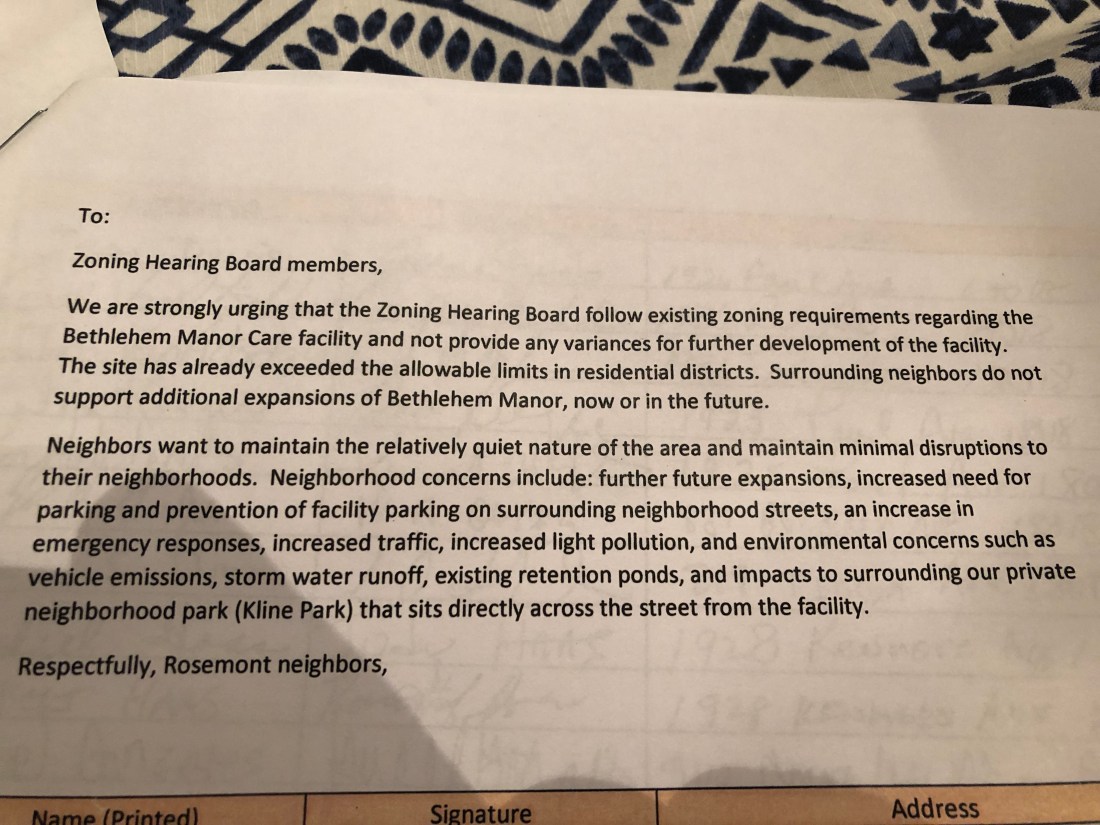

Gadfly is pleased to offer Brian’s complete presentation on audio and a portion of it on video as an example of the kind of productive citizen participation that he loves to highlight and which stimulated two other neighbors to speak out at the meeting as well (we’ll “hear” from them in later posts).
Bottom line — the residents were successful in this instance. Their involvement and their participation paid off. But in the next few posts let’s look a little deeper at the dynamics of the meeting and understand how the process played out.